
Download Assets
Download Assets
This tutorial includes 1 sample image. Downloads are free with a PHLEARN account.
- Free sample files with every tutorial on PHLEARN
- New tutorials published every week
- Unlimited downloads with your free PHLEARN account
Watch the Full Series
description
A watermark is a business decision more than a design one. The discreet mark you put on a photograph for the web is not the same mark you put on a client proof, and the two need building separately.
On Day 28 of 30 Days of Lightroom Classic we create both in the Watermark Editor — a small corner mark using text or a logo, and a large low-opacity graphic for proofs — then roll the proof version into a one-click export preset with the resizing, naming and metadata already set.
This is Day 28 of our 30 Days of Lightroom Classic series. Follow along with all 30 episodes as we explore the magic of Lightroom together!
Continue Watching 30 Days of Lightroom Classic
JOIN 30 DAYS OF LIGHTROOM (FOR FREE!)
Ready to jump in? Sign up and we’ll email you a printable calendar and daily class schedule so you can get started right away!

A Watermark Is a Business Decision, Not a Design One
Yesterday we went through the Export dialog panel by panel and left one section for today: watermarking. It deserves its own day, because a watermark is not really a design decision — it is a business one.
There are two distinct jobs a watermark does, and they call for two completely different watermarks. A small, discreet mark in a corner is for images you put on the internet, so that anyone who finds your work knows whose it is and how to reach you. A large, obvious mark across the middle of the frame is for client proofs, so nobody can quietly use the photograph before the invoice is paid.
Today we build both, then set up an export preset that turns the whole proofing step into one click.
Open the Watermark Editor
-
Select your image and go to File > Export
Scroll down the dialog to the Watermarking panel.
-
Tick the Watermark checkbox
The dropdown beside it holds any watermarks you have already saved.
-
Choose Edit Watermarks
This opens the editor, with a live preview of your photograph so you can see exactly what you are making.
Building a Text Watermark
By default the editor is in text mode. Type your name or your business name into the field at the bottom and it appears on the preview immediately. The controls down the right-hand side handle the rest:
- Font and style — pick something legible at small sizes.
- Alignment — left, centre or right within the text block.
- Shadow — worth switching on if your mark will sit over both light and dark images.
- Opacity — how visible the mark is.
- Size — scale it up or down against the frame.
- Inset — horizontal and vertical padding from the edge.
- Anchor — the nine-point grid that decides which corner or edge it sits in.

Using a Logo or Signature Instead
Switch the Watermark Style at the top of the editor from Text to Graphic and Lightroom lets you load an image file. Click Choose, point it at your logo — a PNG with a transparent background works best — and it replaces the text.
A scanned signature works beautifully here, and so does a simple business mark. Everything else in the editor still applies: size, opacity, inset and anchor all behave the same way.
Two Watermarks, Two Jobs
The small mark, for the web
Anchor it in a bottom corner, keep the size small, and set the opacity somewhere it reads without competing with the photograph. The goal is attribution, not defence — anyone determined enough can crop a corner off, but that is not really the point. The point is that your name travels with the image.
The big mark, for proofs
This one is deliberately in the way. Scale it up until it spans a good portion of the frame, anchor it dead centre, then pull the opacity right down. Low opacity plus large size is the combination that works: the client can see the photograph clearly enough to judge it, but the file is useless as a finished image.
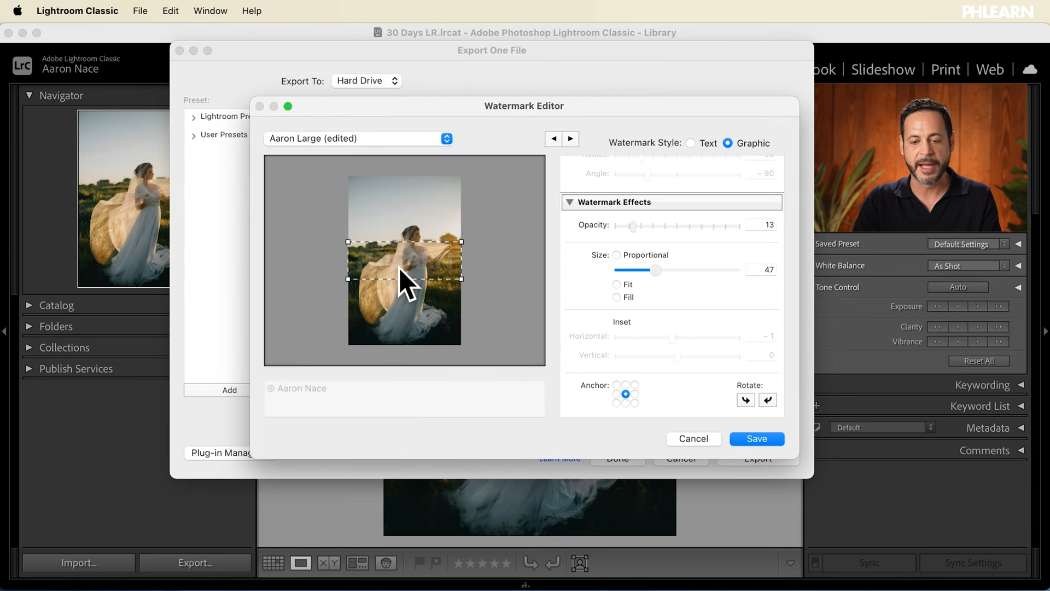
Save each one as its own watermark preset — click the dropdown at the top left of the editor, choose Save Current Settings as New Preset, and give it a name you will recognise later. Something like Corner Small and Proof Centre is clearer than a date.
The Rest of the Proof Export
A watermark on a full-resolution file is only half a safeguard. Back in the Export dialog, set the other panels up so the proof is genuinely a proof:
-
Image Sizing — resize to fit Long Edge
Set it to around 800 pixels, or 1000 if your client needs more detail. Large enough to judge the image, far too small to print or publish.
-
File Settings — JPEG, quality 100, sRGB
Same as any web export. The size cap is doing the protecting, not the compression.
-
Export Location — Choose folder later
Keeps the preset reusable across jobs instead of tied to one client’s folder.
-
File Naming — use your Custom Text recipe
The naming recipe you built yesterday earns its keep here. Type proof into the Custom Text field and every file is labelled at a glance.
Save It All as an Export Preset
Now roll the whole thing up. Click Add at the bottom left of the Export dialog and name the preset — Client Proofs is clear enough. Every setting goes in: the watermark, the resize, the format, the location behaviour, the naming recipe.
Make a matching one for delivery. Same preset, but no watermark, no resizing, and final in the Custom Text field. From then on, sending proofs and sending finals are two different one-click operations.
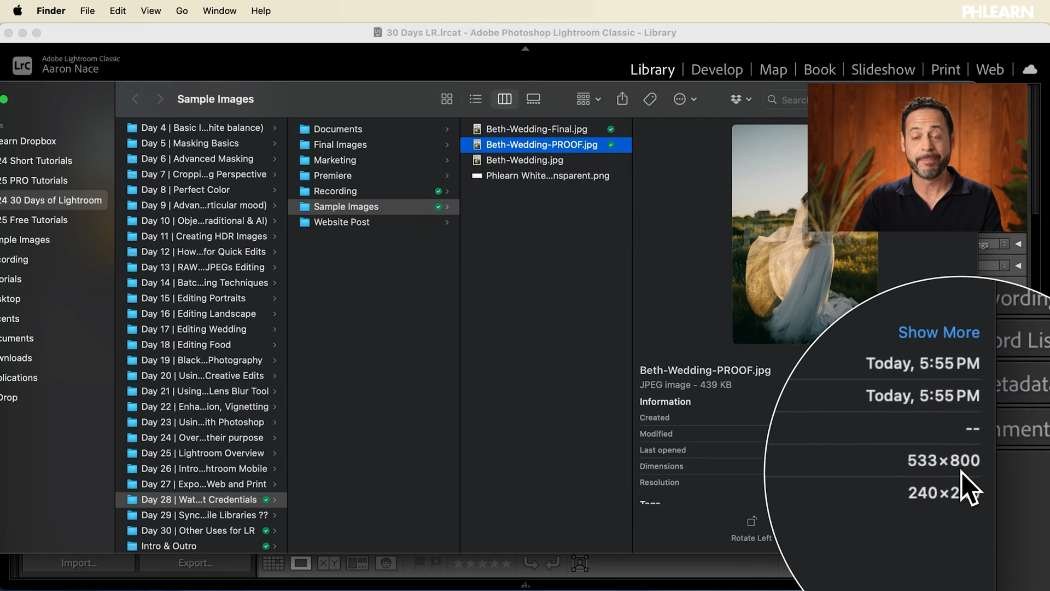
Put the two exported files side by side and the difference is obvious: an 800-pixel proof with a logo across the middle, and a full-resolution final with nothing on it at all.
Tell the Client What Is Happening
This part is not a Lightroom setting, but it matters more than any of them. Say up front, in writing, that proofs arrive small and watermarked and that the final files arrive full size and clean once the balance is settled.
Framed that way it reads as a normal professional process, which it is. Sprung on someone at delivery, it reads as distrust. The watermark is not there because you think your client is a thief — it is there so that neither of you has to think about it at all.
Don’t Forget Metadata and Content Credentials
A watermark is the visible layer of protection. There are two invisible ones sitting in the same Export dialog, and both are worth switching on.
Metadata should be set to include everything, so your copyright and contact details are written into the file itself. Content Credentials goes further, attaching verified authorship information that identifies you as the creator and travels with the image. Between the three, an image of yours that ends up somewhere unexpected still carries a trail back to you.
Quick Reference: Menus and Settings
- Open the editorFile > Export > Watermarking, tick Watermark > Edit Watermarks
- Text or logoType your name, or Watermark Style: Graphic > Choose your logo file
- Proof markSize up, anchor in the center, Opacity way down; save as a new preset
- Proof sizeImage Sizing > Resize to Fit: Long Edge, 800 pixels
- File settingsJPEG, Quality 100, sRGB; Export Location: Choose folder later
- Label the fileFile Naming > Rename To > Edit: Filename, hyphen, Custom Text; type proof
- Save the exportAdd (bottom left), name it; make a final preset with no watermark or resize

Free Downloads
Follow Along on the Same Photo
Get the wedding photo (JPEG) from the video, so you can build a watermark, export a small watermarked proof and a clean final. Free with a PHLEARN account.
Watermarks in Lightroom: Common Questions
Why should I watermark my photos?
Two reasons. A small mark on images you post online means anyone who finds them knows whose they are. A big mark on client proofs protects you until you get your final payment.
Where do I add a watermark in Lightroom Classic?
Go to File > Export, scroll to the Watermarking panel and tick Watermark. Choose Edit Watermarks from the dropdown to open the editor.
How do I make a text watermark?
In the Watermark Editor, type your name and it appears on the preview. The controls on the right set the font, alignment, shadow, opacity, size, inset and anchor position.
Can I use my logo or signature as a watermark?
Yes. Switch the Watermark Style from Text to Graphic, click Choose and load your logo or signature file. Size, opacity, inset and anchor still work the same way.
What kind of watermark should I use on client proofs?
A big one in the middle. Raise the size, anchor it in the center and lower the opacity way down, so the client can see the photo but nobody will use it as a finished image.
How do I save a watermark to reuse?
In the Watermark Editor, save the current settings as a new preset, give it a name like PHLEARN Proof, click Create and then Done.
What size should I export proofs at?
In Image Sizing, choose Resize to Fit: Long Edge and set about 800 pixels, or 1,000. That is big enough to judge the photo but not a full-size image.
How do I label proof files so the client knows?
In File Naming, click Edit and build a recipe of Filename, a hyphen and Custom Text. Type proof in Custom Text and you get files like Beth wedding proof.
How do I save the whole proof export?
Click Add at the bottom left of the Export dialog and name the preset. The watermark, resize, JPEG settings, export location and naming recipe all go in.
Is the sample file free?
Yes, with a free PHLEARN account. You get 1 sample image: the wedding photo (JPEG) used to build and test the watermark.
Master Photoshop, Lightroom and Photography
Join PHLEARN PRO for $12.99 a month or $99.99 a year. Cancel anytime, with a 100% money-back guarantee.