
Download Assets
This tutorial includes 1 PDF guide. Downloads are free with a PHLEARN account.
- Download the sample files from every free tutorial on PHLEARN
- New free tutorials published every week
- One free account: sign up once, then download anything
Free PDF Guide · 3 Pages
This Tutorial as a Step-by-Step PDF
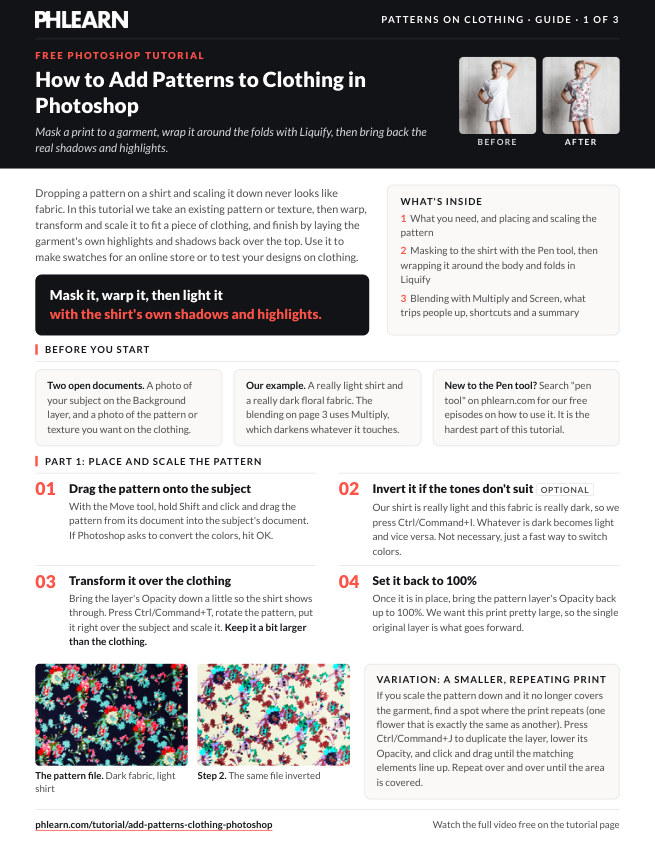
This 3-page guide walks through putting a floral print on a shirt: Free Transform it a bit larger, mask it with a Pen path and a 0.5 px feather, warp it in Filter > Liquify with Forward Warp and Freeze Mask, then blend with Multiply at about 90% and clipped Multiply and Screen copies. Keep it next to your keyboard.
description
Dropping a pattern on a shirt and scaling it down never looks like fabric. Aaron masks the pattern to the shirt’s exact outline with the Pen tool, warps it around the body and its folds with Liquify’s Forward Warp and Freeze Mask, then clips two copies of the original shirt on top, one set to Multiply for shadow and one to Screen for highlight, so the print picks up the garment’s real lighting.
Enjoying This Free Tutorial?
We publish a new free tutorial every week, each one with sample images and PSDs you can download and follow along with. Sign up and they land straight in your inbox, along with early word on sales, events and subscriber-only offers.
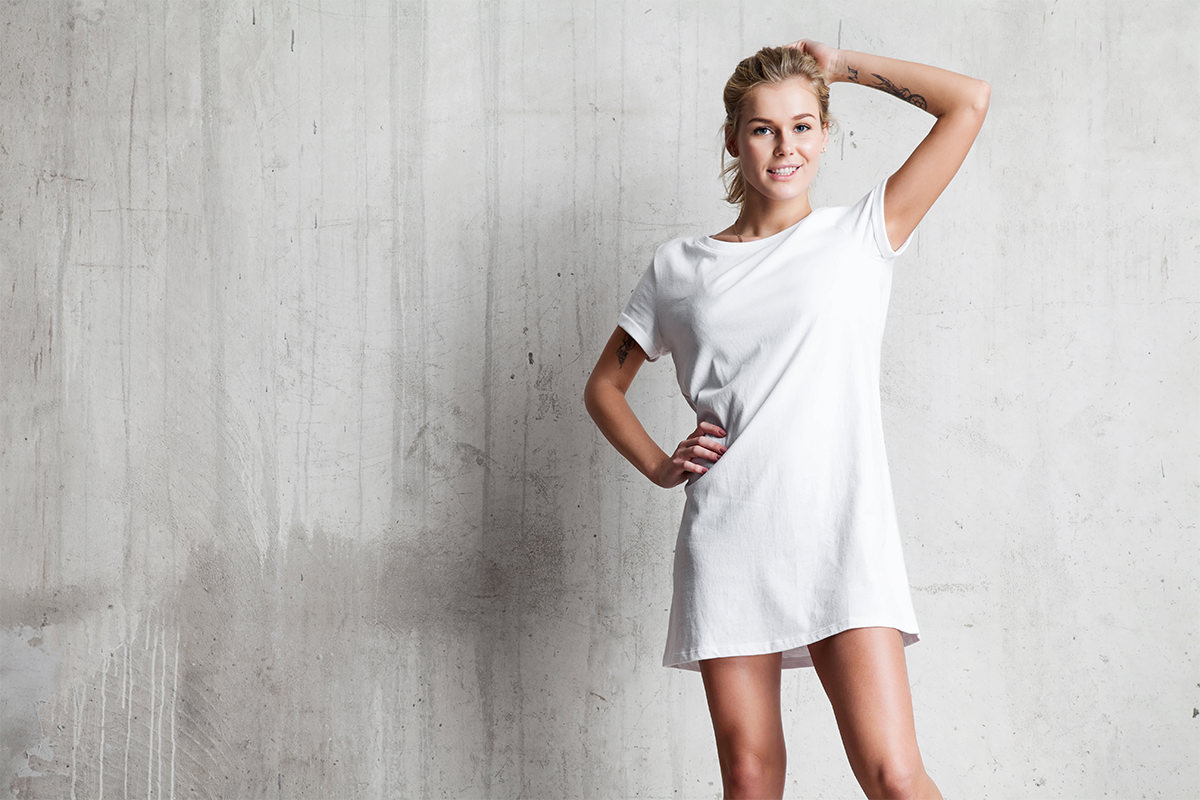
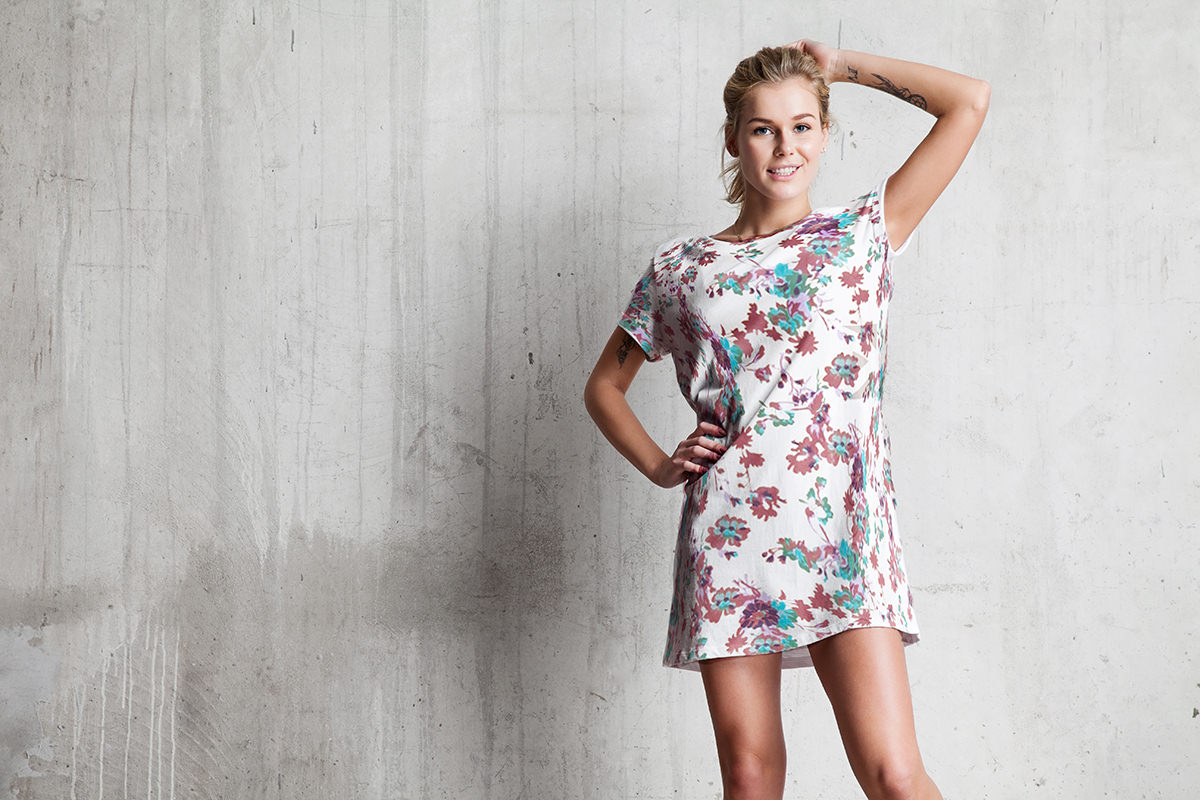
Wrapping a flat pattern around a piece of clothing so it actually looks like part of the fabric takes more than just placing it on top and scaling it down. This tutorial masks a pattern to a shirt’s exact shape with the Pen tool, uses Liquify to warp it around the fabric’s folds and wrinkles, then blends in shadows and highlights lifted from the original shirt to make the pattern look genuinely woven into the clothing.
Bringing In and Scaling the Pattern Onto the Subject
Dragging the pattern onto the subject photo and scaling it a bit larger than the clothing it will cover leaves enough room to work with once it’s warped into place.
-
Drag the Pattern Onto the Subject Image
Use the Move tool, hold Shift, and drag the pattern image onto the subject’s document.
-
Invert the Pattern’s Colors if Needed
Press Cmd/Ctrl+I to invert the pattern’s colors if the original fabric’s tone doesn’t suit the clothing, such as dark fabric against a light shirt.
-
Scale the Pattern Larger Than Needed
Lower the pattern layer’s opacity a little so the shirt shows through, then press Cmd/Ctrl+T and scale the pattern so it’s a bit larger than the area of clothing it will cover, rotating it into a natural position.
Repeating a Smaller Pattern by Duplicating and Aligning It
Duplicating the pattern layer and aligning repeating elements, like matching flowers in a print, extends a smaller pattern across a larger area of clothing.
-
Duplicate the Pattern Layer
Press Cmd/Ctrl+J to duplicate the pattern layer.
-
Lower Opacity to Align Repeats
Lower the duplicate’s opacity temporarily and drag it until matching elements from the pattern line up with the layer beneath.
-
Restore Full Opacity
Bring the opacity back to 100% once the repeated pattern is aligned. In the video the repeat is only a demonstration: Aaron wants a large print here, so the single original pattern layer goes on to the next steps at 100% opacity.
Masking the Pattern to the Shirt With the Pen Tool
Tracing the shirt’s exact outline with the Pen tool and loading that path as a selection restricts the pattern so it only shows up where the actual clothing is.
-
Add an Inverted Black Layer Mask
Add a layer mask to the pattern layer, then press Cmd/Ctrl+I to invert it to black so the pattern is hidden everywhere by default.
-
Trace the Shirt’s Outline
Press P for the Pen tool and click and drag to follow the shirt’s outline, around the sleeves and the fingers resting on it.
-
Adjust Points as Needed
Hold Cmd/Ctrl and click and drag any point on the path to refine the outline as it’s built.
-
Convert the Path to a Feathered Selection
Right-click the finished path, choose Make Selection, and set a small feather radius such as 0.5 pixels for a natural edge.
-
Fill the Mask With White
With the selection active, click the layer mask, press Shift+Delete, and fill it with white so the pattern becomes visible only on the shirt.
Why the Pen Tool Beats a Rough Brush Selection Here
A quick selection painted freehand with the Brush tool works fine for rough mockup purposes, but its edges won’t follow the clothing’s actual contours precisely. Tracing the shirt with the Pen tool instead produces a clean, accurate outline that holds up even when the pattern needs to look convincingly integrated rather than just roughly placed.
Warping the Pattern to Wrap Around the Clothing With Liquify
The Liquify filter’s Forward Warp tool, used with Show Backdrop enabled, pushes the flat pattern to follow the actual curves and contours of the clothing beneath it.
-
Open the Liquify Filter
Go to Filter > Liquify to open the filter on the masked pattern layer.
-
Enable Show Backdrop
Check Show Image and Show Backdrop, and set the backdrop to the background layer so the clothing underneath is visible for reference.
-
Set the Backdrop to Behind
Choose Behind for how the backdrop displays, and lower its opacity slightly to see both the pattern and the clothing clearly.
-
Push the Fabric Inward From the Edges
Use the Forward Warp tool with a large brush, clicking from outside the clothing’s edge and dragging inward so the pattern appears to wrap around the fabric.
-
Adjust Pressure for Subtler or Stronger Warps
Lower the tool’s pressure for a subtler push, or raise it for a stronger effect, depending on how much the fabric needs to curve.
Creating Realistic Folds With the Freeze Mask
The Freeze Mask tool protects part of the pattern from being affected by further warping, which makes it possible to simulate fabric folding under itself at a wrinkle.
-
Paint a Freeze Mask Over One Side of a Wrinkle
Select the Freeze Mask tool and paint over the area on one side of a visible wrinkle to protect it from further warping.
-
Erase Freeze Mask Where Needed
Use the Freeze Mask’s eraser to remove protection from any area that was covered by mistake.
-
Push the Unprotected Side Under the Fold
With the Forward Warp tool, pull the fabric on the unprotected side downward, making it look like it disappears under the frozen fold and reappears on the other side.
-
Pull One Side Down and the Other Up
For a fold or crease, pull the fabric down on one side and up on the other so the pattern appears to curve around the fold, then click OK to apply the transformation.
Why a Freeze Mask Is Necessary for Convincing Folds
Without protecting part of the fabric, pushing the pattern to simulate a fold would drag the entire area along with it, leaving no visible break where the fabric is supposed to tuck under itself. Freezing one side first means only the unprotected area moves, creating the illusion of the fabric passing underneath a fold rather than just bending as one continuous surface.
Adding Shadow Detail From the Original Shirt
Changing the pattern layer’s blend mode to Multiply, then clipping a copy of the original shirt set to the same blend mode on top, brings the shirt’s own shadow detail through the new pattern.
-
Change the Pattern Layer to Multiply
Change the transformed pattern layer’s blend mode from Normal to Multiply and lower its opacity slightly, such as to around 90%.
-
Duplicate the Background Layer
Duplicate the original background layer and move the copy to the very top of the layer stack.
-
Set the Copy to Multiply
Change this duplicate’s blend mode to Multiply so the original shirt’s shadow detail becomes visible.
-
Clip the Shadow Layer to the Pattern
Right-click the duplicate and choose Create Clipping Mask so the shadow detail only shows where the pattern layer is visible.
-
Adjust Opacity to Taste
Lower the clipped shadow layer’s opacity to control how strong the added shadow detail looks.
Why Screen and Multiply Work as a Pair Here
Multiply only ever darkens whatever it’s layered over, which recovers shadow detail but can’t add anything to the brightest areas of the shirt. Screen does the opposite, lightening whatever it touches, so pairing a Multiply-blended shadow layer with a Screen-blended highlight layer recovers both ends of the original shirt’s tonal range instead of just one.
Adding Highlight Detail With a Screen Blend Mode
A second clipped copy of the original shirt, set to Screen instead of Multiply, brings back the shirt’s highlight detail, with a Levels adjustment darkening it so it only shows in the brightest areas.
-
Duplicate the Background Layer Again
Duplicate the original background layer a second time and move it to the top of the stack.
-
Clip This Layer to the Pattern
Right-click and choose Create Clipping Mask so this layer is also restricted to the pattern’s visible area.
-
Change the Blend Mode to Screen
Change this layer’s blend mode from Normal to Screen to bring the shirt’s highlight detail through.
-
Darken the Layer With Levels
Press Cmd/Ctrl+L, and drag the shadows input slider to the right until the layer only shows through on the brightest highlight areas.
-
Fine-Tune Opacity for Character
Adjust this layer’s opacity slightly to control how much highlight character comes through in the final result.
Why This Approach Works
Masking the pattern to the shirt’s exact shape with the Pen tool is what keeps it confined to the clothing rather than floating loosely on top of it. Liquify’s Forward Warp and Freeze Mask tools are what let a flat, rectangular pattern follow the actual curves, folds, and wrinkles of real fabric instead of sitting on it like a flat sticker. Layering in Multiply and Screen copies of the original shirt is what finally sells the illusion, since real fabric always has its own shadow and highlight detail that a flat pattern alone can never fully replicate on its own.
Final Thoughts
This approach won’t produce something that’s a hundred percent indistinguishable from an actual photographed garment, since accounting for every fold and stretch in real fabric is genuinely difficult to fake perfectly. For visualization purposes, though, like testing a design or building swatches for an online store, this combination of Pen tool masking, Liquify warping, and blended shadows and highlights gets remarkably close, and the same workflow applies to any pattern and any piece of clothing.
Quick Reference: Keys, Menus and Settings
- Bring in the patternMove tool, hold Shift and drag it onto the subject’s document; Cmd/Ctrl + I inverts the colors
- Scale itCmd/Ctrl + T, rotate and keep it a bit larger than the clothing
- Repeat a smaller printCmd/Ctrl + J, lower opacity, line up the repeats, back to 100%
- Mask to the shirtBlack mask (Cmd/Ctrl + I), P Pen tool, right-click > Make Selection, Feather Radius 0.5 px, Shift + Delete to fill white
- Warp the fabricFilter > Liquify: Show Backdrop, Use: Background, Mode: Behind; Forward Warp from outside in
- FoldsFreeze Mask on one side of the wrinkle, Forward Warp the other side under it
- Shadows and highlightsPattern on Multiply at about 90%; background copies clipped with right-click > Create Clipping Mask, one Multiply, one Screen darkened with Cmd/Ctrl + L
Free Downloads
Take the Guide With You
Get the PDF guide to wrapping a pattern around clothing: the Pen tool mask, Liquify with Show Backdrop and Freeze Mask, and the Multiply and Screen layers. Free with a PHLEARN account.
Patterns on Clothing: Common Questions
How big should the pattern be before I warp it?
A bit larger than the clothing it will cover. Press Cmd/Ctrl + T, rotate it into place and leave some extra around the edges, because Liquify pushes it inward later.
Can I make a dark pattern suit a light shirt?
Yes. Press Cmd/Ctrl + I on the pattern layer to invert its colors, so dark areas turn light. That’s what the video does with the dark print on the light shirt.
How do I make a smaller print cover the whole shirt?
Duplicate the pattern with Cmd/Ctrl + J, lower the copy’s opacity and line up a repeating element, like a matching flower, with the layer below. Repeat until the area is covered, then set the opacity back to 100%.
Do I have to use the Pen tool for the mask?
No. Painting white on the mask with the Brush tool is quicker and fine for a rough mockup, but the Pen tool gives the accurate edge. Right-click the finished path, choose Make Selection with a Feather Radius of 0.5 pixels and fill the black mask with white.
How do I see the shirt while I warp in Liquify?
Check Show Backdrop, set Use to Background, set Mode to Behind and lower the backdrop Opacity. The pattern and the shirt then show together while you push with the Forward Warp tool.
Which way should I push with the Forward Warp tool?
Start outside the clothing’s edge and drag inward with a large brush. The pattern bunches up toward the edges, which reads as fabric curving around the body. Lower the Pressure for a subtler push.
How do I make the pattern fold under a wrinkle?
Paint a Freeze Mask over one side of the wrinkle, then pull the other side down under it with the Forward Warp tool. The break in the pattern makes the fabric look like it tucks under. For a crease, pull one side down and the other up.
Why does the pattern still look flat after Liquify?
It has no shadows or highlights yet. Set the pattern to Multiply at about 90%, then clip two copies of the background above it: one set to Multiply for shadows, and one set to Screen and darkened with Cmd/Ctrl + L Levels so only the highlights come through.
Will it look exactly like a real printed shirt?
Not 100%. Aaron says every wrinkle and stretch of real fabric is hard to fake, so for a perfect result photograph the real garment. For mockups, design tests and store swatches this gets close.
Is there a free download?
Yes, with a free PHLEARN account. You get 1 PDF guide with the steps from the video: placing and scaling the pattern, the Pen tool mask, the Liquify warp and folds, and the shadow and highlight layers.
From the Magazine View all
Stories, interviews and guides for photographers, new every week.
 BusinessHow to Compete With AI: Give Your Clients MoreEveryone has the same tools now, and your clients know it. The way to compete is to give them more.
 EditingLightCraft vs Lightroom: Is the Free Clone Any Good?The free clone on the same RAW files: what matches, what breaks and who should switch.
 EditingHow to Tell If a Photo Is AI, and Prove Yours Is RealThe tells that still work in 2026, why detectors disagree, and how to prove your own photos.
Master Photoshop, Lightroom and Photography
Join PHLEARN PRO for $12.99 a month, or $99.99 a year (save 36%). Cancel anytime, with a 100% money-back guarantee.