

Download Assets
This tutorial includes 1 sample image, 1 sample PSD and 1 PDF guide. Downloads are free with a PHLEARN account.
- Download the sample images and PSDs from every free tutorial on PHLEARN
- New free tutorials published every week
- One free account — sign up once, then download anything
Free PDF Guide · 4 Pages
This Tutorial as a Step-by-Step PDF
The guide walks through Layer > Smart Objects > Convert to Smart Object, Filter > Camera Raw Filter, then six masks: Select Subject with a Brush subtracted, the bright floor, a Radial Gradient glow, two Linear Gradients and the face. Then it reopens the filter to refine every mask. Keep it next to your keyboard.
description
Use Adobe Camera Raw in Photoshop on a Smart Object and every slider stays live: you can reopen the filter weeks later and change your mind. This tutorial unlocks its secrets, showing you how to use it for non-destructive editing just like Lightroom. Learn how to open photos, master masking basics for selective adjustments, and make targeted exposure, brightness, and color corrections.
Enjoying This Free Tutorial?
We publish a new free tutorial every week, each one with sample images and PSDs you can download and follow along with. Sign up and they land straight in your inbox, along with early word on sales, events and subscriber-only offers.


How to Use Adobe Camera Raw in Photoshop
Camera Raw gives Photoshop the same editing controls Lightroom has — exposure, highlights, shadows, temperature, and a genuinely capable masking system that can find a sky or a subject on its own.
Most people meet it only when opening a raw file, and never realize it works as a filter on any layer, including a JPEG. Used that way it becomes one of the fastest routes to a finished edit in Photoshop.
A note on versions: this was recorded against the 2024 release. Adobe updates Camera Raw regularly, so the masking panel may look different in your version and there may be more mask types available. The workflow is unchanged.
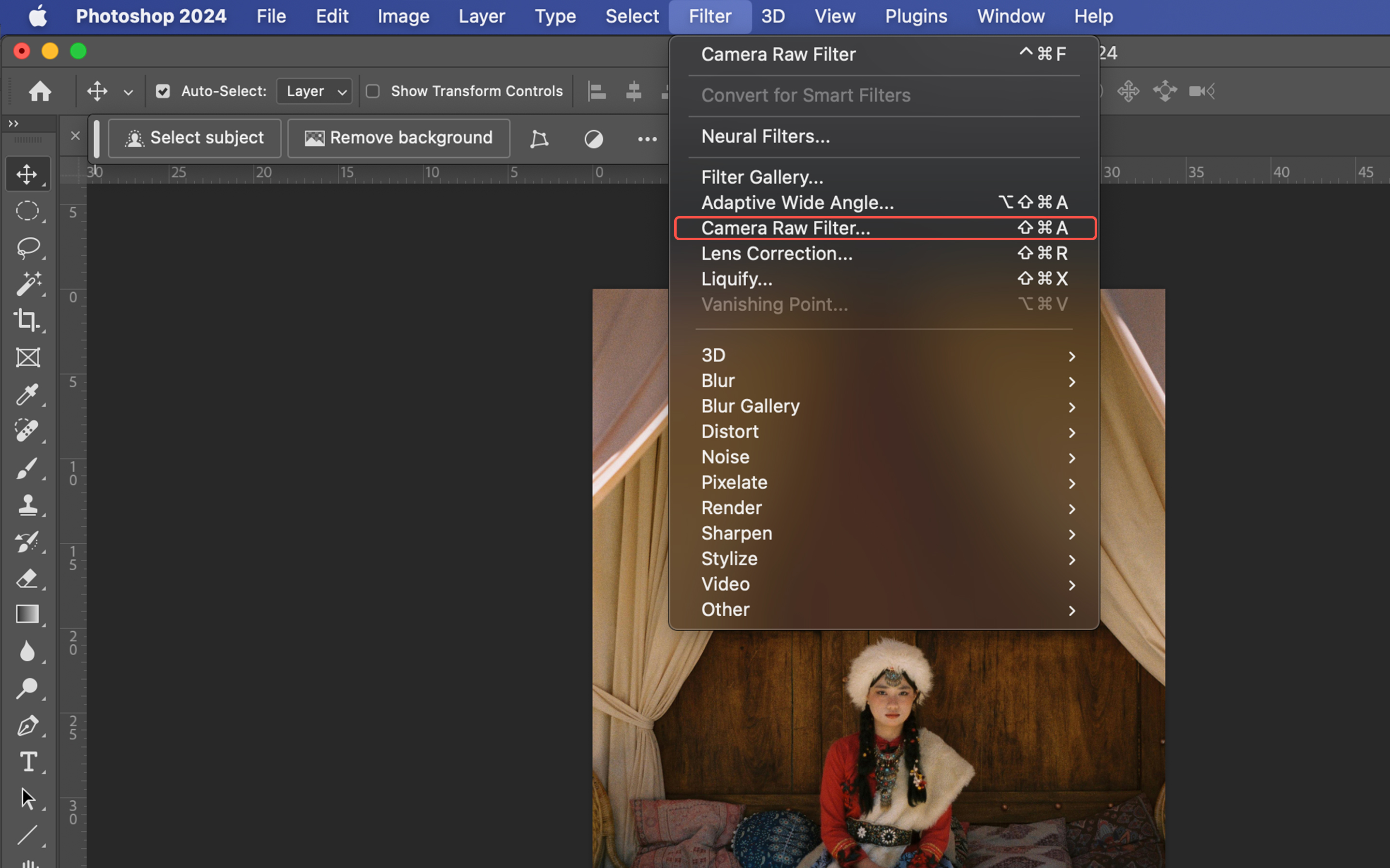
Convert to a Smart Object First
This is the step to get right, because skipping it is not recoverable.
-
Unlock the background layer
Click the padlock, or double-click the layer, to turn it into an ordinary layer.
-
Go to Filter, then Convert for Smart Filters
The layer thumbnail gains a small Smart Object badge.
-
Then open Filter, then Camera Raw Filter
The full Camera Raw interface takes over the screen.
Why it matters so much here
Applied to a normal layer, Camera Raw bakes the adjustment into the pixels. Your sliders, and every mask you built, are gone the moment you click OK.
Applied to a Smart Object, it becomes a smart filter. Double-click it days later and the entire panel reopens with every slider exactly where you left it and every mask still editable. Given that a Camera Raw edit can easily contain half a dozen masks, that is the difference between a file you can revise and one you have to redo.
The Basic Adjustments
The right-hand panel holds the familiar controls: Exposure, Contrast, Highlights, Shadows, Whites, Blacks, Temperature, Tint, Vibrance and Saturation.
These behave better than their equivalents elsewhere in Photoshop. Highlights and Shadows in particular are tone-aware — they recover detail at the ends of the range without flattening the midtones the way a crude curve adjustment would.
On a JPEG the same controls work but with far less latitude than a raw file. Push hard and you will see banding in skies and color breaking up in shadows, so work in smaller amounts than you would on a raw original.
Masking Is the Real Reason to Be Here
Global adjustments are available anywhere. What makes Camera Raw worth opening is that it will build a mask for you.
Open the Masking panel and you get several ways to define an area:
Select Subject — finds the person or main object automatically.
Select Sky — isolates the sky, usually very accurately.
Brush — paint an area by hand, with the square bracket keys resizing the brush as you go.
Linear Gradient — a graduated adjustment across the frame, the digital equivalent of a grad filter.
Radial Gradient — a circular or elliptical area, for vignettes and pools of light.
Create a mask, then move the adjustment sliders. They now apply only inside that mask, and every mask carries its own full set of controls.

Adding to and subtracting from a mask
Each mask can be refined with Add and Subtract. Select the sky automatically, then subtract a brushed area where it caught a building edge. Or select the subject, then subtract their face so a clothing adjustment does not touch skin.
This combination — automatic detection plus manual correction — is what makes the masking practical. The automatic selections are good but rarely perfect, and fixing them takes seconds.
Stack several masks
A typical edit might carry four or five: the sky darkened and cooled, the subject brightened, a radial gradient warming the light around them, and a linear gradient holding back the foreground.
Each is listed in the panel with an eye icon to toggle it, so you can check what each one is contributing rather than judging the whole thing at once. Turning masks off one at a time is the quickest way to find the one that has gone too far.
A Sensible Order
Get the global adjustment roughly right first — overall exposure, white balance, and the broad tonal range. Then build masks for the areas that still need work.
Doing it the other way round means every local adjustment has to be revisited after you change the global exposure, because the two interact. A few minutes on the base image saves redoing the detailed work.
Coming Back to It
Click OK and the edit lands as a smart filter beneath your layer. From there you can:
Double-click the filter name to reopen Camera Raw with everything intact. Click the small slider icon beside it to change the blend mode or reduce the filter’s opacity — a quick way to dial back an edit that went too far without adjusting a single slider. Or paint black on the smart filter’s own mask to hide the whole Camera Raw treatment from part of the image.
That last option is worth remembering. It gives you a layer of control sitting above everything Camera Raw did, which is occasionally simpler than reopening the panel and adjusting individual masks.
Where It Fits
Camera Raw handles tone, color and local adjustment better and faster than doing the same work with adjustment layers — largely because of the automatic masking, which has no real equivalent in Photoshop proper.
What it does not do is anything structural. Retouching, compositing, cloning, generative work and anything involving multiple layers all belong in Photoshop itself.
The efficient pattern is to open Camera Raw first and do all the tonal and color work there while it is fast and non-destructive, then close it and do the pixel-level work in Photoshop. Because the filter stays live, you can return and adjust the grade at any point without disturbing the retouching layered on top.
Quick Reference: Keys, Menus and Settings
- Unlock the layerDouble-click the Background layer and click OK
- Make it editableLayer > Smart Objects > Convert to Smart Object
- Open Camera RawFilter > Camera Raw Filter, then the Masking tool
- Fix a maskSubtract > Brush; [ and ] make the brush smaller or larger
- Glow behind subjectRadial Gradient, Exposure up, a little Temperature and Tint, then Subtract > Select Subject
- Before and afterThe eyeball beside Create New Mask toggles every mask
- Reopen the editDouble-click Camera Raw Filter in the Layers panel

Free Downloads
Follow Along on the Same Photo
Get the photo, the finished PSD with every Camera Raw mask still editable and the 4-page PDF guide. Free with a PHLEARN account.
Adobe Camera Raw in Photoshop: Common Questions
How do I open Camera Raw on a photo that is already in Photoshop?
Go to Filter > Camera Raw Filter. It runs on any layer, not just raw files, so it works on a JPEG like the sample image. Convert the layer to a Smart Object first.
Why convert the layer to a Smart Object first?
On a Smart Object, Camera Raw becomes a smart filter, so every slider and every mask stays editable. Double-click the Background layer to unlock it, then go to Layer > Smart Objects > Convert to Smart Object.
I clicked OK and my Camera Raw masks are gone. Why?
The layer wasn’t a Smart Object, so the edit was baked into the pixels. That is not recoverable. Undo, convert the layer to a Smart Object and run the filter again.
Select Subject grabbed too much. How do I fix the mask?
Under the mask, click Subtract and choose Brush, then paint over the extra area. In the video it caught a pillow beside the subject, and a few brush strokes removed it.
How do I add a glow behind the subject?
Create a new mask with Radial Gradient and drag it out behind the subject. Raise Exposure and add a little warmth and magenta. Then click Subtract > Select Subject so the glow stays behind them.
How do I resize the brush in Camera Raw masking?
Use the open and close bracket keys, [ and ], to make the brush smaller or larger as you paint.
How do I see a before and after of my masks?
Click the eyeball on any mask to toggle it. The eyeball beside Create New Mask toggles all the masks at once. Turning masks off one at a time is the quickest way to find one that went too far.
How do I go back and change a Camera Raw edit?
Double-click the words Camera Raw Filter under the layer in the Layers panel. Click the Masking tool and every mask is still there to adjust. Hit OK and Photoshop reprocesses the filter.
Can I edit a JPEG as hard as a raw file?
The same controls work, but with far less latitude. Push hard and you will see banding in skies and color breaking up in shadows, so work in smaller amounts.
Are the sample files free?
Yes, with a free PHLEARN account. You get 1 sample image, 1 sample PSD and 1 PDF guide: the photo, the finished file with the Camera Raw filter still live and a 4-page step-by-step guide.
Master Photoshop, Lightroom and Photography
Join PHLEARN PRO for $12.99 a month or $99.99 a year. Cancel anytime, with a 100% money-back guarantee.