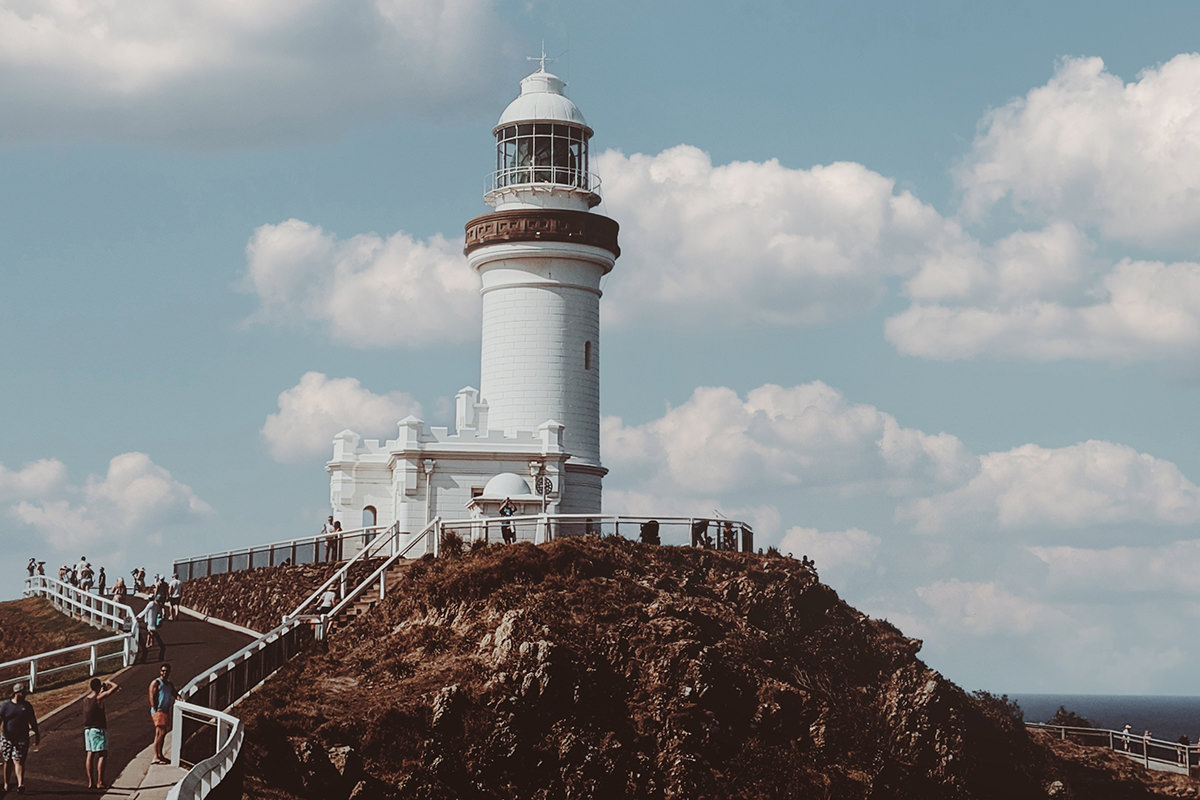

Download Sample Images
Download Assets
This tutorial includes sample images and 1 sample PSD. Downloads are free with a PHLEARN account.
- Free sample files with every tutorial on PHLEARN
- New tutorials published every week
- Unlimited downloads with your free PHLEARN account
description
Sky replacements were once tricky business. You either had to go through the process manually which could take a lot of time and require a lot of surprisingly detailed compositing. Or you could have simplified the process using a third-party plug-in , but that still required you to find tools that exist outside of Photoshop. But luckily, times have changed and sky replacements are now easier than ever!
Learn all about Photoshop’s new automated Sky Replacement Tool which allows you to quickly swap a sky while adjusting things like exposure and color temperature to get a seamless composite. We even take it step further, showing you how to analyze the lighting in a photo so that you can choose a sky that will fit realistically into the scene.
Enjoying This Free Tutorial?
We publish a new free tutorial every week, each one with sample images and PSDs you can download and follow along with. Sign up and they land straight in your inbox, along with early word on sales, events and subscriber-only offers.
The Sky Lights the Ground — Which Is Why Most Sky Replacements Fail
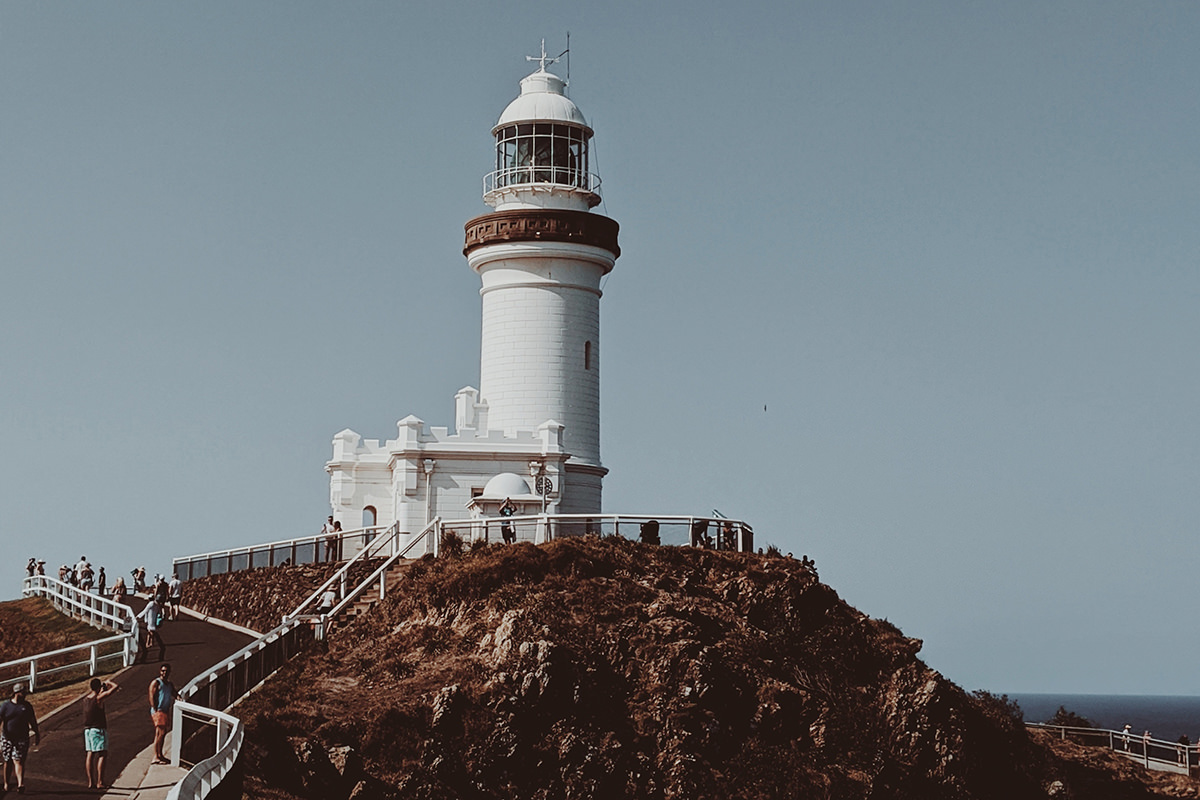
Photoshop’s built-in Sky Replacement is genuinely excellent. It finds the horizon, masks around fine detail, relights the foreground and outputs the whole thing as editable layers. The technical problem is essentially solved.
Which leaves the part no tool can do for you: choosing a sky whose light agrees with the photograph you’re putting it into. Get that wrong and a technically flawless composite still looks wrong, and you won’t be able to say why.
Read the Shadows Before You Open the Tool
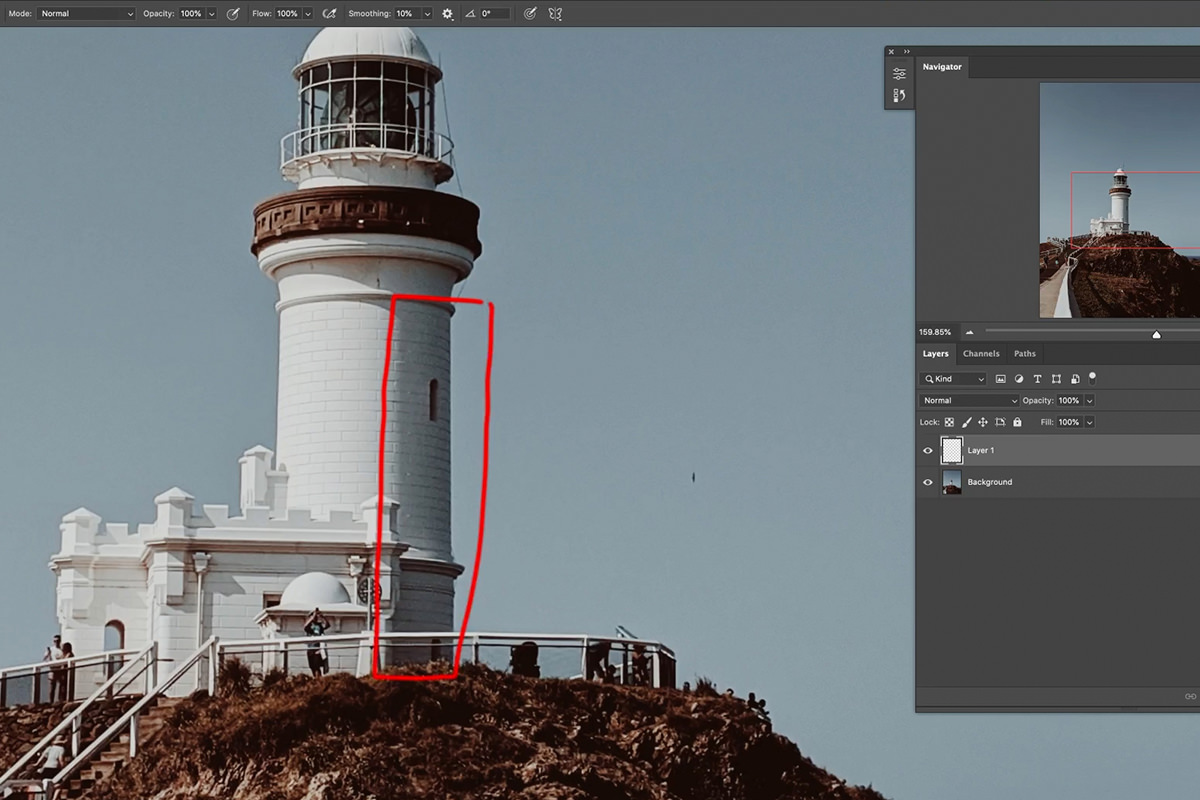
Shadows tell you two things, and both constrain your choice of sky.
Direction
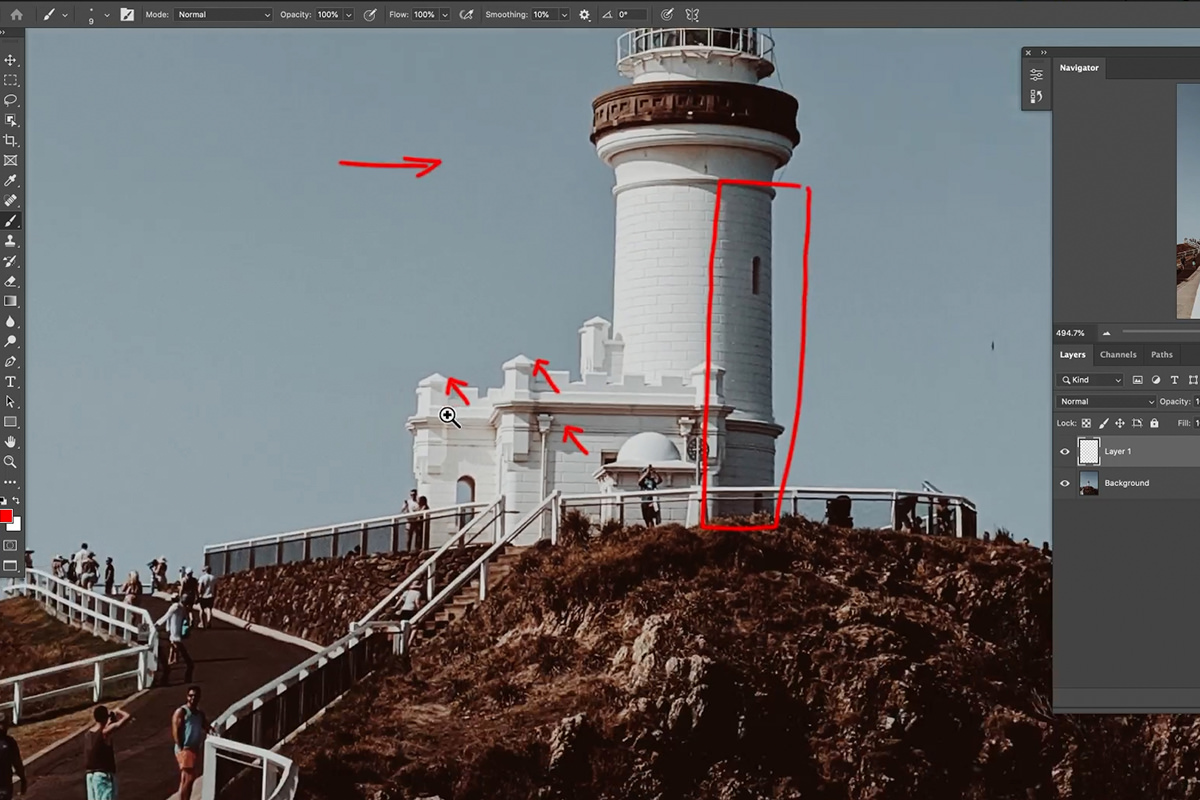
Find a shadow with a clear edge and note which side of the object it falls on. A shadow on the right means light from the left. Then look at several shadows together — a railing, a building edge, a post — and notice they all run at the same angle. Trace that angle back and you have the sun’s position, even when the sun is outside the frame.
In the example, the shadows fall right and run at a consistent angle, placing the sun off-camera to the upper left. Any replacement sky has to put its brightest area in roughly that position. A beautifully composited sky with the sun on the wrong side reads as fake no matter how perfect the mask is.
Quality
Hard-edged shadows mean a small, bright, direct source — a clear sunny day. Soft, diffuse shadows mean a broad source — overcast cloud.
This rules things out immediately. A photograph with crisp shadows cannot take a heavy overcast sky, because an overcast sky physically cannot produce those shadows. And a sunset sky is wrong for a scene whose shadows are short and steep, because short shadows mean a high sun and a sunset means a low one.
Sky replacement is compositing, and compositing is a lighting problem before it is a masking problem.
Running the Sky Replacement Tool
-
Duplicate the background layer
Cmd/Ctrl + J. Not strictly required given the output options, but a good habit.
-
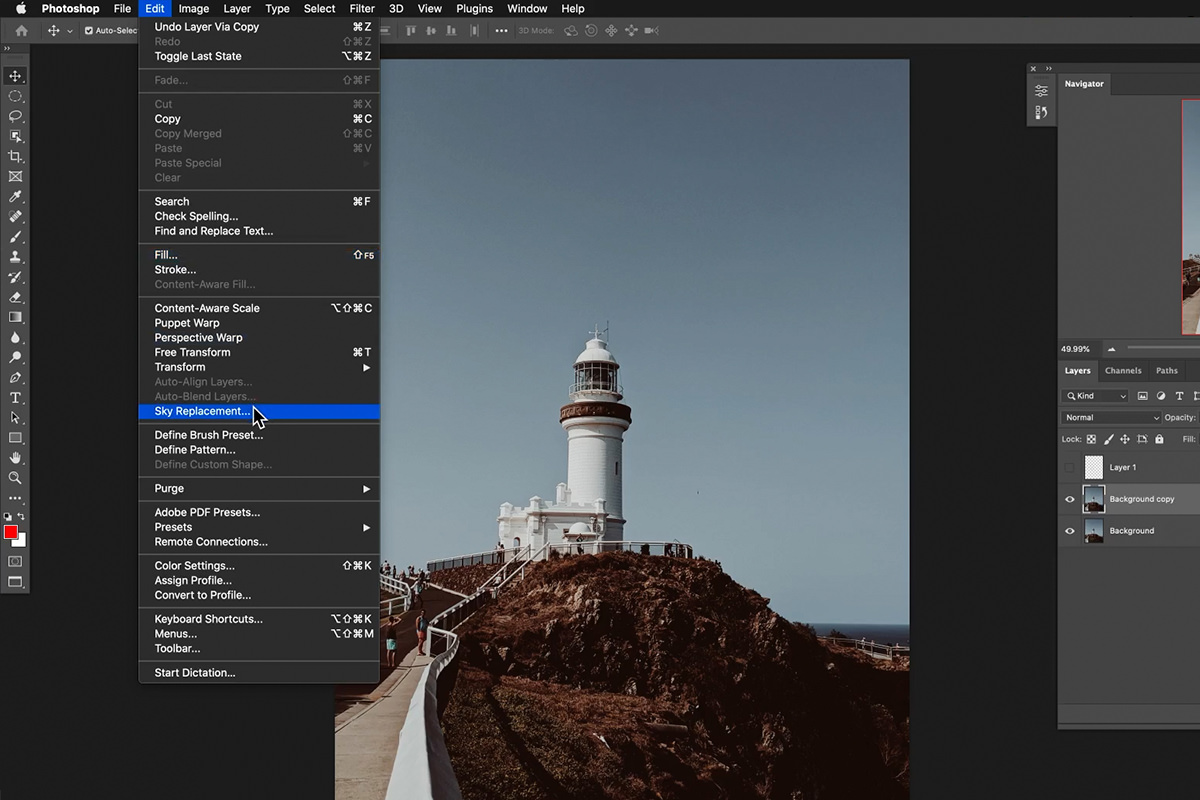
Edit › Sky Replacement
Note it’s under Edit, not Filter — which is where most people look first.
-
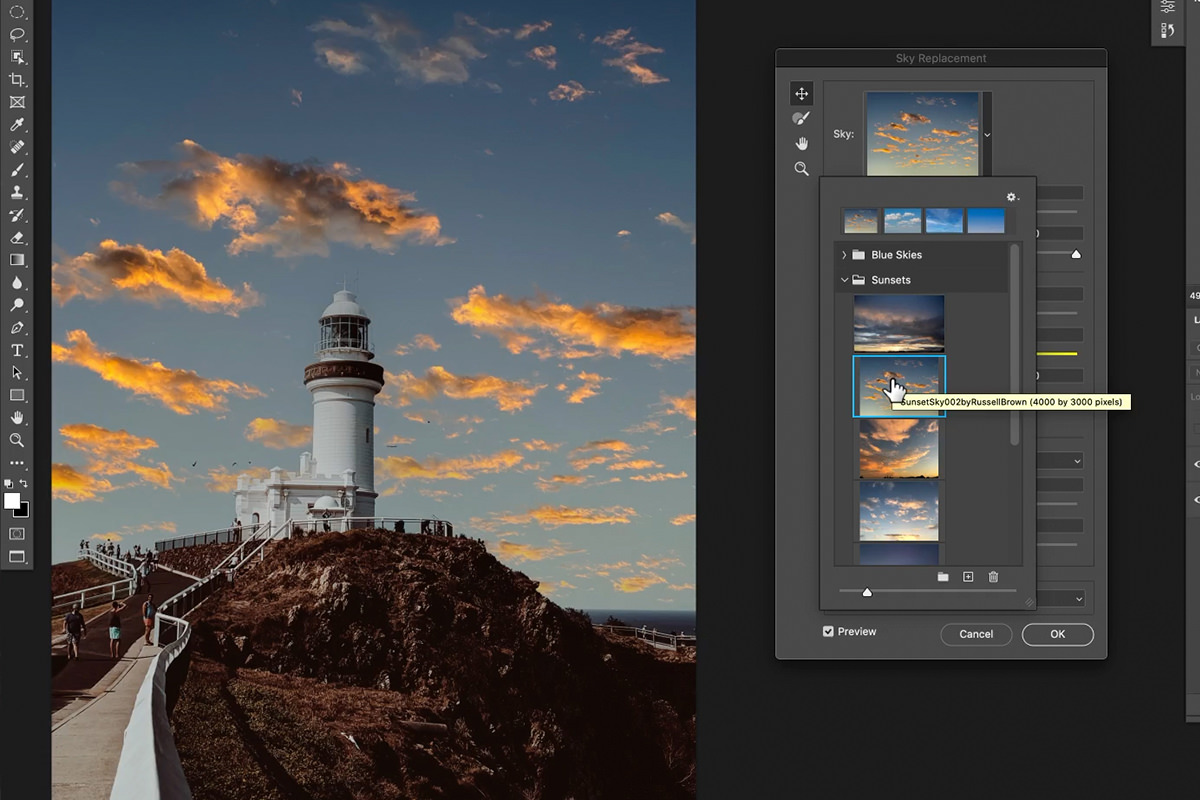
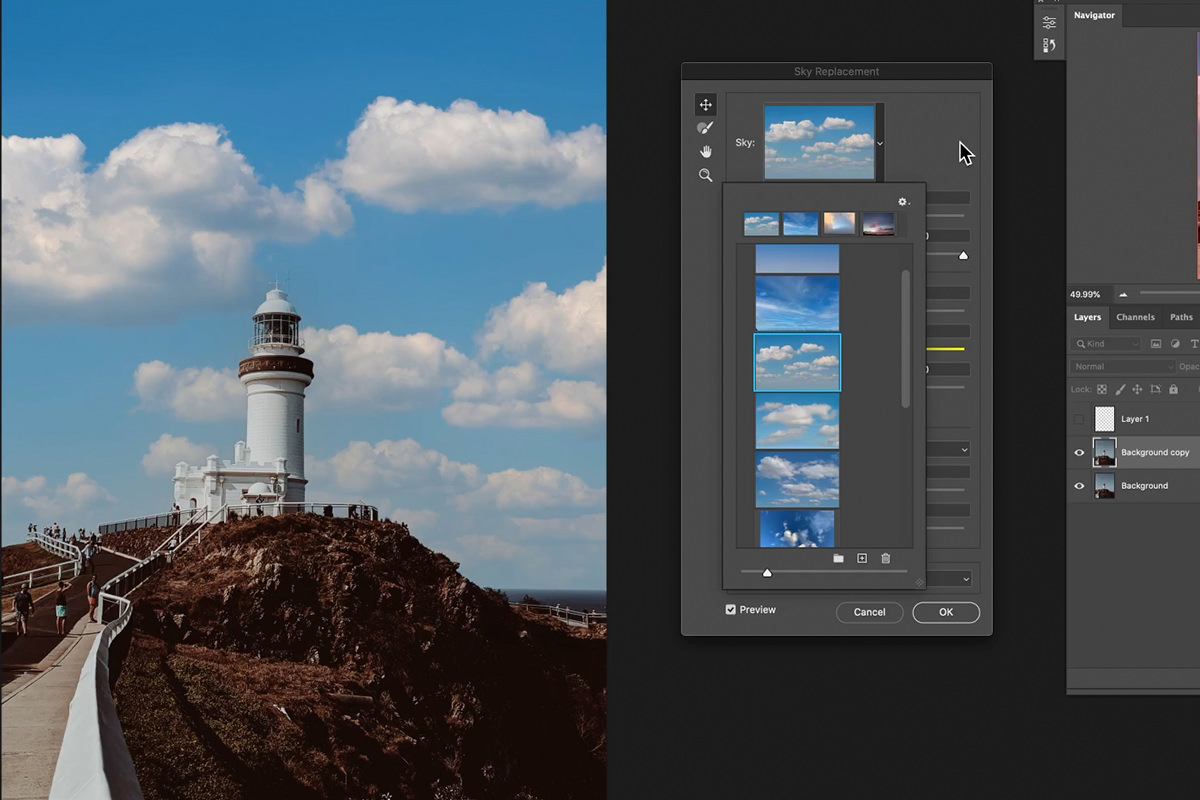
Click through the bundled skies
Three folders: Blue Skies, Sunsets and Spectacular. You can load your own. The defaults are good enough that clicking through is often all it takes.
-
Judge each against your shadow analysis
Look at where the highlights fall on the clouds. A sky lit from its upper left belongs in a scene lit from the upper left.
Cmd/Ctrl + + zooms in and the spacebar pans, so you can inspect edges without leaving the dialog. The preview toggle shows before and after.
The Settings Worth Understanding
Shift Edge and Fade Edge
Two sliders controlling where the mask sits and how softly it transitions. Shift Edge moves the boundary in or out — useful when a halo of old sky survives around a rooftop. Fade Edge softens it.
The Refine Edge brush
Built into the dialog. Paint to add sky where the automatic mask missed; hold Alt/Option to remove it where it went too far. Handy for gaps between railings and similar detail.
Brightness and Temperature
These matter more than they look. A dark sky above a brightly lit building is instantly wrong — the highlights don’t agree. Match the sky’s brightness to the highlights already in your scene, then use Temperature to bring its warmth in line with the original.
Flip
Mirrors the sky horizontally. This is often the fastest fix for a sky that’s right in every way except that its brightest area is on the wrong side.
Foreground Adjustments — open this section
It’s collapsed by default and it’s where the relighting lives. Lighting Mode offers Screen or Multiply: Screen lightens the foreground with the new sky’s light, Multiply darkens it. There’s no universal right answer — a bright sky usually wants Screen, a moody one Multiply. Below that, Lighting Adjustment and Color Adjustment set how strongly the sky’s light and color carry into the scene.
Skipping this section is the most common reason a technically clean replacement still looks pasted on.
Output as New Layers — Always
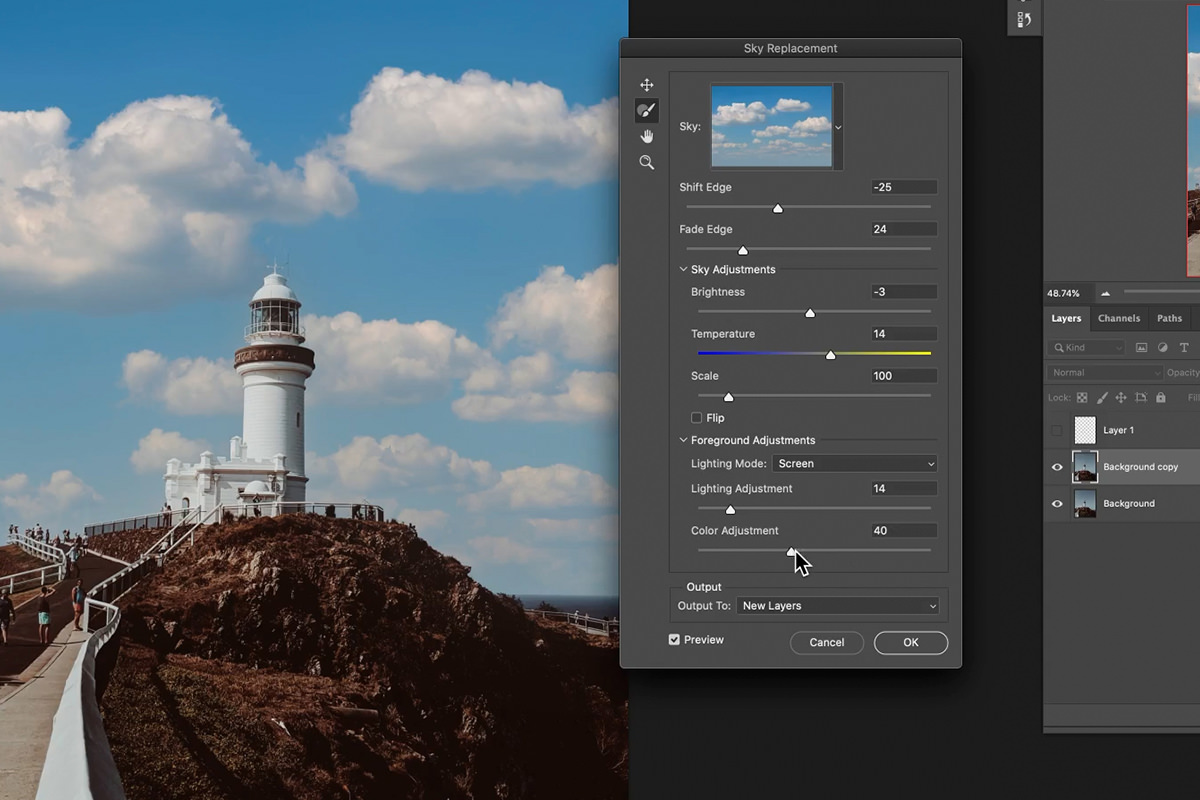
At the bottom of the dialog, Output To offers New Layers or Duplicate Layer. Choose New Layers.
You get a Sky Replacement group containing the sky itself, a sky temperature adjustment, foreground lighting and foreground color — each as a real adjustment layer with its own mask. Every decision you made in the dialog remains editable afterwards.
So if the sky came out too dark, you don’t reopen the tool — you adjust the brightness layer. If a mask edge is rough, you paint on that mask. This is exactly how an automated tool should behave, and it’s what makes this better than most alternatives.
Cleaning Up the Mask with an Overlay Brush

An automatic mask will never be perfect. There’s a technique that cleans edges far better than ordinary brushing.
-
Alt or Option-click the mask thumbnail
Shows the mask itself, so you can see the fuzzy areas.
-
Take a large soft brush and set its blend mode to Overlay
The brush’s blend mode, not the layer’s. It’s in the options bar at the top.
-
Paint white to push light areas to pure white
Overlay makes lights lighter and darks darker while leaving the opposite alone — so painting white on a mostly-white area cleans it to solid white without bleeding across the boundary into the black.
-
Switch to black and do the same on the dark areas
The edge tightens from both sides while staying in the right place.
-
Set the brush blend mode back to Normal
Do this immediately. Leaving it on Overlay and then wondering later why the brush appears to do nothing on a new layer is a genuinely common and very confusing mistake.
Matching Saturation with a Clipped Adjustment
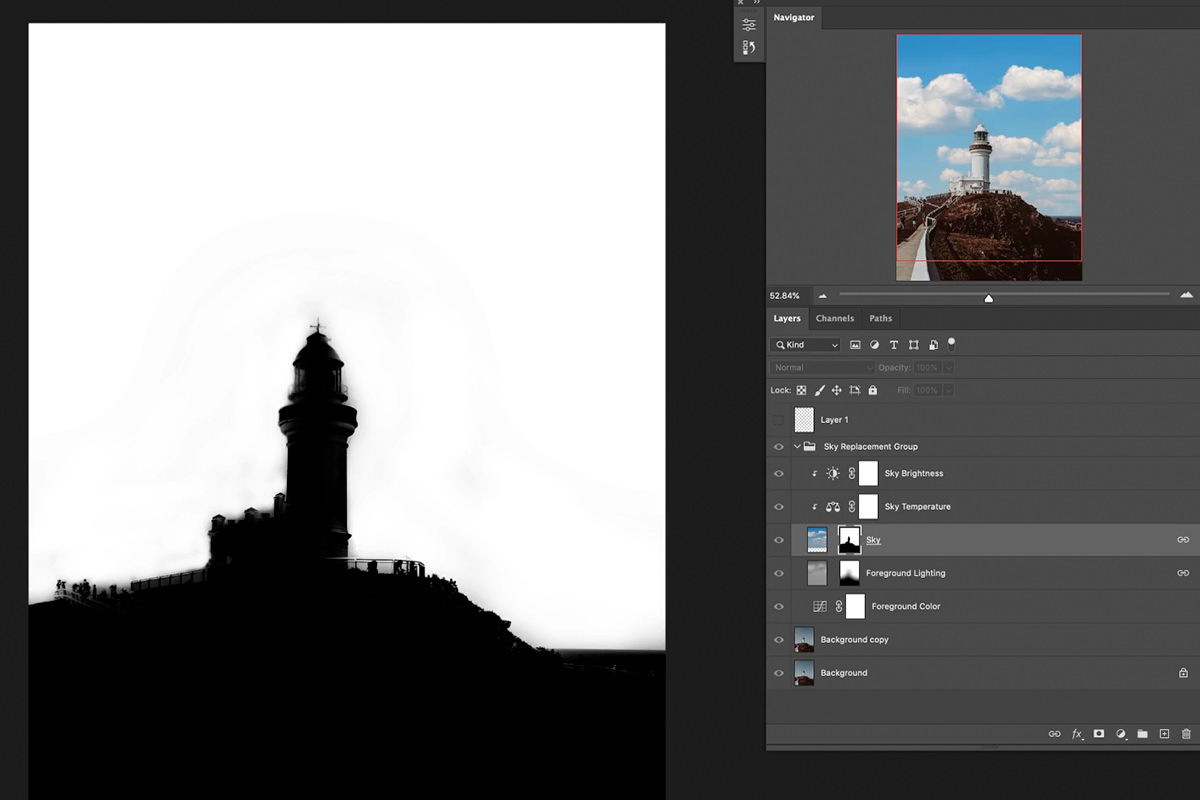
Stock skies tend to be more saturated than the photograph you’re putting them into, and a vivid sky above a muted scene gives the game away.
Add a Hue/Saturation adjustment layer above the sky and clip it — click the clipping icon in the Properties panel and a small down-arrow appears, meaning it now affects only the layer beneath it.
Then bring Saturation down to match the original image rather than up to make the sky impressive. You can nudge Hue as well — a little cyan often integrates a blue sky better than the stock version.
Where Sky Replacements Fail
Light coming from the wrong side
The one that ruins otherwise perfect work. Read the shadows first, choose the sky second.
Mismatched shadow quality
Hard shadows need a clear sky; soft shadows need cloud. The shadows already in your photo tell you which.
A sunset over a high-sun scene
Short shadows mean a high sun. A sunset sky contradicts them.
Leaving Foreground Adjustments collapsed
The relighting lives there, and it’s closed by default. Open it every time.
Outputting to Duplicate Layer
You lose all the editable adjustment layers. New Layers, every time.
Forgetting to reset the brush blend mode
Overlay left on will quietly break your next twenty minutes of brushwork.
More Free Photo Editing Tutorials
If this was useful, these go further in the same direction:
- How to Create a Composite in Photoshop — building the layered file first.
- Compositing Highlights, Shadows and Reflections — making an added element sit in the scene.
- How to Use the Select and Mask Workspace — cleaner cut-outs, which compositing depends on.
- How to Create and Use Layer Masks — confining an effect to exactly where it belongs.
- How to Make Realistic Shadows in Photoshop — the shadow that anchors an object.
- How to Use Select Subject in Photoshop — the selection engine behind most cut-outs.
More Free Compositing Tutorials
- The Fastest Way to Replace a Sky (Featuring A.I.) — the same job in Luminar, with the same lighting rules.
- How to Match Light & Color — doing the relighting by hand.
- Intro to Photoshop Compositing for Beginners — the wider workflow.
- How to Place Anything into Perspective — the other half of believable composites.
The Tool Is the Easy Part
Adobe has made the mechanical side of this close to effortless — the masking, the relighting, the layered output are all better than they have any right to be.
What remains yours is the judgement: spend thirty seconds reading the shadows before you open the dialog, and you’ll pick a sky that works on the first attempt instead of cycling through forty that don’t.
New Free Tutorials View All »







Enjoying This Free Tutorial? Go Further with PRO.
Unlock Full Sample Files, PSDs, and Hundreds of Masterclasses!

Download full project assets, original PSDs, and RAW images for every lesson
Unlimited access to our complete library of PRO Photoshop & Lightroom courses
Instant 4K Ultra HD streaming on all devices, anytime, anywhere
Full access to our entire library of Photoshop Actions, Presets, and LUTs
Flexible monthly and annual membership plans
Cancel anytime with zero hassle or commitments