
Download Assets
Download Assets
This tutorial includes 30 sample images. Downloads are free with a PHLEARN account.
- Free sample files with every tutorial on PHLEARN
- New tutorials published every week
- Unlimited downloads with your free PHLEARN account
Watch the Full Series
description
Lightroom folders vs collections is the first thing to settle: folders mirror your hard drive, collections group photos across it. Get both right and a catalog stays findable.
On Day 2 of 30 Days of Lightroom Classic we rename folders by project, build a capture, export and PSD structure, batch-rename files so they are searchable anywhere, and cover how collections differ from folders.
This is Day 2 of our 30 Days of Lightroom Classic series. Follow along with all 30 episodes as we explore the magic of Lightroom together!
Continue Watching 30 Days of Lightroom Classic
JOIN 30 DAYS OF LIGHTROOM (FOR FREE!)
Ready to jump in? Sign up and we’ll email you a printable calendar and daily class schedule so you can get started right away!
Image Source

Lightroom Folders vs Collections: Where Each One Belongs
Most photographers do not have a storage problem. They have a retrieval problem. The pictures are all there somewhere, spread across a drive in folders named after whatever seemed obvious at the time, and finding the one you want three years later turns into an afternoon of guesswork.
Day 2 fixes that, and it does it in a way that survives Lightroom itself. Everything you build here in the Folders panel is written to your hard drive at the same time, so the structure keeps working in Finder, in Explorer, in Dropbox, and in any program you open next. Then we will look at collections, which work in the opposite way, and be clear about when each one is the right tool.
Lightroom’s Folders Are Your Computer’s Folders
This is the idea the whole day rests on. The Folders panel on the left of the Library module is not a Lightroom-only view of your pictures. It is a live window onto the actual folder structure on your drive. Create a folder there and it appears on your computer. Rename one and it is renamed on disk. Drag images between folders and the files physically move.
Right-click any folder and choose Show in Finder (or Show in Explorer on Windows) to prove it to yourself. That two-way link is what makes this worth doing properly, and it is also why moving files outside Lightroom breaks things: the catalog is only watching from one side.
If you have not brought any images in yet, Day 1 covers creating a catalog and importing, and this all builds directly on it.
Rename the Dated Folder to Include the Project
Importing by date gives you folders like 2024-12-09. That is a good start and a poor finish, because a date on its own tells you nothing about what is inside. Adding the project name to the folder means you can scan a year at a glance and read what each shoot actually was.
-
Right-click the dated folder and choose Rename
Do this inside Lightroom, never in Finder, so the catalog follows the change.
-
Add the project name after the date
2024-12-09 becomes 2024-12-09 30 Days LR. Now you only need to remember roughly when you shot something to find it, and the shoot name confirms you are in the right place.
Build the Capture, Export and PSD Structure
Inside each project folder, three subfolders will keep raw files, finished exports and layered documents from turning into one undifferentiated pile.
Capture
Everything straight off the camera. Raw files, untouched. This is the folder you back up most carefully, because it is the only one you cannot regenerate.
Export
Finished JPEGs and anything else you produce for a client, a print lab or social media. Disposable in principle, since you can always export again.
PSD
Layered Photoshop documents and TIFFs from any round trip out of Lightroom. Big files, and worth keeping separate so they are easy to find and easy to prune.
-
Right-click the project folder and choose Create Folder Inside
Name the first one Capture.
-
Repeat for Export and PSD
Three right-clicks and you are done. This same shape works for every shoot you will ever import.
-
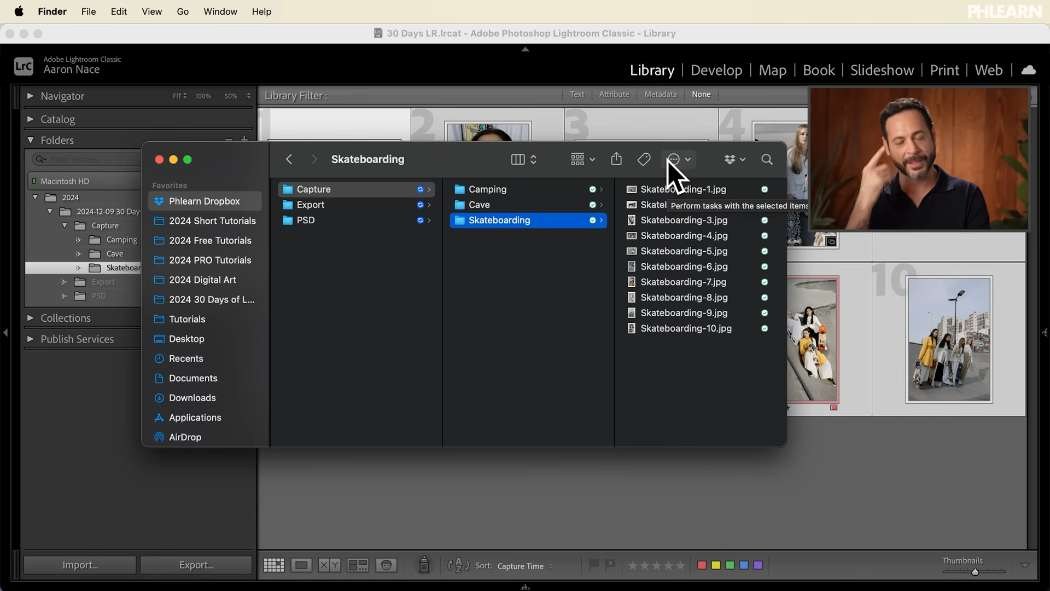
Select every image and drag it into Capture
Ctrl or Cmd + A selects the lot. Dragging inside Lightroom moves the real files on disk, so the catalog never loses track of them.

Break Each Shoot into Its Own Subfolder
One card often holds more than one thing. A wedding is a ceremony, a reception and portraits. A studio day might be half studio and half location. Splitting those inside Capture costs a minute and saves a lot of scrolling later.
-
Create a folder inside Capture for each shoot or segment
In our sample set that is camping, cave and skateboarding. On a wedding it might be ceremony, reception and portraits.
-
Drag each group of images into its folder
Select with Shift or Ctrl and Cmd as usual, then drag. Check the result in Finder if you want the reassurance — it will match exactly.
Rename Your Files So You Can Find Them Anywhere
This is the step that pays off outside Lightroom. A file called DSC_4417.NEF is invisible to any search you will ever run. A file called camping-4.NEF turns up the moment you type “camping” into Finder, Explorer or Dropbox, whether or not Lightroom is open.
-
Select every image in one subfolder
Ctrl or Cmd + A inside that folder.
-
Choose Library > Rename Photos, or press F2
F2 is worth learning; you will use this more than you expect.
-
Pick Custom Name – Sequence and type the shoot name
Lightroom numbers them for you, giving camping-1 through camping-10. Repeat for each subfolder. It works on raw files exactly as it does on JPEGs.
Sync One Edit Across an Entire Folder
Once a folder holds one coherent shoot, you can treat it as a batch. Edit one frame properly, then push those settings to everything else in the folder.
-
Edit one image in the Develop module
For a quick demonstration, drop Saturation to zero for a black and white conversion. Any combination of adjustments works the same way.
-
Back in Library, select that image first, then Shift-click to the last
The image you edited must be the active one. Lightroom copies from the active photo to the rest of the selection.
-
Click Sync Settings, then Synchronize
Check All is fine while you are learning. On a real edit you will want to leave crop and spot removal unchecked, since those rarely transfer sensibly between frames.
There is a lot more to this than one button — our PRO guide to syncing settings in Lightroom goes through which adjustments travel well and which do not.
Exporting, and Why Your Originals Never Change
Look in Finder after that batch conversion and the files are still in color. Nothing you do in Lightroom rewrites the original. The adjustments live in the catalog and are only baked into pixels when you export, which is the whole basis of non-destructive editing.
-
Select your images and choose File > Export
Start with Export Location and point it at your Export folder.
-
Build a filename under File Naming
Click Edit to open the template builder. Combining Filename, a hyphen and Custom Text of “BW” turns skateboarding-1 into skateboarding-1-BW, so the treatment is readable in the filename itself.
-
Set File Settings and export
JPEG at 100 quality is a safe default for now. Exporting formats properly, for print and for web, gets its own treatment on Day 27.
You can create folders in the export dialog as you go, so an Export folder can hold skateboarding, then black and white inside it. The same logic applies to Instagram, portfolio or print subfolders later.
When Lightroom Cannot See Files You Added
Export those JPEGs and the Export folder in Lightroom will still look empty. That is expected. Lightroom only knows about files it has been told about, and it did not import what it just wrote.
Right-click the folder and choose Synchronize Folder. Lightroom scans the folder on disk, reports how many new images it found, and imports them into the catalog. This is also the fix any time you have copied files into a folder from outside Lightroom and they have not appeared.
Collections: The Other Way to Group Photos
Collections sit below Folders in the same panel and work on a completely different principle. A collection is a grouping that exists only inside the catalog. Adding an image to one does not move, copy or duplicate anything on your drive, which means a single photo can live in as many collections as you like.
Smart collections
Lightroom ships with several, built from rules rather than by hand. The Five Stars smart collection gathers every five-star image in the catalog automatically, so rating a photo anywhere puts it there without any further work.
Collections you build yourself
Click the plus icon beside Collections, name it — portraits, say — and drag images in from any folder. Because collections ignore folder boundaries, one called Portraits can hold the best frames from the camping, cave and skateboarding shoots at once. For a wedding you might run ceremony, reception and rehearsal dinner alongside each other.
Folders or collections?
Folders are permanent and portable. They exist on your drive, they survive Lightroom, and they are what you will still be able to navigate in ten years. Collections are flexible and temporary, and they are the better tool for a shortlist, a client selection or a themed set that cuts across shoots. Build your structure in folders, then use collections on top of it. If you want a deeper professional workflow, our PRO course on importing and organizing photos in Lightroom Classic takes this considerably further.

Where This Usually Goes Wrong
Reorganising in Finder instead of Lightroom. Move or rename a folder outside Lightroom and the catalog is left pointing at nothing, which shows up as question marks on your thumbnails. Do the work in the Folders panel and both stay in step.
Treating collections as storage. A collection is a saved view, not a place. Delete the underlying file and the collection entry goes with it. Nothing is ever “in” a collection in the way it is in a folder.
Renaming files one at a time. Rename Photos is a batch tool and works on an entire selection. Doing it individually is slow and produces inconsistent names, which defeats the point of renaming at all.
Forgetting to synchronize. If a folder looks empty when you know it is not, the answer is almost always Synchronize Folder rather than a re-import that would create duplicates.
Take It From Here
None of this is glamorous, and all of it compounds. A dated folder with a project name, three subfolders, files named after the shoot and collections layered on top will still make sense to you after a thousand imports, which is more than can be said for most systems.
Tomorrow we start choosing: flags, stars and the view modes that let you work a few hundred frames down to the handful worth editing.
Quick Reference: Keys, Menus and Settings
- Folder actionsRight-click a folder: Rename, Create Folder Inside, Show in Finder
- Move into CaptureCmd/Ctrl + A, then drag onto the folder
- Rename photosLibrary > Rename Photos or F2; Custom Name – Sequence
- Sync an editClick the edited photo, Shift-click the last, Sync Settings > Synchronize
- ExportFile > Export; File Naming > Edit; JPEG, Quality 100
- Find new filesRight-click the folder > Synchronize Folder
- New collectionPlus icon beside Collections > Create Collection, then drag photos in
Do every rename and move inside Lightroom, not in Finder or Explorer, so the catalog keeps track.

Free Downloads
Follow Along on the Same Photos
Get the 30 sample images, three shoots of camping, a cave and skateboarding, to build the same folders, file names and collections. Free with a PHLEARN account.
Lightroom Folders and Collections: Common Questions
What is the difference between folders and collections in Lightroom?
Folders are the real folders on your drive, so they last outside Lightroom. Collections exist only inside the catalog, and one photo can sit in as many collections as you like. Build your structure in folders and use collections on top.
Does changing a folder in Lightroom change it on my computer?
Yes. Create, rename or drag between folders in the Folders panel and the same happens on disk. Right-click a folder and choose Show in Finder (Show in Explorer on Windows) to see it.
How should I name my Lightroom folders?
Import by date, then right-click the dated folder, choose Rename and add the project name after the date, like 30 Days LR. Do it inside Lightroom so the catalog follows the change.
What subfolders should each shoot have?
Aaron uses three: Capture for the files off the camera, Export for finished JPEGs and PSD for Photoshop documents. Right-click the project folder and choose Create Folder Inside for each.
How do I rename a batch of photos in Lightroom?
Select them with Cmd/Ctrl + A, choose Library > Rename Photos or press F2, pick Custom Name – Sequence and type the shoot name. Lightroom numbers them for you, and it works on raw files too.
How do I copy one edit to every photo in a folder?
In Library, click the edited photo first, Shift-click the last one, then click Sync Settings and Synchronize. Lightroom copies the settings from the active photo to the rest.
Why are my photos unchanged in Finder after I edit them?
Lightroom never rewrites the original. The edits live in the catalog and only become pixels when you choose File > Export.
Why doesn’t Lightroom show files I exported or added to a folder?
Lightroom only knows about files it has imported. Right-click the folder and choose Synchronize Folder; it finds the new images and adds them to the catalog.
Does adding a photo to a collection copy the file?
No. A collection is a saved view inside the catalog. Nothing is moved, copied or duplicated on your drive. Click the plus icon beside Collections to make one and drag photos in from any folder.
Are the sample files free?
Yes, with a free PHLEARN account. You get 30 sample images: the camping, cave and skateboarding shoots Aaron organizes in the video.
Master Photoshop, Lightroom and Photography
Join PHLEARN PRO for $12.99 a month or $99.99 a year. Cancel anytime, with a 100% money-back guarantee.