

Download Assets
This tutorial includes 2 sample images and 2 sample PSDs. Downloads are free with a PHLEARN account.
- Download the sample images and PSDs from every free tutorial on PHLEARN
- New free tutorials published every week
- One free account — sign up once, then download anything
description
To correct white balance in Photoshop, work in Camera Raw on a Smart Object and click something that should be neutral. The whole cast shifts at once, and the correction stays editable.
Learn how to master white balance correction in Photoshop, even with JPEGs! This tutorial will guide you through the process of achieving accurate and natural colors in your photos using the Camera Raw filter and the white balance eyedropper tool.
Enjoying This Free Tutorial?
We publish a new free tutorial every week, each one with sample images and PSDs you can download and follow along with. Sign up and they land straight in your inbox, along with early word on sales, events and subscriber-only offers.
Artist Credit
- Becca Correia
- Zahra Talebizadeh
Images sourced from Pexels.

How to Correct White Balance in Photoshop
A color cast is one of those problems that is invisible until you fix it. A photograph shot under tungsten light looks orange, one shot in shade looks blue, and because your eye adapts while you work, you can spend an hour on an image without noticing it is the wrong color throughout.
White balance is straightforward to correct in Lightroom when you have a raw file. What is less widely known is that Photoshop gives you the same controls for a JPEG, through the Camera Raw Filter — and set up properly, the correction stays editable indefinitely.
Set It Up Non-Destructively First
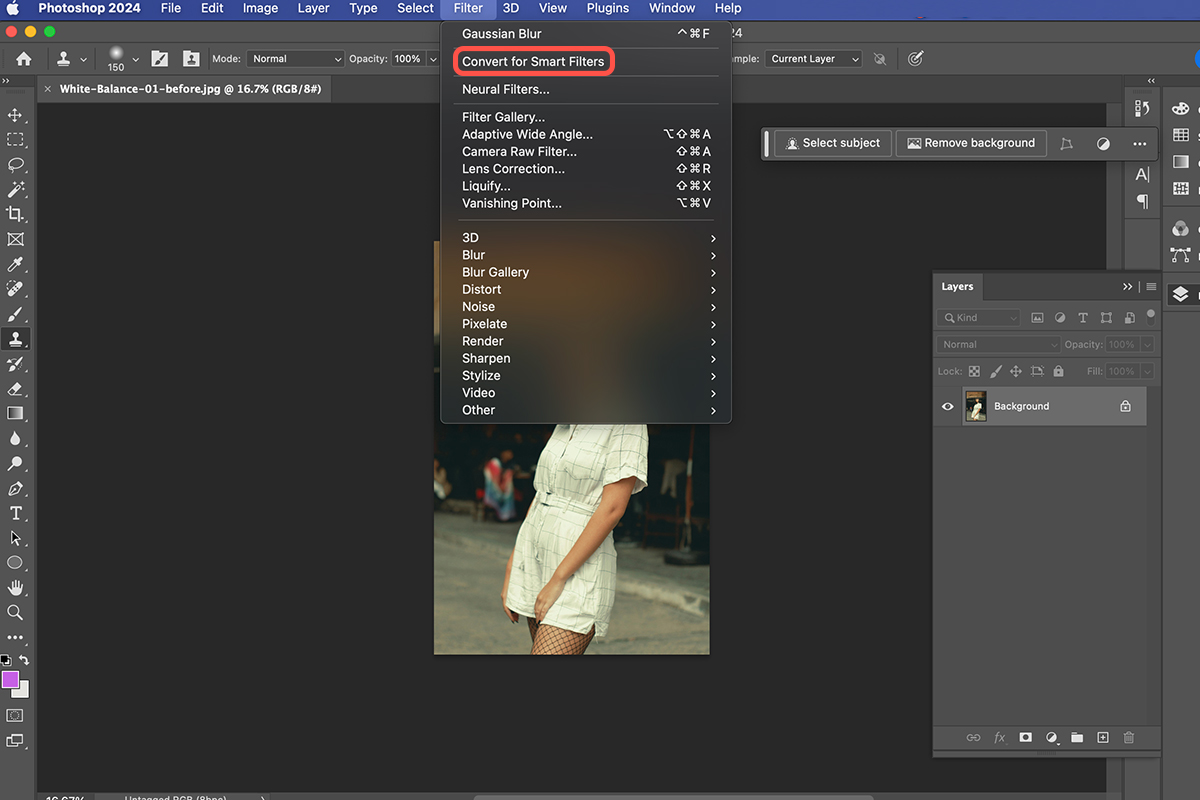
Before touching any settings, convert your layer to a Smart Object. Go to Filter, then Convert for Smart Filters.
This takes one click and changes what the whole edit is worth. With a Smart Object, the Camera Raw Filter is applied as a smart filter — meaning you can double-click it hours later and reopen the panel with every slider exactly where you left it. Without it, the adjustment is baked into the pixels and the only way to change your mind is to undo.
White balance in particular is something you often want to revisit, because how warm an image should be is a judgment that shifts once the rest of the edit is in place.
The Correction
-
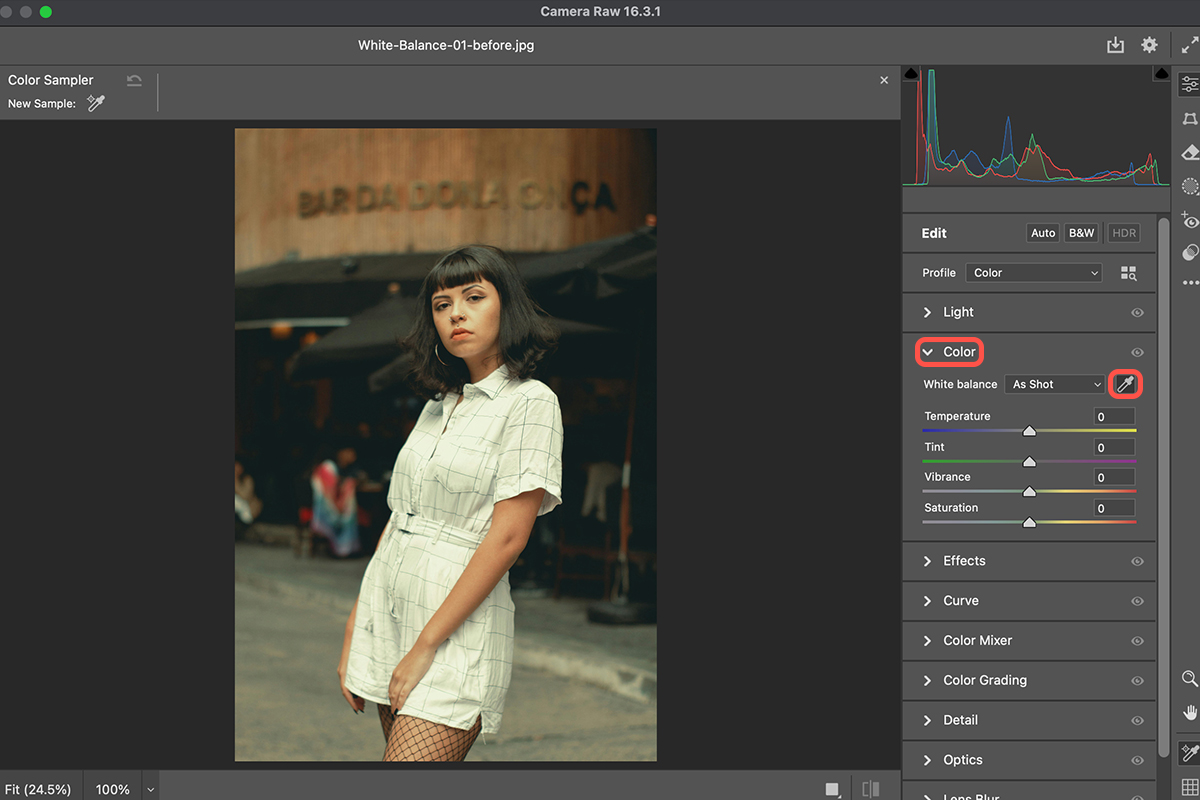
Go to Filter, then Camera Raw Filter
The full Camera Raw interface opens over your image.
-
Find the White Balance controls in the Color section
You get an eyedropper, a Temperature slider and a Tint slider.
-
Select the White Balance eyedropper
This is the fastest route to a correct starting point.
-
Click on something that should be neutral
Camera Raw analyzes that pixel and shifts the whole image so the sampled area becomes neutral gray.
-
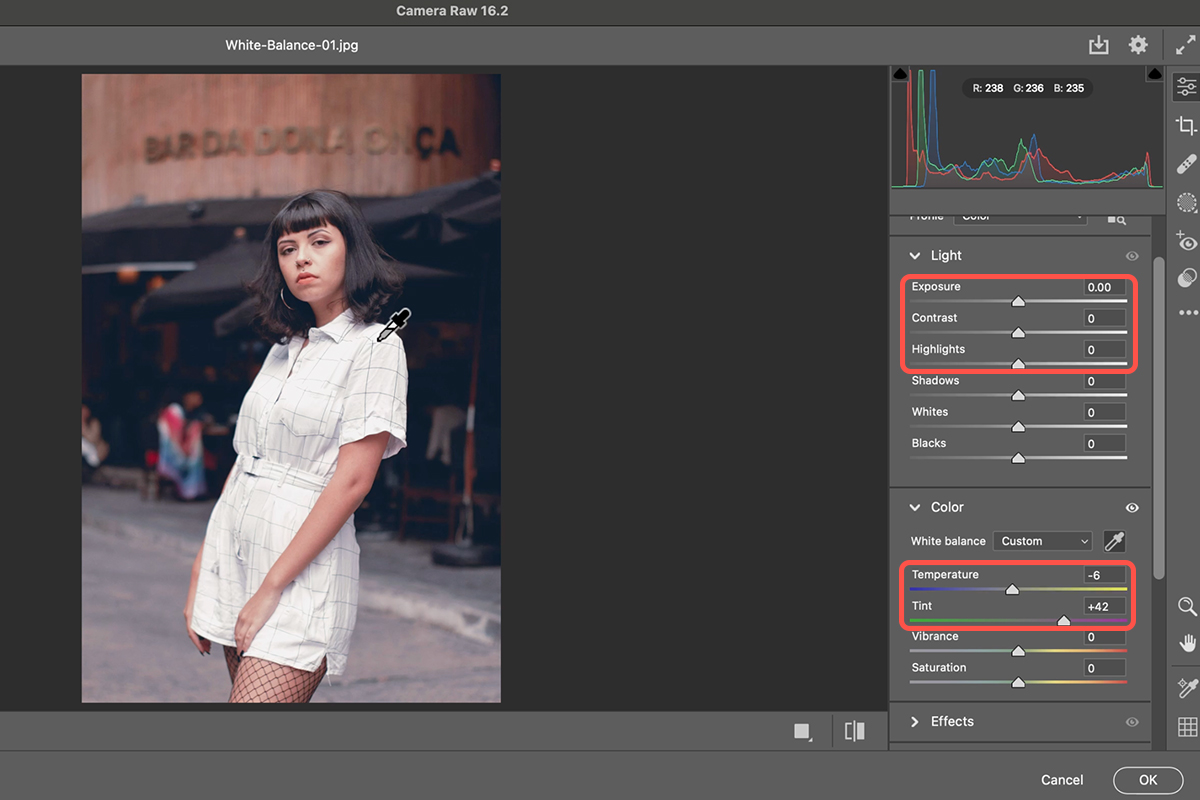
Fine-tune with Temperature and Tint
The eyedropper gets you close; your eye decides the rest.
-
Click OK
The adjustment appears as an editable smart filter beneath your layer.
Choosing Where to Click
This is the whole technique, and it is where results are won or lost.
Look for something genuinely neutral
Concrete, a gray pavement, asphalt, a white or gray garment, a plain wall, the white of an eye, a shadow on a neutral surface. You are looking for something you know should have no color of its own.
Avoid saturated colors
Clicking a red jacket tells Photoshop that red should be gray, and it will shift the entire image toward cyan to make that true. The result is dramatically wrong. The same applies to any strongly colored surface — grass, sky, skin.
Avoid blown highlights and crushed shadows
A pure white blown area carries no usable color information, and neither does a completely black shadow. Sample from a mid-tone where there is real data.
Try several spots
The eyedropper is instant and non-committal, so click around. Sample the pavement, then a shirt, then a wall, and watch how each one shifts the image. Comparing three or four attempts tells you far more than agonising over the first.
Fine-Tuning by Eye
Temperature runs blue to yellow. Drag right to warm the image, left to cool it.
Tint runs green to magenta. This is the one people forget, and it is often the reason an image still looks slightly off after the temperature is right — fluorescent lighting in particular pushes images green, and no amount of temperature adjustment will fix that.
Technically correct is not always what you want. A portrait usually benefits from being a touch warmer than neutral, and a winter landscape often reads better slightly cool. Use the eyedropper to establish what neutral actually is, then move deliberately away from it if the image calls for it.
While You Are In There
The Camera Raw Filter gives a JPEG the same Basic panel Lightroom offers on a raw file: Exposure, Contrast, Highlights, Shadows, Whites and Blacks.
Since you are already in the panel, recovering some highlight detail or lifting shadows here is often better than doing it later with adjustment layers — Camera Raw’s tone controls are well-behaved and, because everything is inside one smart filter, all of it stays editable together.
The limits of a JPEG still apply. There is far less latitude than a raw file, so push too far and you will see banding in skies and color breaking up in the shadows. Work in smaller amounts than you would on a raw file.
Checking the Result
Toggle the smart filter’s visibility off and on. Your eye adapts to a cast within seconds, so a direct before-and-after is the only reliable way to judge whether you have actually corrected it or simply moved it somewhere else.
A useful habit: look at the neutral areas rather than the subject. Skin tones are forgiving and your eye will accept a wide range as plausible. Concrete, white shirts and paper are not — if those look neutral, the image is balanced.
When There Is Nothing Neutral to Sample
Some images contain nothing that should be gray — a sunset, a scene lit entirely by one strong color, a studio shot on a colored backdrop. The eyedropper has nothing useful to work with.
In that case, set the Temperature and Tint by eye instead. Push the temperature well too warm, then well too cool, and note where it stops looking wrong in each direction; the right answer is usually near the middle of that range. It is slower than sampling, but it is more reliable than clicking hopefully on something that only looks neutral.
It is also worth remembering that a strong color cast is sometimes the photograph. Golden hour is meant to be warm, and neutralizing it removes the reason the shot was taken. Correct casts that are mistakes; keep the ones that are the point.
Download the Practice Files
The practice files for this tutorial include 2 sample images and 2 sample PSDs, so you can correct the same color casts and compare your result against the finished documents. Downloads are free with a PHLEARN account.
More Free Photo Editing Tutorials
If this was useful, these go further in the same direction:
- How to Create a Composite in Photoshop — building the layered file first.
- Compositing Highlights, Shadows and Reflections — making an added element sit in the scene.
- How to Use the Select and Mask Workspace — cleaner cut-outs, which compositing depends on.
- How to Create and Use Layer Masks — confining an effect to exactly where it belongs.
- How to Make Realistic Shadows in Photoshop — the shadow that anchors an object.
- How to Use Select Subject in Photoshop — the selection engine behind most cut-outs.
New Free Tutorials View All »








Enjoying This Free Tutorial? Go Further with PRO.
Unlock Full Sample Files, PSDs, and Hundreds of Masterclasses!

Download full project assets, original PSDs, and RAW images for every lesson
Unlimited access to our complete library of PRO Photoshop & Lightroom courses
Instant 4K Ultra HD streaming on all devices, anytime, anywhere
Full access to our entire library of Photoshop Actions, Presets, and LUTs
Flexible monthly and annual membership plans
Cancel anytime with zero hassle or commitments