
Download Assets
This tutorial includes 1 PDF guide. Downloads are free with a PHLEARN account.
- Download the sample files from every free tutorial on PHLEARN
- New free tutorials published every week
- One free account: sign up once, then download anything
Free PDF Guide · 3 Pages
This Tutorial as a Step-by-Step PDF
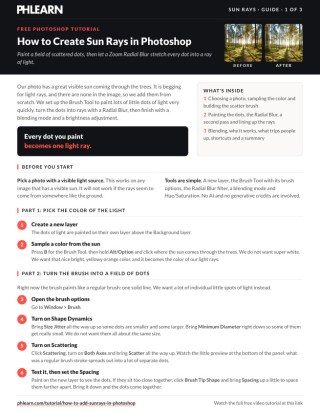
This guide walks through making sun rays from scratch: sampling the sun’s color, setting up a scatter brush in Window > Brush, painting dots, Filter > Blur > Radial Blur with Zoom at Amount 100, a second pass with Ctrl/Command+F, then Screen or Color Dodge and Ctrl/Command+U. Use it on any photo with a visible sun.
description
Convincing sun rays start as nothing more than a field of scattered dots. This tutorial sets up a brush with Shape Dynamics and Scattering to paint that random pattern, stretches it into streaks of light with the Zoom mode of Radial Blur, aligns the result precisely over the real light source, and blends it into the photo with Screen or Color Dodge.
Enjoying This Free Tutorial?
We publish a new free tutorial every week, each one with sample images and PSDs you can download and follow along with. Sign up and they land straight in your inbox, along with early word on sales, events and subscriber-only offers.
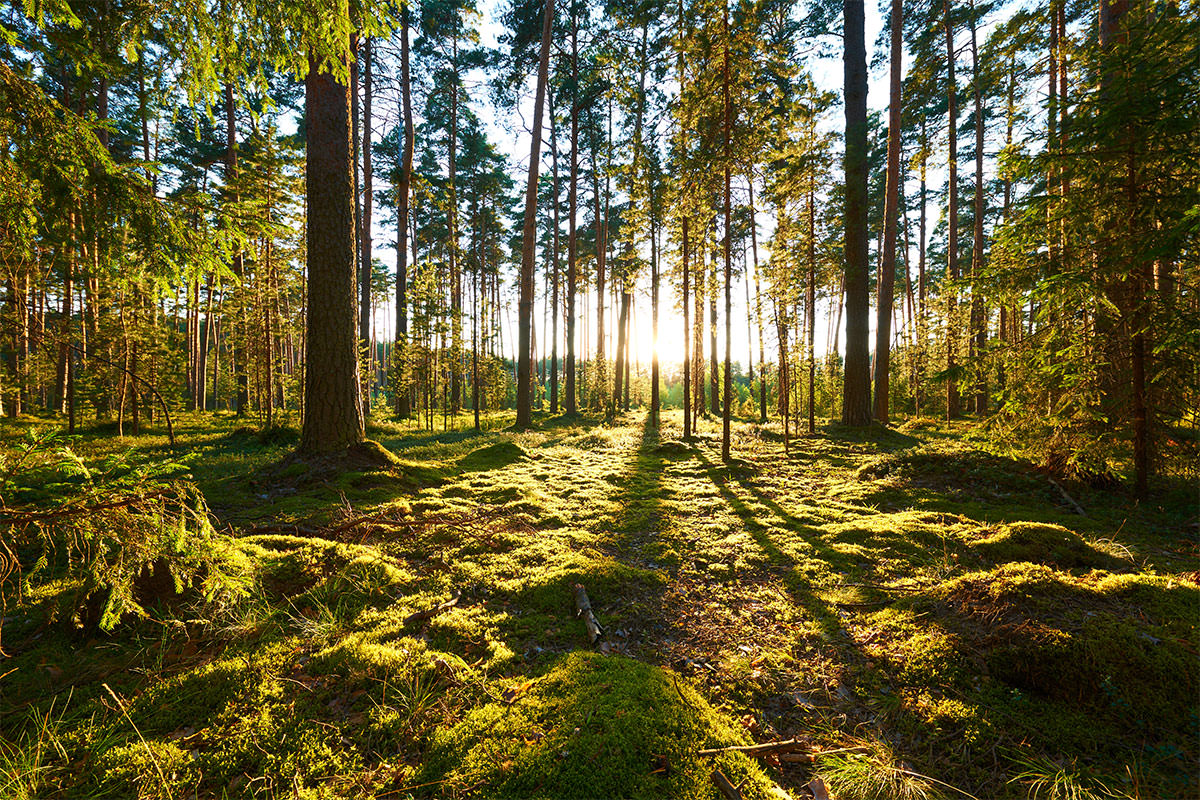
Light rays coming from a visible sun start out as nothing more than a scattered cluster of little dots painted with the brush tool, before a radial blur stretches them into convincing streaks of light. This tutorial covers building that dot pattern with Shape Dynamics and Scattering, turning it into rays with the Zoom radial blur, positioning it over the light source, and blending it into the photo.
Choosing an Image With a Visible Light Source
This effect only reads as believable when the photo already has an actual visible source of light, such as a sun shining through trees, for the rays to appear to come from.
-
Pick a Photo With a Clear Light Source
Choose an image that already shows a visible sun or bright light, ideally one partially obscured by something like trees, since it’s already suggesting light rays.
Sampling a Color From the Light Source
Rather than pure white, sampling an actual color from the glow around the light source gives the eventual rays a more natural, warm tone.
-
Create a New Layer
Add a new layer above the background to paint the light dots onto.
-
Sample a Color From the Light
Select the Brush tool, then hold Alt/Option and click on the bright yellow-orange glow around the light source to sample that color as the foreground.
Building a Scattered Dot Pattern With Brush Settings
Shape Dynamics and Scattering together turn a single, uniform brush stroke into a wide field of randomly sized, randomly placed dots of light.
-
Open the Brush Settings Panel
Go to Window > Brush to open the Brush Settings panel.
-
Enable Shape Dynamics and Raise Size Jitter
Turn on Shape Dynamics and raise Size Jitter, then lower Minimum Diameter so the dots vary between very small and larger sizes.
-
Enable Scattering on Both Axes
Turn on Scattering, check Both Axes, and raise the Scatter amount to spread a single brush stroke into many separated dots.
-
Adjust Spacing Between Dots
Raise the Spacing value in the Brush Tip Shape section to space the dots farther apart, or lower it to bunch them closer together.
Why Random Scattering Matters More Than a Perfect Pattern
A brush stroke without scattering paints a solid, obviously artificial line, which looks nothing like the way real light actually radiates from a source. Heavy scattering breaks the dots up into a random, uneven spread, which is exactly what keeps the finished effect from looking like it was mechanically produced in Photoshop.
Painting the Dots of Light Around the Source
Painting more densely right around the light source, and letting the pattern taper off elsewhere, concentrates the eventual light rays exactly where they should be strongest.
-
Paint Loosely Across the Image
Paint with the customized brush across the areas where light rays should appear, letting the scattering settings create natural-looking randomness.
-
Cluster Extra Dots Around the Light Source
Paint a denser cluster of dots directly around the actual light source, since that’s where the strongest rays should originate.
Turning the Dots Into Light Rays With a Radial Blur
The Zoom option in Radial Blur is what actually stretches each small dot outward into a streak, turning the scattered pattern into believable rays of light.
-
Open Radial Blur
With the layer of painted dots selected, go to Filter > Blur > Radial Blur.
-
Choose Zoom and Raise the Amount
Select Zoom as the blur method and raise the Amount toward 100 to stretch the dots into long light rays.
-
Set the Blur Center to the Light Source
Drag the blur center point in the preview box to match where the actual light source sits in the image, such as the center or a corner.
-
Apply the Blur
Click OK to apply the radial blur and turn the dot pattern into light rays.
Why Repeating the Same Blur Is Faster the Second Time
Manually reopening the Radial Blur dialog and resetting Zoom, Amount, and the blur center for a second dot layer would waste time repeating settings that already worked well the first time. Pressing Cmd/Ctrl+F instantly reapplies the exact same Radial Blur settings to a new layer, making it quick to try a second, differently sized set of rays for comparison.
Combining Multiple Blur Passes for Variation
Repeating the same Radial Blur on a second dot layer, using a different dot size, produces a second set of rays that can be layered with the first for more visual variety.
-
Create a Second Dot Layer
Add another new layer and paint a second pattern of dots, using smaller or larger dots than the first layer.
-
Reapply the Same Radial Blur
Press Cmd/Ctrl+F to reapply the same Radial Blur settings instantly to the new layer.
-
Compare or Combine Both Ray Layers
Turn both light ray layers on together, or use just one, depending on which combination looks best.
Positioning the Rays Precisely Over the Light Source
Because the center of the radial blur doesn’t always land exactly on the true light source, transforming the ray layers afterward lines them up correctly.
-
Select the Ray Layers
Select the light ray layer or layers that need repositioning.
-
Transform to Align With the Light Source
Press Cmd/Ctrl+T and move or stretch the layer so the rays’ center lines up exactly with the actual light source in the photo.
Why the Rays Must Be Centered Exactly on the Light Source
Light rays that appear to radiate from somewhere other than the actual light source, such as an empty patch of sky instead of the sun itself, immediately break the illusion. Taking the extra step to transform and align the ray layer’s center precisely over the real light source is what keeps the effect looking physically believable rather than obviously pasted in the wrong spot.
Merging and Blending the Rays Into the Photo
Merging the ray layers together and switching their blend mode integrates the light rays with the existing colors and tones of the photo instead of sitting flatly on top.
-
Adjust Opacity Before Merging
Lower the opacity of one ray layer slightly if using two together, for a more balanced combined result.
-
Merge the Ray Layers
Shift-click to select both ray layers and press Cmd/Ctrl+E to merge them into one.
-
Change the Blend Mode
Change the merged layer’s blend mode from Normal to something like Screen, Overlay, or Color Dodge, comparing each option to see which integrates best.
-
Adjust Brightness and Color With Hue/Saturation
Press Cmd/Ctrl+U to bring up Hue/Saturation, then raise Lightness, adjust Saturation, or shift Hue to fine-tune the color and brightness of the finished light rays.
Why This Approach Works
Building the initial pattern from scattered, randomly sized dots rather than drawing rays directly is what gives the finished effect its natural, uneven quality, since real light rarely radiates in perfectly uniform lines. The Zoom option in Radial Blur is specifically what stretches those dots outward into streaks, which is why it’s chosen over the Spin option that instead rotates them around a center point. Centering the rays precisely on the actual light source, and blending them with a mode like Screen or Color Dodge rather than leaving them at Normal, is what ties the whole effect back into the existing light and color of the photo.
Final Thoughts
Every step in this technique, from the scattered brush dots to the radial blur to the final blend mode, is simple on its own, but the combination is what turns an ordinary sunlit photo into one with dramatic visible light rays. The same dot-and-blur approach works on any image with a clear light source, whether it’s a sun, a window, or a bright lamp.
Quick Reference: Keys, Menus and Settings
- Sample the lightBrush tool B, Alt/Option-click the glow around the sun
- Scatter the dotsWindow > Brush: Shape Dynamics (Size Jitter up, Minimum Diameter down), Scattering on Both Axes
- Space the dotsBrush Tip Shape: raise Spacing to spread them out
- Make the raysFilter > Blur > Radial Blur: Zoom, Amount 100, center on the light source
- Repeat the blurCmd/Ctrl + F on a second layer of dots
- Line up and mergeCmd/Ctrl + T to center on the sun; Shift-click, Cmd/Ctrl + E
- Blend and tuneScreen, Overlay or Color Dodge; Cmd/Ctrl + U for Lightness and Saturation
No AI, no generative credits.
Free Downloads
Take the Guide With You
Get the PDF guide with each step, from the scatter brush settings and the Zoom Radial Blur to lining up and blending the rays. Free with a PHLEARN account.
Adding Sun Rays: Common Questions
What kind of photo works for sun rays?
One with a visible light source, like the sun coming through trees in the video. Rays that come from somewhere with no light, like the ground, will never look real.
What color should the rays be?
Sample it from the photo rather than using pure white. With the Brush tool, hold Alt/Option and click the bright yellow-orange glow around the sun.
How do I paint lots of little dots at once?
Open Window > Brush. Turn on Shape Dynamics with Size Jitter all the way up and Minimum Diameter down, then Scattering with Both Axes and the scatter amount all the way up.
My dots are too close together. How do I spread them out?
Raise Spacing in Brush Tip Shape. Lower it to bunch the dots together.
Where should I paint the dots?
Across the area where rays should appear, with an extra cluster right around the sun so the strongest rays come from there. Each dot becomes a ray.
How do the dots become light rays?
Go to Filter > Blur > Radial Blur, choose Zoom (not Spin), raise the Amount to 100 and drag the blur center to where the light source is in the photo.
How do I apply the same blur to another layer?
Paint a second layer of dots, larger or smaller for variety, and press Cmd/Ctrl + F to repeat the last filter with the same settings.
The rays do not start at the sun. How do I fix that?
Select the ray layers and press Cmd/Ctrl + T to move or stretch them until the center sits on the light source. A temporary black layer underneath makes the center easier to see.
Which blend mode should I use for the rays?
Merge the ray layers with Cmd/Ctrl + E and try Screen, Overlay and Color Dodge. Aaron expected Screen but chose Color Dodge for this photo. Press Cmd/Ctrl + U to adjust Lightness, Saturation or Hue.
Is there a free download?
Yes, with a free PHLEARN account. You get 1 PDF guide that walks through the scatter brush settings, the Zoom Radial Blur, positioning and blending the rays.
Master Photoshop, Lightroom and Photography
Join PHLEARN PRO for $12.99 a month or $99.99 a year. Cancel anytime, with a 100% money-back guarantee.