
Download Assets
This tutorial includes 5 Lightroom profiles and 1 PDF guide. Downloads are free with a PHLEARN account.
- Download the sample images and PSDs from every free tutorial on PHLEARN
- New free tutorials published every week
- One free account — sign up once, then download anything
Free PDF Guide · 3 Pages
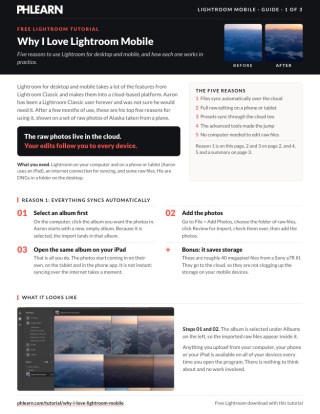
This Tutorial as a Step-by-Step PDF
The guide walks through all five reasons: select an album and use File > Add Photos, edit in Light, Color and Effects on the iPad, export with Save to Camera Roll, create a preset that syncs, heal dust spots, add a graduated filter and press and hold for the before. Keep it next to your iPad.
description
Lightroom for desktop and mobile rebuilds Lightroom around the cloud, so your photos, edits, and presets follow you between computer, phone, and tablet instead of living on one machine. Here are the five reasons it earned a permanent spot in the workflow — automatic sync across devices, real raw editing on a phone or tablet, presets that travel with you, the advanced tools Lightroom Classic users already know, and importing straight from an SD card with no computer involved.
Enjoying This Free Tutorial?
We publish a new free tutorial every week, each one with sample images and PSDs you can download and follow along with. Sign up and they land straight in your inbox, along with early word on sales, events and subscriber-only offers.


Why I Love Lightroom for Desktop and Mobile
Lightroom for desktop and mobile takes a lot of what makes Lightroom Classic great and rebuilds it around the cloud, so your photos, edits, and presets follow you between your computer, phone, and tablet instead of living on one machine. After using it for a few months, here are the five reasons it’s earned a permanent spot in the workflow — along with exactly how each one works.
Getting Started with Lightroom for Desktop and Mobile
Lightroom for desktop and mobile isn’t a stripped-down companion app to Lightroom Classic — it’s a full raw editor built from the ground up around cloud storage. That distinction is what makes every reason below possible, so it’s worth understanding before diving into the specific features.
Automatic Cloud Sync Across All Your Devices
The first reason is the simplest to appreciate: every photo you add to Lightroom syncs automatically over the cloud, with no manual step required.
-
Import Photos on Your Computer
Create an album, go to File > Add Photos, and bring in your raw files. If you had an album selected before importing, the photos land directly inside it.
-
Watch Them Appear on Your Other Devices
Open the same album on your phone or tablet. Within moments — the exact timing depends on your internet connection — the same photos appear there automatically, with no export or transfer step on your part.
Why This Doesn’t Fill Up Your Phone’s Storage
Even with large raw files — Aaron’s are roughly 40 megapixel images from a Sony a7R III — your mobile device isn’t storing the full-resolution originals locally. The files live in the cloud, so you get access to every photo on every device without eating into your phone’s or tablet’s storage the way a local copy would.
Full Raw Editing Right on Your Phone or Tablet
The second reason is that the editing on mobile isn’t a watered-down version of raw editing — it’s the real thing, applied directly to the raw files stored in the cloud.
-
Open the Light Panel and Adjust the Basics
Tap into an image and open the Light tab to adjust exposure and bring the highlights down. Aaron jumps into the Effects tab early for some Dehaze, then comes back to Light to set the exposure, shadows and blacks. A small boost in contrast alone can noticeably improve the image’s punch.
-
Add Color and Effects
Use the color temperature slider to warm the image a touch, then go back into the Effects tab to add a little clarity and texture, plus some sharpening.
Confirming It’s Really Raw Data
Pinch to zoom into the image after editing and you can see the actual raw sensor detail rather than a compressed preview — confirmation that the adjustments are being applied to genuine raw image data, not a lightweight proxy.
Because the edit syncs, you can pick it up on the computer. Open the same photo on the desktop and every slider sits exactly where you left it on the iPad. Aaron lifts the blacks, adds clarity and exposure and lowers the highlights there, goes back to grid view, and the change syncs back to the iPad.
To get the finished photo onto your device, tap the export icon and choose Save to Camera Roll at the maximum size available. Lightroom pulls the photo down from the cloud, applies your changes and saves a JPEG, ready for Instagram.
Presets That Sync Through the Cloud Too
The third reason follows naturally from the first: it’s not just your photos that sync automatically, it’s your presets as well.
-
Create a Preset from Your Edit
Once you’ve dialed in an edit you like, open the preset menu, choose Create Preset, name it, and file it into a new or existing group.
-
Apply It on Another Device
Switch to your phone or tablet and the same preset group is already there. Apply the preset to a new image, then fine-tune individual sliders like exposure or contrast for that specific photo.
Advanced Editing Tools You Already Know from Lightroom Classic
The fourth reason matters most for longtime Lightroom Classic users: the advanced tools that power users rely on made the jump to the mobile-friendly platform too, rather than being left behind for a simplified feature set.
-
Heal Dust Spots on Your Tablet
Zoom into a spot where sensor dust shows up in the sky or another flat area, select the healing tool, and paint right over the spot to remove it. The healing tool can heal and clone, right on the tablet. Check for more spots, then tap Done.
Selective Edits with the Graduated Filter
Beyond global adjustments, you can target specific parts of an image using tools like the graduated filter, radial filter, or brush — the same selective-editing toolkit from Lightroom Classic. Dragging a graduated filter up from the bottom of a frame, for example, lets you edit just the lower portion of a landscape without touching the sky above it. Inside the filter, Aaron adds a little contrast in Light, lifts the shadows slightly and brings the exposure down, then in Color adds saturation to bring the blues into the shadows.
To check your work, tap Done, then press and hold on the photo to see the before, straight out of camera. Let go to see the edit.

Editing Raw Files Without Ever Touching a Computer
The fifth and final reason is the one with the biggest practical impact for working photographers: you no longer need a computer in the loop to edit raw files at all.
Importing Directly from an SD Card on Location
A USB-C card reader plugs directly into the port on a tablet, letting you import raw photos straight from an SD card without a computer anywhere in the chain. Many modern cameras also have built-in Wi-Fi, so full-resolution images can transfer wirelessly straight to a phone or tablet for editing on location — a workflow that simply wasn’t possible when raw editing required a desktop machine.
Why This Approach Works
What makes cloud-based Lightroom worth adopting alongside — or instead of — Lightroom Classic isn’t any single feature, it’s that the cloud sync ties every other benefit together. Because the raw files themselves live in the cloud rather than on one device, edits made on a tablet apply to the same underlying image a desktop sees, presets built on a computer are available on a phone the moment they’re saved, and even the process of getting photos into the software in the first place no longer depends on a computer being present. That’s a fundamentally different model from a traditional raw workflow, where files, presets, and edits are all tied to whichever single machine holds the library. For anyone starting from scratch, this beginner’s guide to Lightroom Mobile is the natural place to build that foundation before layering on more advanced techniques.
Final Thoughts
The common thread through all five reasons is that Lightroom for desktop and mobile removes the assumption that raw editing has to happen at a desk. Cloud sync keeps every device current automatically, mobile editing applies the same real adjustments as desktop, presets travel with you, the advanced tools power users depend on made the jump, and photos can now get into the system without a computer ever entering the picture. For a deeper walkthrough of the whole platform from start to finish, The Ultimate Guide to Lightroom for Desktop & Mobile covers the platform end to end — it’s the resource to reach for once these five reasons have you sold on making the switch, and it builds on everything covered as Lightroom for Desktop and Mobile continues to expand.
Quick Reference: Menus and Settings
- Add photosSelect the album, then File > Add Photos > Review for Import
- Edit on the iPadLight: Exposure, Highlights, Shadows, Blacks, Contrast; Color: Temperature; Effects: Dehaze, Clarity, Texture; then some sharpening
- Export to the deviceExport icon > Save to Camera Roll, maximum size available (JPEG)
- Save a presetPresets > small menu > Create Preset, name it and pick a group; it syncs
- Fix and targetHealing tool for dust; plus icon > graduated filter, radial filter or brush
- Before and afterTap Done, then press and hold on the photo
- No computerUSB-C card reader into the iPad, or camera Wi-Fi
Free Downloads
Get the Presets and the Guide
Get the five Cinematic Lightroom profiles to try on your own photos, plus the 3-page PDF guide to all five reasons. Free with a PHLEARN account.
Lightroom Mobile: Common Questions
How do photos from my computer get to my iPad?
Select an album on the computer, go to File > Add Photos, click Review for Import and add the photos. Open the same album on the iPad or phone and they come in on their own. It isn’t instant, since syncing over the internet takes a moment.
Will raw files fill up my phone’s storage?
No. The photos go to the cloud, so they aren’t clogging up the storage on your mobile devices. Aaron’s are roughly 40 megapixel files from a Sony a7R III.
Is editing on mobile real raw editing?
Yes. Lightroom saves your small edits and applies them to the raw photo in the cloud. Pinch to zoom after editing and you are looking at the actual raw photo at full resolution.
Do edits made on the iPad show up on my computer?
Yes. Open the photo on the desktop and every slider is exactly where you left it on the iPad. Tweak it there, go back to grid view, and the change syncs back to the iPad.
How do I save an edited photo to my phone or iPad?
Tap the export icon and choose Save to Camera Roll at the maximum size available. Lightroom pulls the photo down from the cloud, applies your edits and saves a JPEG, ready for Instagram.
Do my presets sync to Lightroom mobile?
Yes. On the computer, go to Presets, click the small menu and choose Create Preset, then name it and put it in a group. In almost no time the group shows up in Presets on the iPad, ready to apply and fine-tune for each photo.
Can I remove sensor dust spots in Lightroom mobile?
Yes. Zoom in on the spots, pick the healing tool, which can heal and clone, and paint right over each one. Tap Done when you’re finished.
Can I edit just part of a photo on mobile?
Yes. Tap the plus icon and add a graduated filter, a radial filter or a brush. Aaron drags a graduated filter up from the bottom, then adjusts Light and Color inside it. Tap Done, then press and hold on the photo to compare it with the before.
Can I edit raw photos without a computer?
Yes. Put your SD card in a USB-C card reader, plug it into the port on the iPad and import the raw photos straight into Lightroom. Many cameras with built-in Wi-Fi can also send full-resolution pictures wirelessly to the iPad.
Are the presets free?
Yes, with a free PHLEARN account. You get 5 Lightroom profiles and 1 PDF guide: five Cinematic profiles to try on your own photos and a 3-page guide to the five reasons.
From the Magazine View all
Stories, interviews and guides for photographers, new every week.
 EditingLightCraft vs Lightroom: I Edited the Same RAW Files in BothThe free clone on the same RAW files: what matches, what breaks and who should switch.
 InspirationRare Historical Photos: 13 of the Rarest Pictures Ever TakenFrom the earliest surviving picture of a person to the last passenger pigeon: who took each one and why it survives.
 EditingArtCraft: Photoshop Cloned by AI in Two Weeks. Is It Legal?ArtCraft cloned Photoshop and Lightroom with AI and gave them away. Any good? Legal? Safe?
Master Photoshop, Lightroom and Photography
Join PHLEARN PRO for $12.99 a month, or $99.99 a year (save 36%). Cancel anytime, with a 100% money-back guarantee.