
Download Sample Images
Download Assets
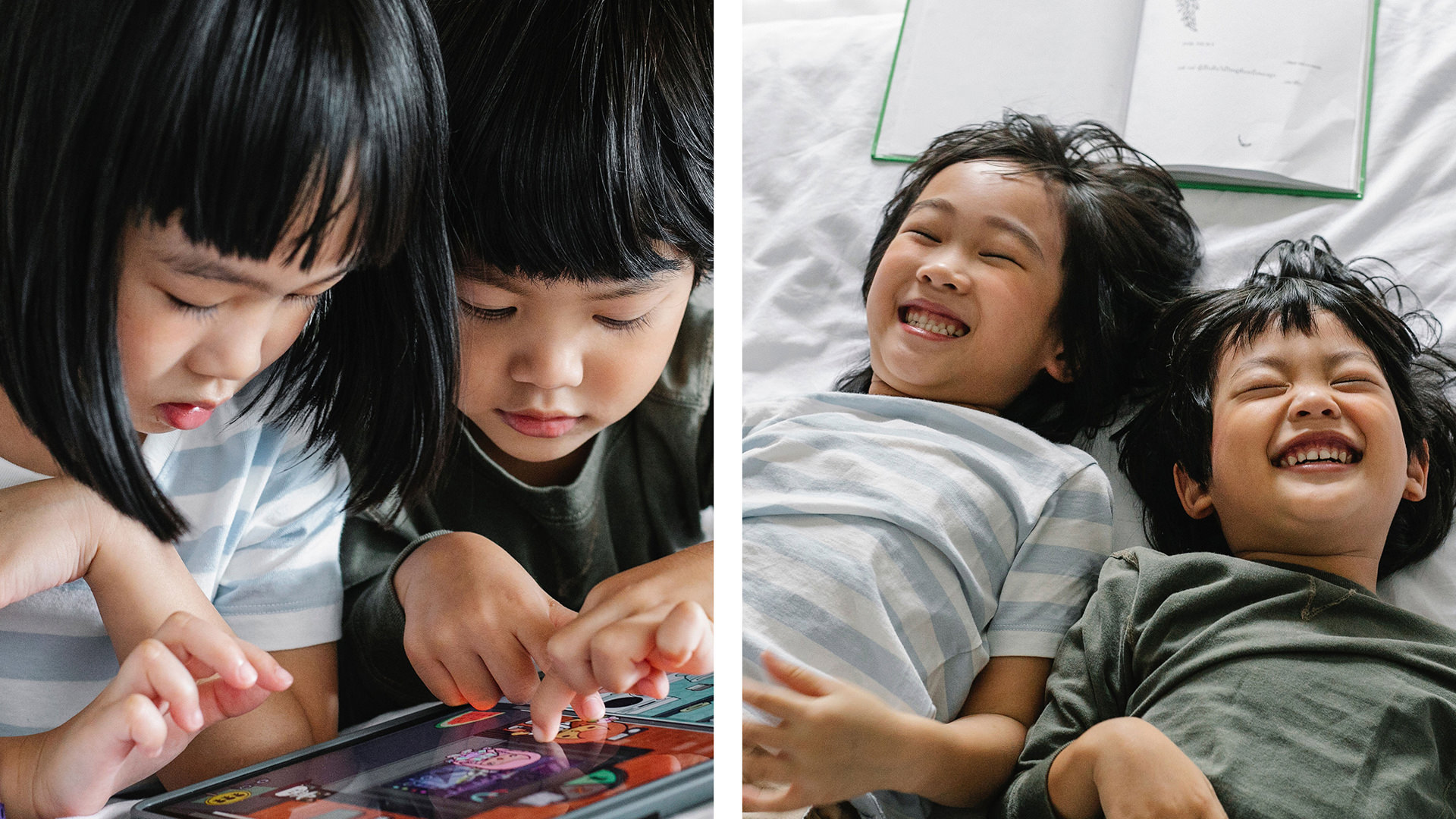
This tutorial includes 2 sample images, 1 sample PSD and 1 PDF guide. Downloads are free with a PHLEARN account.
- Download the sample images and PSDs from every free tutorial on PHLEARN
- New free tutorials published every week
- One free account — sign up once, then download anything
Free PDF Guide · 3 Pages
This Tutorial as a Step-by-Step PDF
The guide walks through the whole build: drag both photos into one document, fill a white divider with Edit > Fill and center it with Ctrl/Command+A and the align button, use Select > Inverse for the border, mask the right photo, then unlink the mask to compose. Keep it next to your keyboard.
description
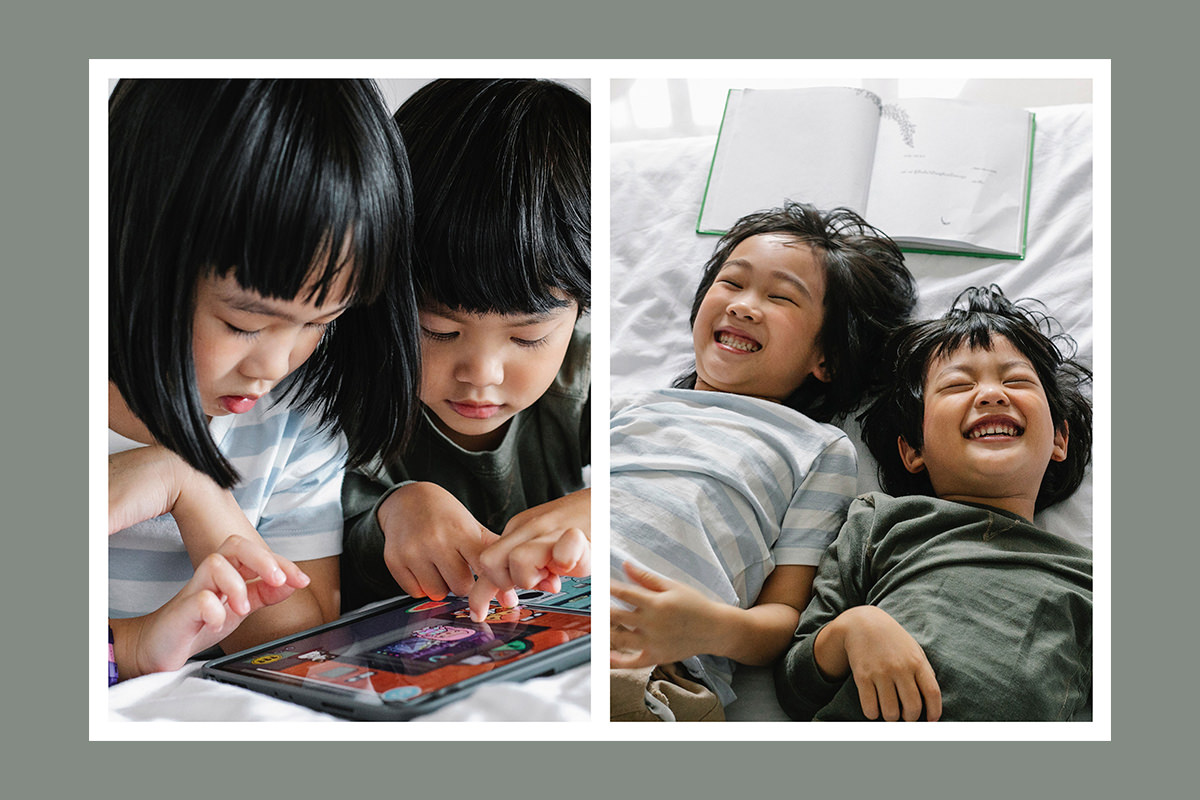
Capturing and editing photos is one thing, but figuring out how to put them together and display them can be a fun project all its own. Learn how to create a quick and easy diptych-style photo collage in Photoshop!
And if you don’t want to go through the process of making a template from scratch, just download the free sample PSD and just add your own images.
Enjoying This Free Tutorial?
We publish a new free tutorial every week, each one with sample images and PSDs you can download and follow along with. Sign up and they land straight in your inbox, along with early word on sales, events and subscriber-only offers.
CREATE AN EASY PHOTO COLLAGE
Two Photographs, One Frame, and a Template You Keep
A diptych is two images presented as a single piece — a format that goes back centuries in painting and works because the pair says something neither photograph manages alone.
Building one in Photoshop takes three steps and about five minutes. More usefully, what you end up with is a reusable template: once the borders and masks exist, swapping in a new pair takes seconds.
Choose Two Photographs That Belong Together
Worth getting right before you open Photoshop, because the format only works when the pairing does.
Look for images that tell one story between them — two frames from the same session, a wide shot and a detail, two moments a few seconds apart. Consistent lighting and color matter, since the two sit inches from each other and any mismatch in white balance or exposure is glaring.
What generally doesn’t work is two unrelated favourites. Without a connection the viewer reads them as two photographs that happen to share a border, and the format adds nothing.
Step One: The Center Divider
-
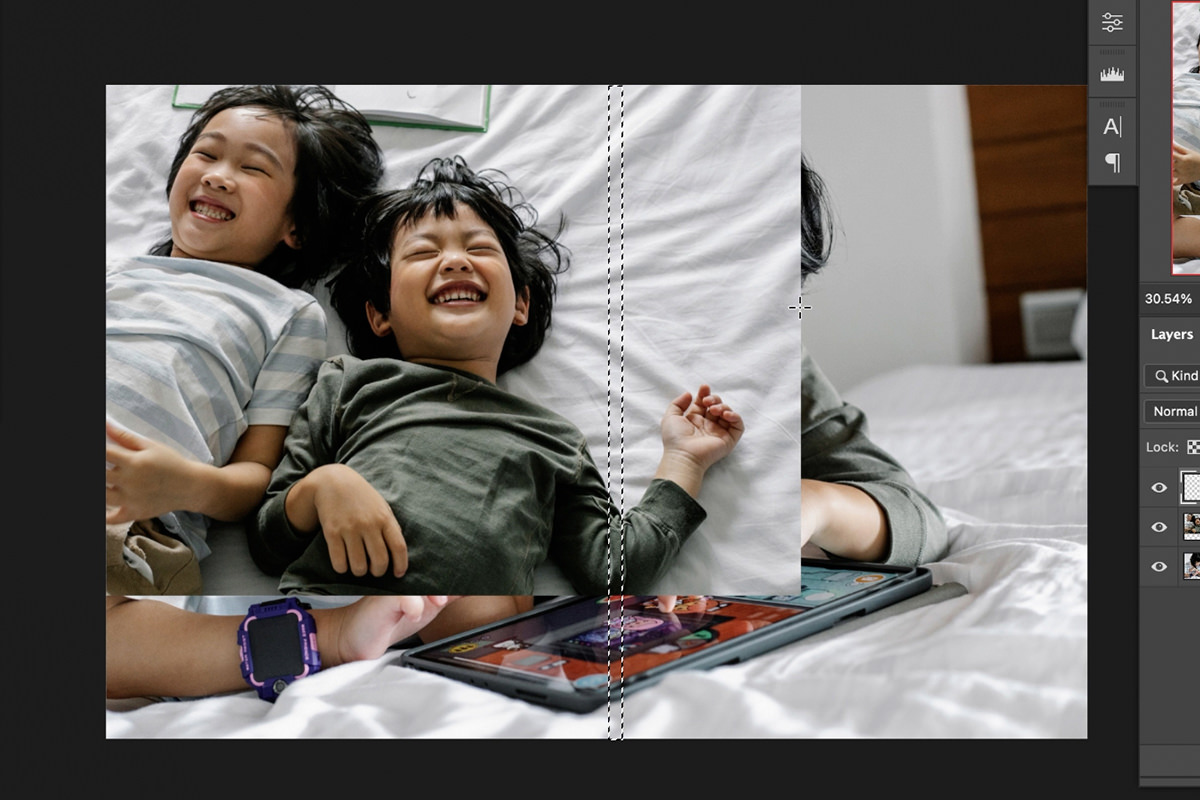
Bring both images into one document
Move tool, drag from one document tab to the other.
-
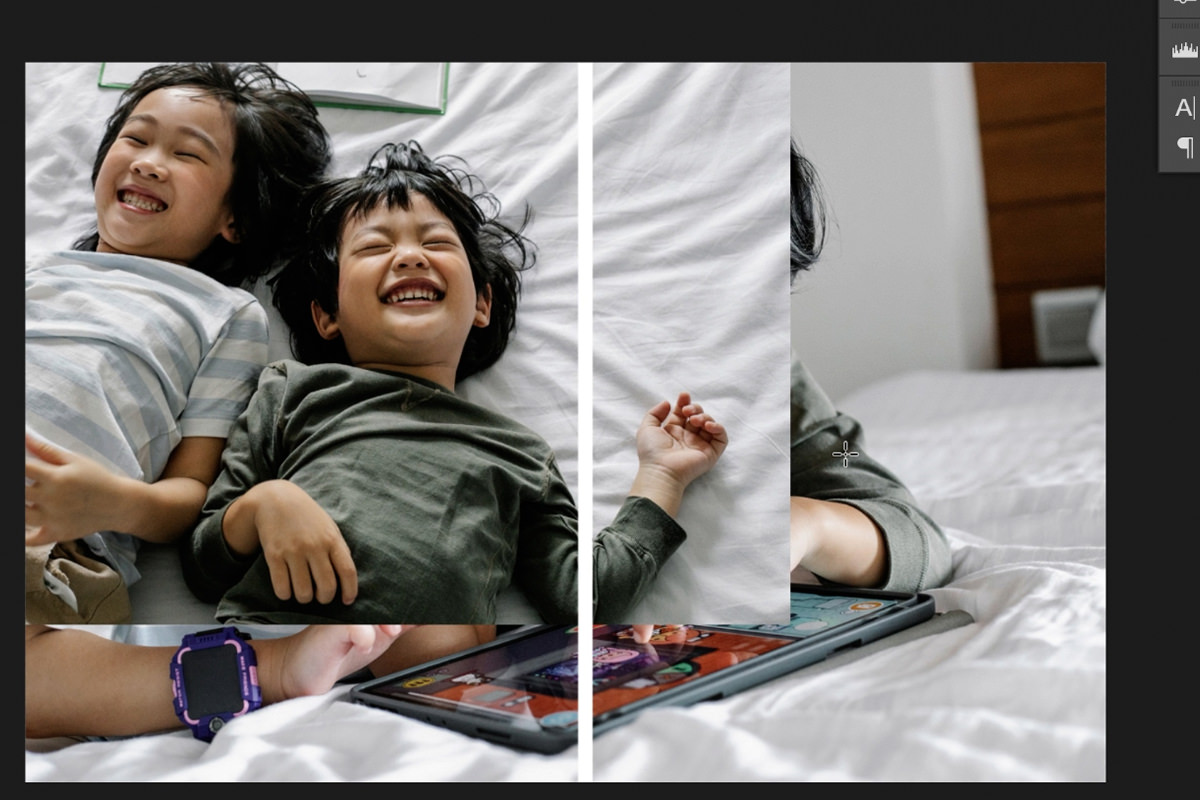
Create a new layer and draw a vertical bar
Rectangular Marquee, roughly down the middle. Position doesn’t matter yet.
-
Fill it with white
Edit › Fill › White.
-
Center it exactly
Press Cmd/Ctrl + A to select the whole canvas, take the Move tool, and click Align Horizontal Centers in the options bar. The bar snaps to the exact center of the document.
That alignment trick is the useful part and it works far beyond this: select the whole canvas first and the align buttons align to the document rather than to other layers. No guessing, no rulers, no nudging with arrow keys.
It also means the divider is genuinely centered, which matters here more than almost anywhere — the eye detects an off-center split in a symmetrical layout immediately.
Step Two: The Outer Border
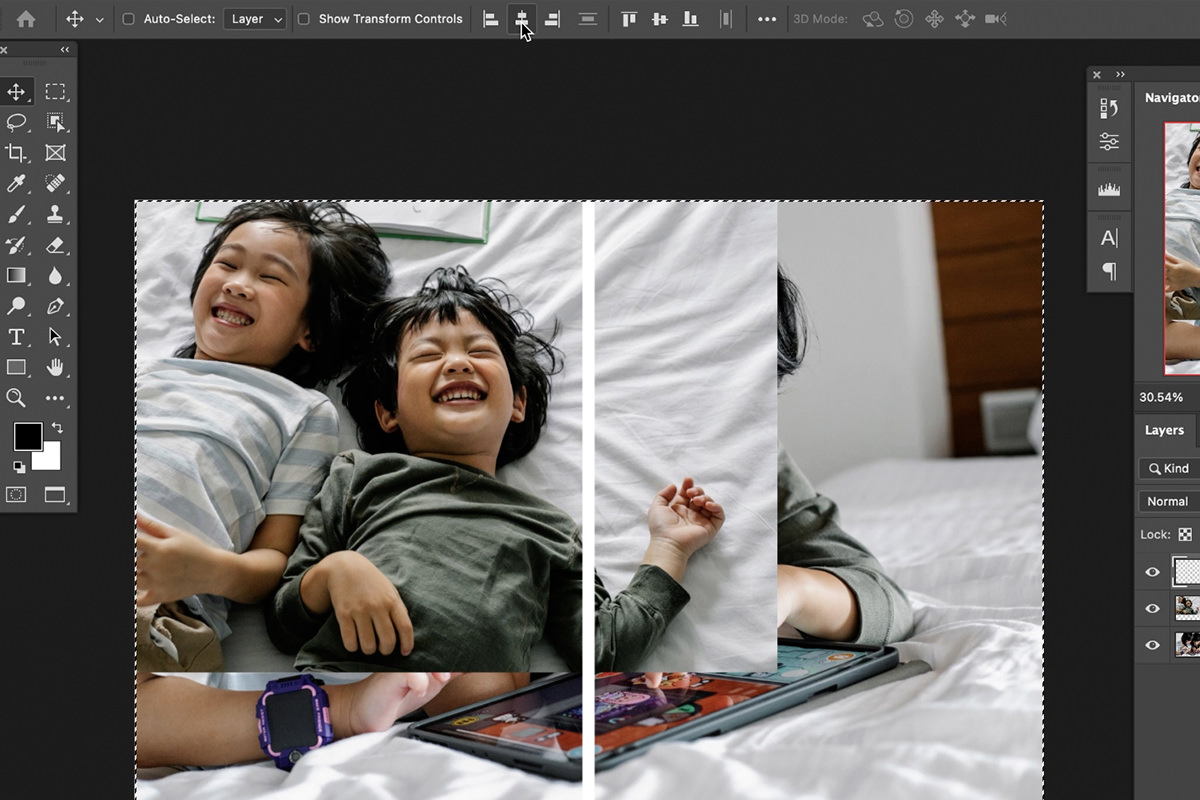
The frame around the outside is made by selecting the inside and inverting.
-
New layer, and marquee the inner area
Draw a rectangle a little inside the document edges. The gap you leave becomes the border width.
-
Select › Inverse
Now everything outside that rectangle is selected — the border itself.
-
Fill with white
Edit › Fill › White.
Selecting the easy shape and inverting is consistently faster than trying to draw a frame directly, and it’s a habit worth having: whenever a shape is awkward to select, select its opposite and invert.
Keep the outer border and the center divider roughly the same width. Unequal gaps look like a mistake rather than a decision.
Step Three: Place the Photos
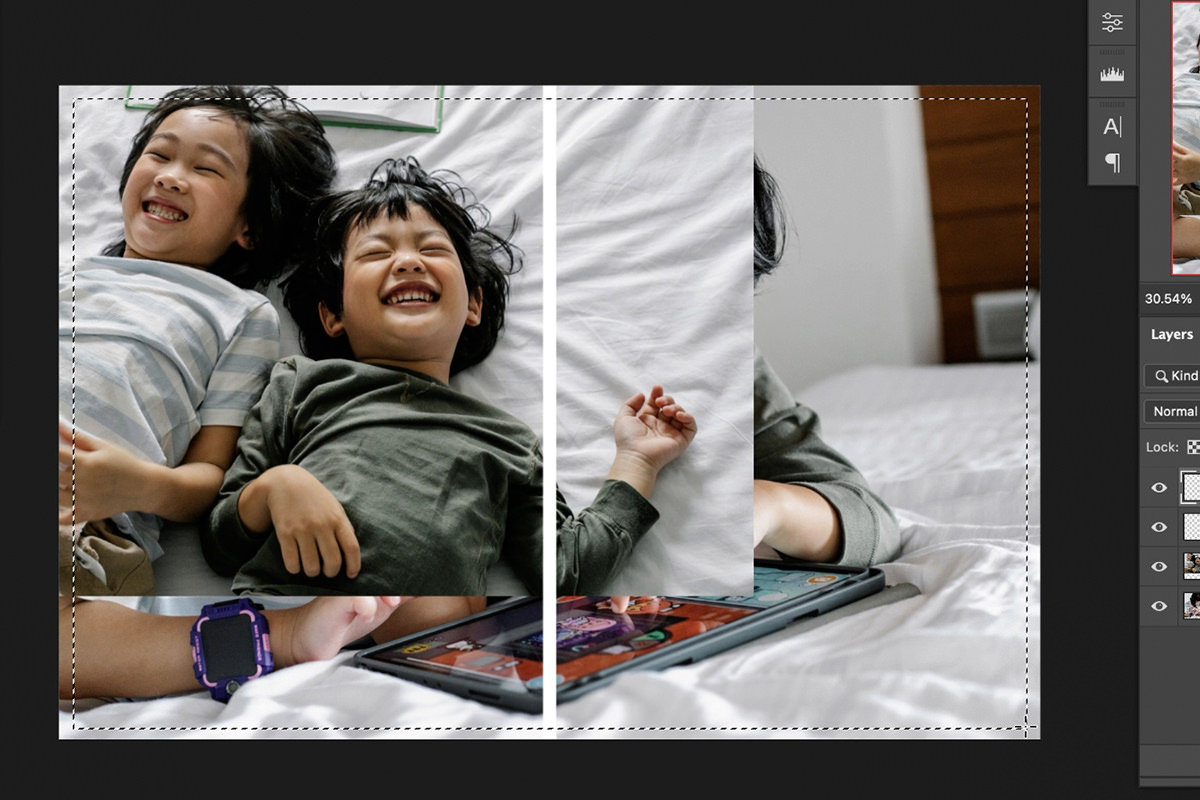
-
Position the first image roughly where you want it
It will overspill into the other half. That’s fine.
-
Marquee its half of the frame
Select the area it should occupy.
-
With that layer selected, click the layer mask icon
The selection becomes a mask and the photo is confined to its half.
-
Unlock the background layer for the second image
Double-click the Background layer to convert it to a normal layer, then use the Move tool to move it over to the left. In the video it stays the bottom layer and gets no mask of its own: the masked right photo and the two white layers sit above it and cover anything that spills past its half. If your left photo sits above the other one, mask it to the left half the same way.
Unlink the Mask to Compose Inside the Frame
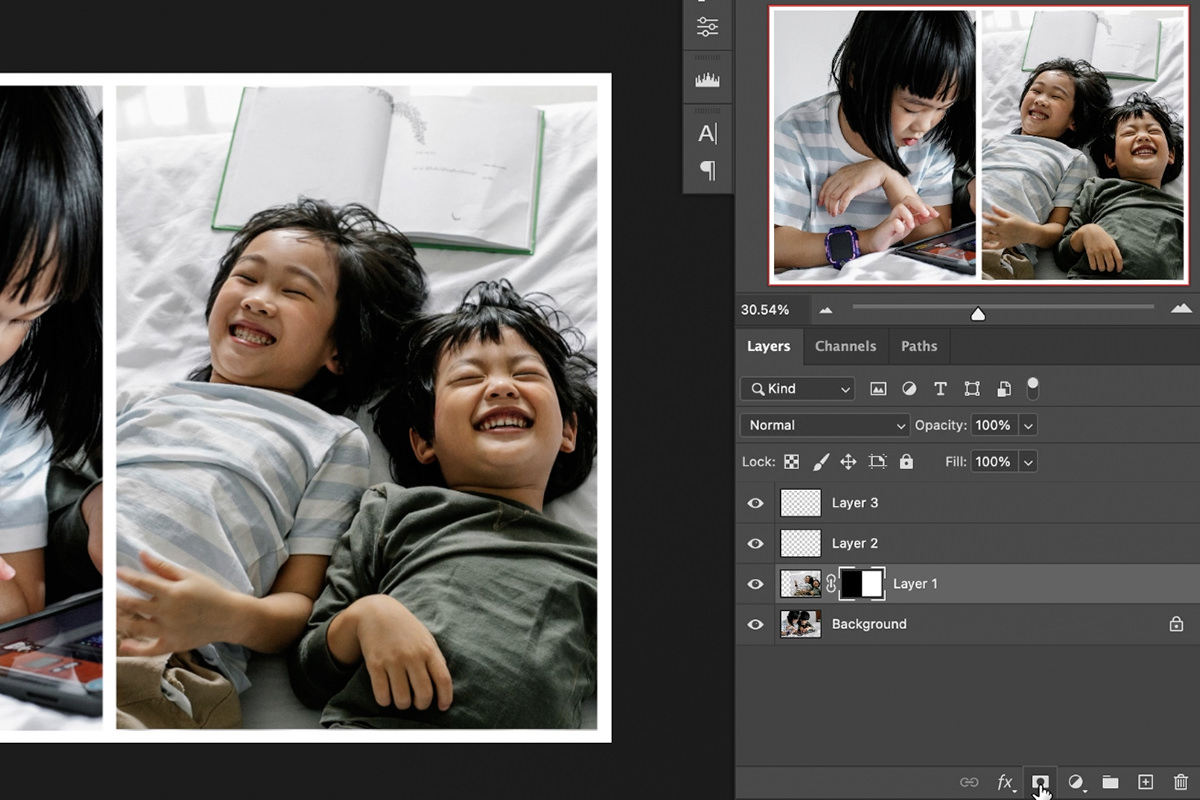
Try to reposition a photo now and its mask travels with it, so the whole panel slides. Not what you want.
Click the small chain link icon between the layer thumbnail and the mask thumbnail. With them unlinked, selecting the image thumbnail lets you move and scale the photograph while the frame stays exactly where it is.
Now you can compose within each panel like cropping through a window — the Move tool slides the framing. In the video the resizing comes first: Cmd/Ctrl + T makes a photo smaller or larger, for example to really focus in on the faces, and it all stays within the frame. Then the mask is unlinked so the photo can move on its own. This is what turns a rigid template into something you actually design in, and the same trick applies anywhere you mask a photo into a shape.
Save It as a Template
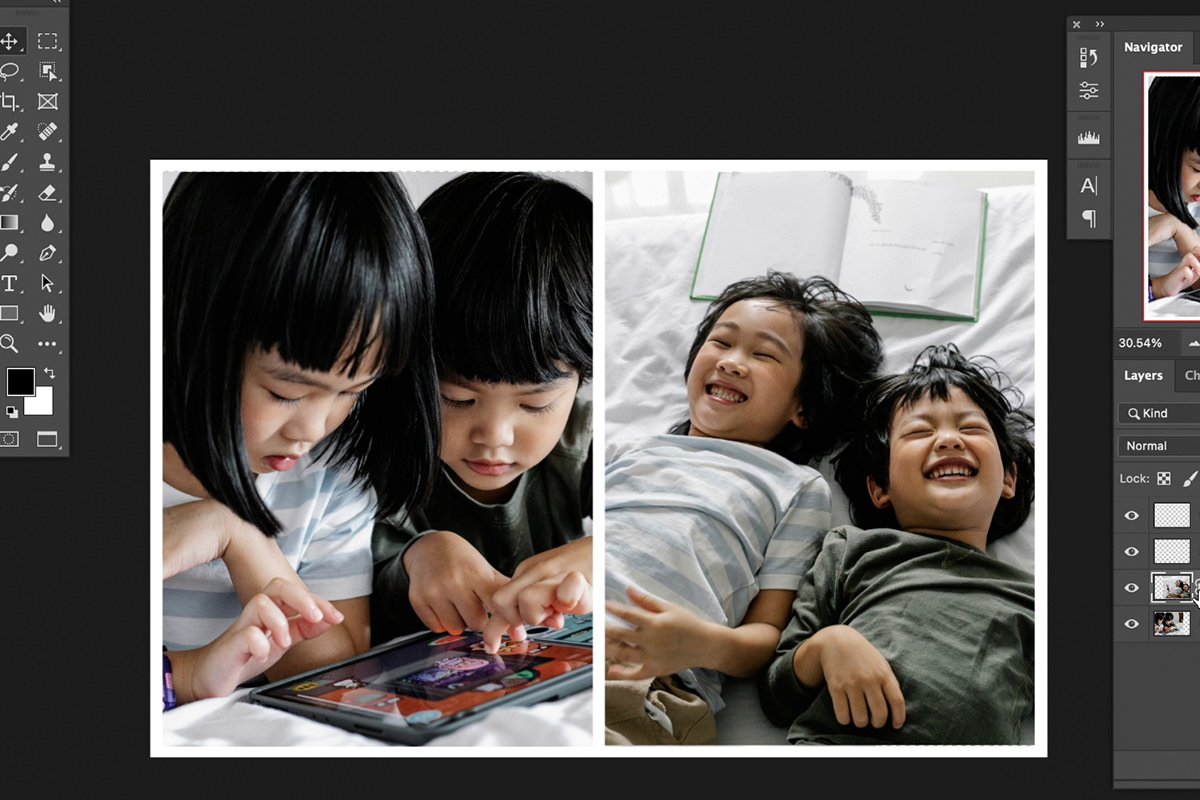
Save the layered PSD before you flatten anything. The divider, the border and the mask are all reusable.
Next time, open it, drag two new photographs in, place them in the existing halves and compose. A layout that took five minutes to build takes under a minute to reuse — and every diptych you make shares the same proportions, which starts to read as a consistent style rather than a one-off.
The layout isn’t fixed to two vertical panels either. The same three steps produce horizontal splits, three-panel triptychs or a grid — only the shapes you fill and mask change.
Where Diptychs Go Wrong
An off-center divider
Select the whole canvas first, then use the align buttons. Judging it by eye never quite works.
Mismatched borders
The center gap and the outer frame should be the same weight. Unequal spacing reads as an error.
Forgetting to unlink the mask
Move the photo and the panel goes with it. One click on the chain icon.
Pairing unrelated images
Two good photographs that share no story make a worse diptych than two ordinary ones that do.
Inconsistent color between the two
Side by side, a white balance difference is unmissable. Match them before you combine them.
Resizing without a Smart Object
Convert each photo to a Smart Object first and you can scale it repeatedly with no loss of quality. This is an extra tip, not a step in the video, which transforms the plain layers with Cmd/Ctrl + T.
Let the Pair Do the Work
The technique here is genuinely simple — two white fills, one layer mask and an alignment click. What makes a diptych worth making is the editing decision in front of it: which two frames, placed together, say more than either does alone.
Go back through a recent shoot looking specifically for pairs rather than single best shots. It’s a different way of reading your own work, and it tends to surface images you’d otherwise have passed over.
Quick Reference: Keys, Menus and Settings
- Combine the photosCmd/Ctrl + - to zoom out, then drag one image onto the other with the Move Tool
- Center dividerNew layer, Rectangular Marquee, Edit > Fill > White
- Center it exactlyCmd/Ctrl + A, then Move Tool > Align Horizontal Centers in the options bar
- Outer borderNew layer, marquee the inside, Select > Inverse, Edit > Fill > White
- Right photoMarquee the right half, then click the layer mask icon with the photo layer selected
- Left photoDouble-click the Background layer to unlock it, then move it left
- ComposeCmd/Ctrl + T to resize; click the link icon to unlink the mask, then move the photo
No AI, no generative credits.

Free Downloads
Follow Along on the Same Photos
Get the two sample photos from the same shoot, the finished diptych template PSD and the 3-page PDF guide. Free with a PHLEARN account.
Diptych Collages in Photoshop: Common Questions
What is a diptych?
Two separate photos combined into one piece of art. Choose images that are similar and help tell the same story, like two frames from the same shoot, so the pair shows more than either photo alone.
How do I put the divider exactly in the center?
Press Cmd/Ctrl + A to select the whole document. With the divider’s layer selected, take the Move Tool and click Align Horizontal Centers in the options bar. The bar aligns to the selection, which is the entire image.
How do I make the white divider bar?
Create a new layer, drag a tall, narrow selection with the Rectangular Marquee Tool, then go to Edit > Fill and choose White. Where you draw it doesn’t matter, because you center it afterward.
How do I add the white border around the outside?
On a new layer, marquee an area a little inside the document edges, go to Select > Inverse, then Edit > Fill with White. The gap you leave becomes the border.
How do I keep a photo inside its half of the frame?
Marquee the half where the photo should show, make sure the photo layer is selected, and click the layer mask icon. The selection becomes the mask and the photo only shows in its half.
Does the left photo need a mask too?
Not in the video. The left photo is the bottom layer, so the masked right photo and the white layers cover anything that spills past its half. If your left photo sits above the other one, mask it the same way.
Why won’t the bottom photo move?
It is still the locked Background layer. Double-click it to turn it into a regular layer, then move it with the Move Tool.
Why does the frame move when I move the photo?
A layer and its mask are linked by default, so the mask travels with the photo. Click the link between the layer and mask thumbnails to unlink them, and the mask stays in exactly the same place.
Can I zoom in on the faces inside the frame?
Yes. Press Cmd/Ctrl + T to make a photo smaller or larger, and it all stays within the frame. Unlink the mask to slide the photo around behind it.
Are the sample files free?
Yes, with a free PHLEARN account. You get 2 sample images, 1 sample PSD and 1 PDF guide: the two photos, the finished diptych template you can drop your own images into, and the 3-page step-by-step guide.
From the Magazine View all
Stories, interviews and guides for photographers, new every week.
 EditingLightCraft vs Lightroom: I Edited the Same RAW Files in BothThe free clone on the same RAW files: what matches, what breaks and who should switch.
 InspirationRare Historical Photos: 13 of the Rarest Pictures Ever TakenFrom the earliest surviving picture of a person to the last passenger pigeon: who took each one and why it survives.
 EditingArtCraft: Photoshop Cloned by AI in Two Weeks. Is It Legal?ArtCraft cloned Photoshop and Lightroom with AI and gave them away. Any good? Legal? Safe?
Master Photoshop, Lightroom and Photography
Join PHLEARN PRO for $12.99 a month, or $99.99 a year (save 36%). Cancel anytime, with a 100% money-back guarantee.