
Download Assets
This tutorial includes 1 PDF guide. Downloads are free with a PHLEARN account.
- Download the sample files from every free tutorial on PHLEARN
- New free tutorials published every week
- One free account: sign up once, then download anything
Free PDF Guide · 5 Pages
This Tutorial as a Step-by-Step PDF
The 5-page guide walks through the coffee background with a clipped Levels layer, Healing Brush texture, a Color Range silhouette, Magic Wand horns at a Tolerance of 25, the apron as an inverted mask, a perspective rectangle for the cup, a white gradient, a Pen tool knife and the tagline. Keep it next to your keyboard.
description
Where part one chased photographic realism, this poster goes graphic: a silhouette built from stock images over a single original studio photograph. This tutorial covers shooting cream separating in coffee as a light-to-dark background, blending its mask with a clipped Levels layer, cutting the figure out with Select Color Range and the Magic Wand, and loading an apron as an inverted layer mask.
Enjoying This Free Tutorial?
We publish a new free tutorial every week, each one with sample images and PSDs you can download and follow along with. Sign up and they land straight in your inbox, along with early word on sales, events and subscriber-only offers.
Create a DIY Horror Movie Poster in Photoshop: The Graphic Approach
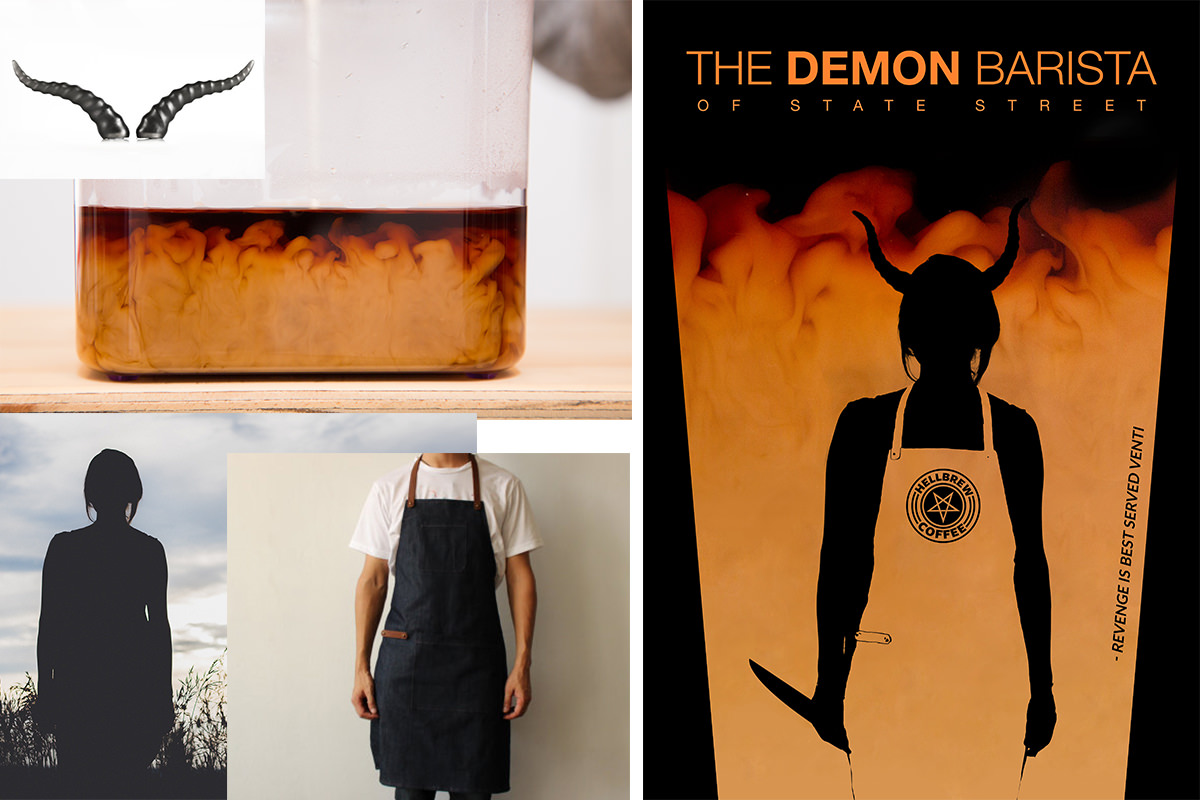
Part one leaned on photography and realism. This one goes the other way: a mostly graphic, silhouette-driven poster assembled from stock images, with a single original studio photograph doing the work of the background. It covers the coffee shoot, the masking that turns it into a light-to-dark gradient, and the Color Range and Magic Wand selections that build the silhouette.
This tutorial is part of the Horror Movie Poster Collection, and the contest it originally ran alongside has finished — you can view the winners here.
Turning Something Loved Into Something Feared
Last time we wrapped Aaron up like a warm deli sandwich, and the result was about as horrifying as we could have hoped. This week the idea was to transform something everyone loves into something to fear. iPhones? Corgis? Coffee? No. Please. Anything but the coffee.
The theme became a coffee shop spoof of Stephen Sondheim’s Sweeney Todd: The Demon Barber of Fleet Street. Instead of chasing photographic realism, the plan was a graphic approach: stock images pulling most of the poster together, with at least one original photo shot in the studio.
Photographing Cream Pouring Into Coffee
Aaron’s idea was to photograph coffee as creamer is poured in, catching the initial separation of the two liquids. That image becomes the background, supplying texture and an eerie transition from light to dark.
The shoot was simple: a large clear container filled with coffee, a white v-flat as the backdrop, and a strobe placed directly behind the camera aimed at the ceiling so the light bounced back down onto the coffee, enhancing detail and separation.
The Settings
Shot on a Canon 5D Mark III with a 24-105mm lens at 1/200 second, f/6.3 and ISO 400, with a Paul C Buff Einstein as an additional light source.
After another successful photoshoot, we pounded the gallon of coffee we had just made and promptly lost our minds. It was time to bring The Demon Barista of State Street to life in Photoshop.
Building the Light-to-Dark Background
Open the coffee image and use the Crop Tool, C, to put it into portrait orientation. Create a Solid Color Adjustment Layer filled with black and move it to the bottom of the layer stack as your background. Here the cream-colored area of the coffee sits near the bottom of the frame and transitions to black toward the top.
With the coffee positioned, select its layer mask. Use the Marquee Tool to select the larger areas you don’t want visible and fill those selections with black. The Brush Tool handles the areas needing more detail — use a large soft brush around the places where the cream transitions into the background.
Tip: This mask doesn’t have to be perfect! Create a Levels Adjustment Layer and clip it to your coffee layer. In the Levels Adjustment window, drag your black point from the left to the right until the dark areas around the coffee cream change from dark gray to completely black. This will make the transition seamless!
Filling and Texturing the Gaps
Press CTRL or CMD + T to scale and reshape the coffee layer so it fills the part of the poster you want.
For any gaps underneath the cream, create a new layer, sample a color from the cream by holding ALT or OPTN, and paint with the Brush Tool until the area is filled. Then make the brush large and soft, lower Flow to about 10%, and keep sampling nearby colors from the cream to add variation so the transition looks natural.
Matching the Texture
Painted areas still need the cream’s texture. Create a new layer and select the Healing Brush Tool, J. Sample an area with the texture you want by holding ALT or OPTN, then paint where you want it applied. Repeat, sampling new areas regularly so the painted texture doesn’t repeat visibly.
Cutting Out the Barista Silhouette
Bring the silhouette image in on top of the layer stack. The Rectangular Marquee Tool deletes the areas left and right of the subject, since only the silhouette is needed.
Transform the subject with CTRL or CMD + T until she fits. To cut her out of the remaining background, go to Select > Color Range, click on the subject and raise Fuzziness until the whole figure is selected. It grabs some grass too, which is fine. With that selection active, create a new layer and fill it with black, then refine further with the Marquee Tool and Lasso Tool to remove anything unwanted.
The Horns
With the Magic Wand Tool, click the white outside the horns (a Tolerance of about 25 worked here), then choose Select > Inverse so the horns are selected. Add a little Smooth in Select > Select and Mask and fill the selection with black on a new layer. Bring them into the main image and scale them to fit the head. To pose each horn, select one, press Ctrl/Cmd + X to cut it and Shift + Ctrl/Cmd + V to paste it back in place on its own layer, then rotate each one and keep both in the Subject group.
Adding the Apron as a Mask
Drag the apron image to the top of the layer stack with the Move Tool. Lower its opacity so you can position and transform it onto the subject. Use the Magic Wand Tool to select the parts of the apron you want, then fill that selection with white on a new layer — white simply makes it easier to see what you’re doing.
Since these elements should read as rough and jagged, the Lasso Tool fills in any missing areas of the apron: draw with it and fill those selections with white. If a selection comes out too rough, select the layer, go to the Select menu and choose Select and Mask, and apply smoothing to whatever needs cleaning up.
Load the apron as a layer mask on your subject and invert it with CTRL or CMD + I. The apron area becomes invisible, revealing the coffee layer underneath.
Logo, Title and Finishing the Shape
To tie the theme together, a coffee shop-style logo (a little take on Starbucks) was designed before recording. Drag it in, right-click the layer and choose Convert to Smart Object so it keeps its definition when you scale it down onto the apron, then press Ctrl/Cmd + I to invert it from white to black. The point is that once you have a theme, have fun with it and bring in as many elements as you can to tell the story.
With the main pieces in place, shape the background like a tall coffee cup. Add a layer mask to the Background group, draw a shape with the Rectangle tool, press Ctrl/Cmd + T and hold Shift + Alt/Option + Ctrl/Cmd while you drag a top corner out and a bottom corner in. That is perspective, and it turns the rectangle into a trapezoid. Ctrl/Cmd-click the shape to load it as a selection, then on the Background group’s mask press Ctrl/Cmd + I, deselect and press Ctrl/Cmd + I again, so the coffee shows only inside the cup.
Drag in the title, press Ctrl/Cmd + A, pick the Move Tool and click the align centers button to center it on the document. To lighten the bottom of the cup, a Curves layer added odd color and saturation, so it was deleted. Instead, on a new layer, drag a white Foreground to Transparent gradient with the Gradient Tool (G) and lower the layer’s opacity.
For the knife, click out the blade with the Pen Tool, clicking and dragging one point to curve it; the handle is already in her hand. Right-click, choose Make Selection with no feather for a very sharp edge, fill it with black on a new layer, then move and rotate it into place. Last, press T for the tagline, “Revenge is best served Venti”, make it black and bold in Window > Character, and run it up the side of the cup like the caution note on a hot drink.
You don’t need expensive equipment or complex photoshoots to make something fun and original. So get weird, channel that weirdness into something creative, and see where it lands.
The Rest of the Series
- Create a DIY Horror Movie Poster in Photoshop (Part I)
- Create a DIY Horror Movie Poster in Photoshop (Part III)
- DIY Horror Movie Poster: Contest Winners
Why the Graphic Approach Is Easier Than It Looks
A silhouette poster forgives almost everything a realistic composite punishes. Because every element ends up as flat black, the cutouts don’t need perfect edges, the lighting between stock images doesn’t need matching, and rough Lasso work reads as intentional texture rather than error. All the craft moves to two places instead: the one real photograph carrying the light-to-dark gradient behind everything, and the silhouette’s outline, which is the only thing telling the viewer what they’re looking at.
Final Thoughts
For a graphic horror poster, shoot one textured background — here cream separating in coffee — and let a clipped Levels layer blend its mask into pure black. Build the figure from stock using Select Color Range and the Magic Wand, fill every piece with black, load the apron as an inverted layer mask so the background shows through, and finish with a logo and title that commit to the theme.
Quick Reference: Keys, Menus and Settings
- Crop and fillC to crop to portrait; Shift + Delete fills a selection
- Blend the coffeeLevels clipped with Alt/Option + Cmd/Ctrl + G, black slider dragged right
- SilhouetteSelect > Color Range, Fuzziness up, then Edit > Fill > Black on a new layer
- HornsMagic Wand at Tolerance 25, Select > Inverse, Smooth in Select and Mask; Cmd/Ctrl + X, then Shift + Cmd/Ctrl + V to split them
- Apron maskCmd/Ctrl-click the apron layer, layer mask icon, Cmd/Ctrl + I to invert
- Cup shapeRectangle tool, Cmd/Ctrl + T, Shift + Alt/Option + Cmd/Ctrl-drag a corner for perspective
- KnifePen Tool, right-click > Make Selection with no feather, fill with black
No AI, no generative credits.

Free Downloads
Take the Guide With You
There are no sample files for this part, since the poster is built from stock images, but the 5-page PDF guide covers every step and shortcut. Free with a PHLEARN account.
Graphic Horror Poster: Common Questions
Why build the poster from silhouettes?
Every piece ends up as flat black, so nothing has to be cut out perfectly and the lighting between stock images does not need to match. The one real photo, creamer pouring into coffee, carries the texture.
How was the coffee photo shot?
A clear container of regular black coffee, the camera on a tripod, and pictures taken as creamer was added, to catch the separation between the dark coffee and the light creamer.
How do I hide the straight line the Marquee leaves on the mask?
Paint black along it on the mask with the Brush Tool, then clip a Levels layer to the coffee with Alt/Option + Cmd/Ctrl + G and drag the black slider right, so leftover gray drops to pure black.
How do I add texture to an area I painted in?
On a new layer, use the Healing Brush: Alt/Option-click a textured part of the creamer and paint over the flat paint. It takes the texture from where you sample and the color from where you paint. If a patch visibly repeats, sample somewhere else.
How do I turn a stock photo of a person into a silhouette?
Go to Select > Color Range, click the subject and raise Fuzziness until the figure is selected. Fill the selection with black on a new layer, then delete stray areas with the Marquee and Lasso tools.
How do I select the horns cleanly?
Click the white outside them with the Magic Wand (a Tolerance of about 25 here), choose Select > Inverse, and add a little Smooth in Select and Mask before filling with black. Too much smoothing rounds the shape off.
How does the apron become see-through?
Make the apron a white shape, Cmd/Ctrl-click it to load it as a selection and add a layer mask to the subject. The mask comes in backward, so press Cmd/Ctrl + I to invert it and the coffee shows through.
How is the coffee cup shape made?
Draw a rectangle, press Cmd/Ctrl + T and hold Shift + Alt/Option + Cmd/Ctrl while dragging a corner for perspective. Load it as a selection and use it on the Background group’s mask.
Why use a white gradient instead of Curves to brighten?
Curves added odd color and saturation here. A white Foreground to Transparent gradient on a new layer, at lowered opacity, brightens the bottom without shifting the color.
Is there a free download?
Yes, with a free PHLEARN account. You get 1 PDF guide: 5 pages covering every step, from the coffee background to the knife and tagline, plus the shortcuts. There are no sample images for this part.
New Free Tutorials View All »









Enjoying This Free Tutorial? Go Further with PRO.
200+ PRO courses. 1,000+ practice files. One membership.

Unlimited access to every PRO course
New PRO courses every month
Layered PSDs and RAW files to follow along
100+ Lightroom Presets, LUTs, Actions and Brushes
Stream in up to 4K, with captions and chapters
Watch on any device: desktop, tablet or phone
4.93 average from 3,900+ reviews · 2M+ students