

Download Assets
Download Assets
This tutorial includes 1 sample RAW file. Downloads are free with a PHLEARN account.
- Free sample files with every tutorial on PHLEARN
- New tutorials published every week
- Unlimited downloads with your free PHLEARN account
Watch the Full Series
description
Remove objects in Lightroom Classic and most of the work is choosing what to paint. Every shoot leaves things in the frame that were necessary at the time and unwanted afterwards — an assistant with a reflector, a sign, a stray pedestrian.
On Day 10 of 30 Days of Lightroom Classic we use the AI Remove tool to take people out of a shot cleanly, then rebalance the whole image with masking, Transform and a crop.
This is Day 10 of our 30 Days of Lightroom Classic series. Follow along with all 30 episodes as we explore the magic of Lightroom together!
Continue Watching 30 Days of Lightroom Classic
JOIN 30 DAYS OF LIGHTROOM (FOR FREE!)
Ready to jump in? Sign up and we’ll email you a printable calendar and daily class schedule so you can get started right away!
Image Source
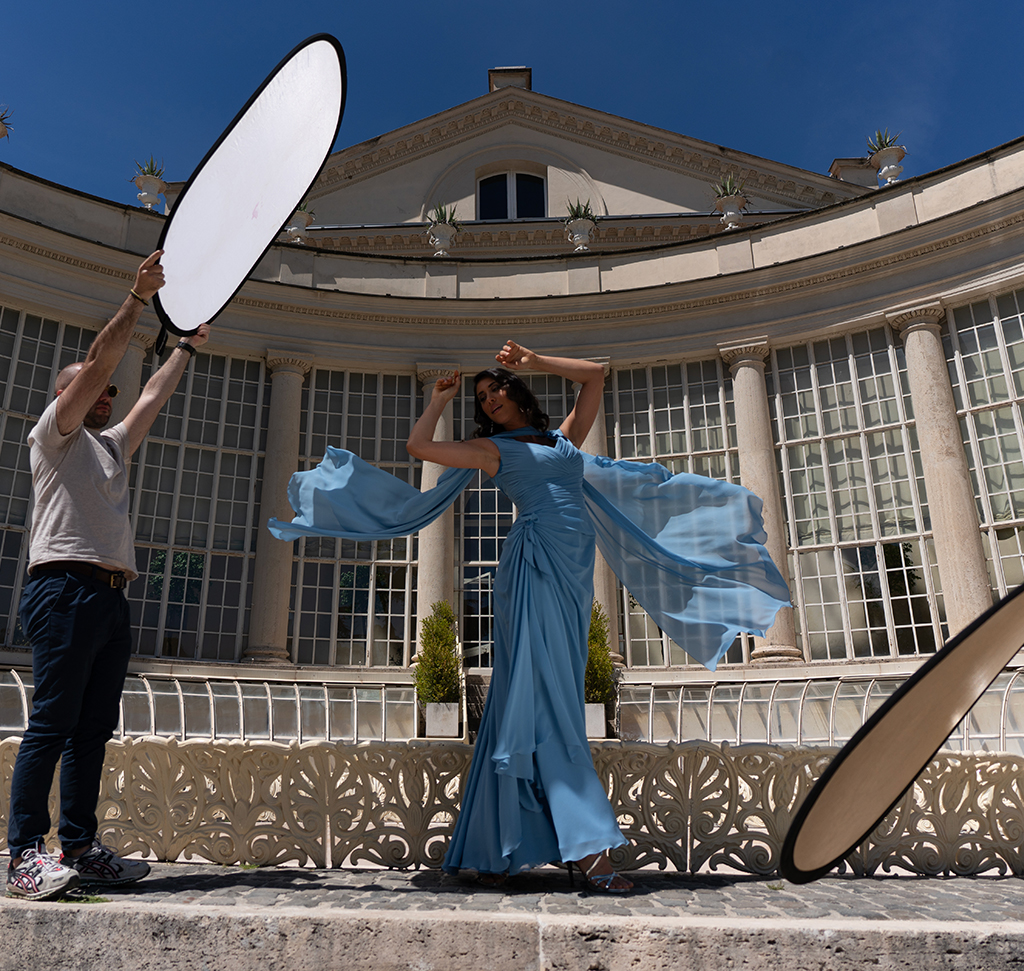

The Remove Tool Does the Boring Part for You
Every shoot leaves things in the frame that were necessary at the time and unwanted afterwards. An assistant holding a diffusion panel. A reflector just inside the edge. A bin, a sign, a stray pedestrian.
Lightroom Classic used to be poor at this, and you would round-trip to Photoshop. That is no longer true. Day 10 covers the AI Remove tool, which handles most of it in seconds, and then the rest of the edit — because removing something is usually the first step, not the whole job.
The Remove Tool
It lives in the tool strip under the histogram, and Q is the shortcut.
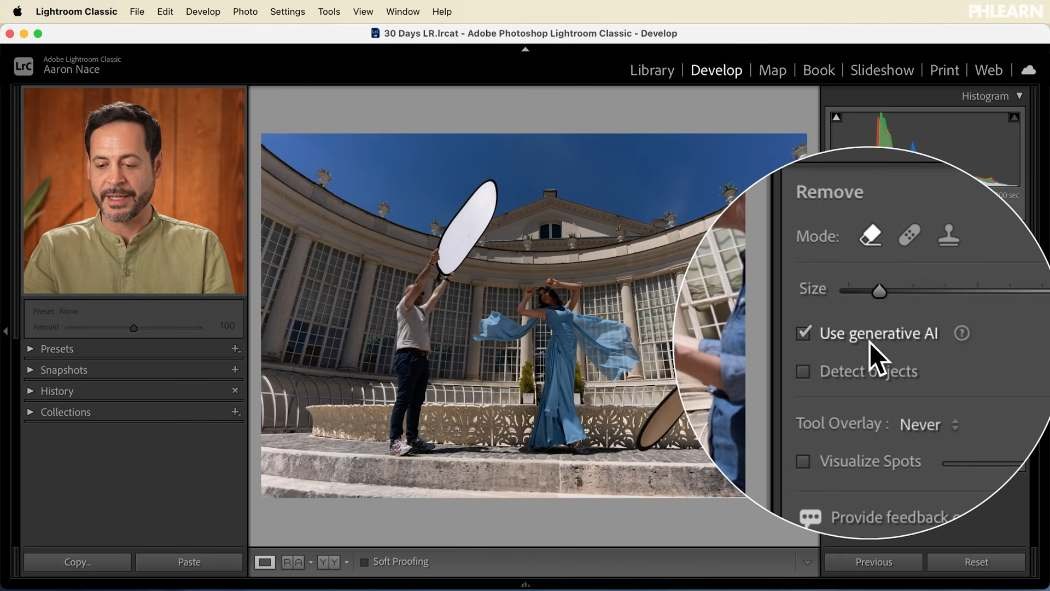
Check that Use Generative AI is switched on. This is the single most important setting on the panel. With it off you get the older content-aware behaviour, which is dramatically worse at anything complicated. With it on, Lightroom generates new pixels that match the scene.
Painting the Selection
Adjust the brush with the bracket keys or the size slider, then paint over whatever you want gone. A red overlay shows what is selected.

Two things make the difference between a clean result and an obvious one:
Be generous. Painting slightly wider than the object gives the AI more context to work with. A tight selection tends to leave a faint outline of whatever was there.
Include the shadow. This is the one people miss. Remove a person and leave their shadow on the ground and the image is instantly wrong in a way viewers notice without being able to say why.
The Add and Subtract controls refine the selection before you commit, which is useful when you realise a corner of a reflector is still poking out.
Remove, Then Choose a Variation
Click Remove and Lightroom generates the replacement.
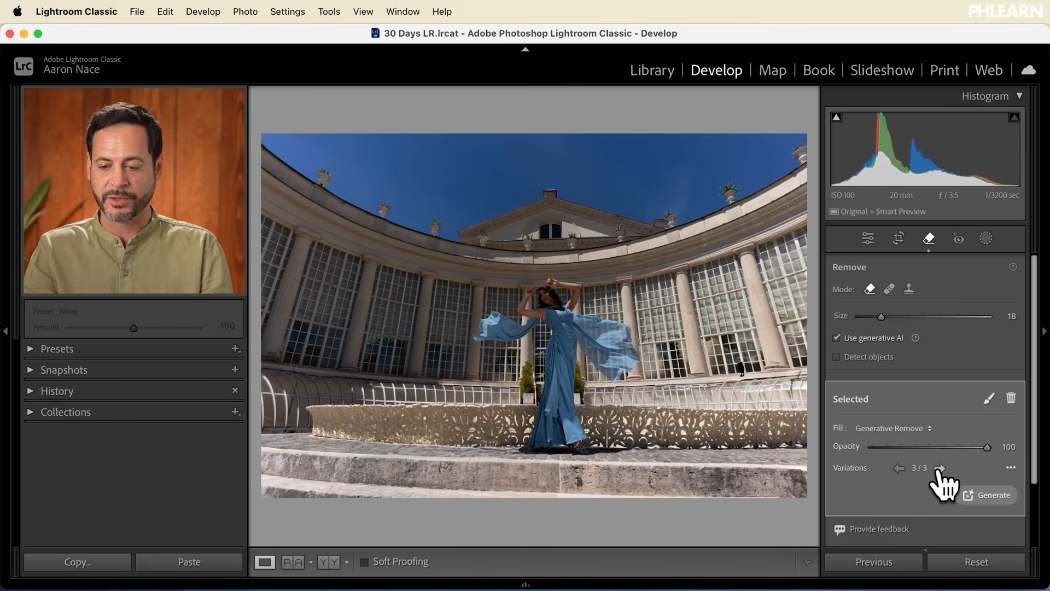
It produces several variations, exactly as Photoshop does, and you can cycle through them. This is worth doing every time — the first result is not reliably the best one, and on a busy background the differences between them can be significant.
Press the backslash key for an instant before and after.
What about the healing and clone tools?
They are still there, and the honest answer is that generative Remove is better at nearly everything. Clone stamp still has a place when you want exact control over the source pixels, but as a default the AI tool wins. It is worth knowing that each generation consumes generative credits.
Finishing the Photograph
Removing the distraction rarely finishes the image. A realistic sequence after the clean-up:
-
Basic adjustments
Lift the exposure a little, open the shadows, add Vibrance to bring out color.
-
A subject mask
Select Subject and raise the exposure slightly so the person separates from the background.
-
A radial gradient for light
Drag one over the subject and lift the exposure inside it, which puts light into the scene where you want attention.
Transform for Symmetry
Architectural backgrounds that are nearly symmetrical are more distracting than ones that are obviously not. Once the distractions are gone, this tends to become visible.
Transform fixes it, but Auto is the wrong choice with a person in frame — it corrects aggressively and distorts them. Use the manual Horizontal slider instead to skew the background level, with a touch of Vertical or Rotate if needed, then crop in.
Getting the background even matters more than centring the subject perfectly. The eye reads the architecture as the reference.
Comparing Before and After
Lightroom has more comparison views than most people use. The backslash key toggles the original against your current state, which is the quickest. The Y view splits the screen properly, and cycling it gives you left/right, top/bottom and split-screen arrangements — all of which zoom together, so you can inspect a removal at 100% side by side.
Individual panels also have their own eyeball toggle, so you can check what Transform alone did without undoing the rest.
Where This Usually Goes Wrong
Leaving Use Generative AI unchecked. Worth checking every session. The difference in quality is not subtle.
Forgetting the shadow. The most common reason a removal looks wrong.
Painting too tightly. Give the AI room. A slightly oversized selection produces cleaner results than a precise one.
Accepting the first variation. Cycle through them. It costs nothing.
Using Auto transform on a photo with people. It will straighten the building and stretch the person.
Take It From Here
The Remove tool has quietly changed what is worth shooting. Things you would once have carefully avoided — a sign, an assistant, a parked car — are now a fifteen-second fix, which means you can concentrate on light and moment and clean up later.
Tomorrow we combine several exposures into one file: creating HDR images in Lightroom Classic.
Quick Reference: Keys, Menus and Settings
- Open RemoveQ; make sure Use Generative AI is on
- Brush size[ and ], or the Size slider
- SelectPaint a little wider than the object and include its shadow; Add or Subtract to fix it
- RemoveClick Remove, then click through the Variations
- Finish the editBasic: Exposure, Shadows, Vibrance; Masking > Select Subject; Radial Gradient for light
- Even the backgroundTransform: manual Horizontal, not Auto; then crop in
- Before and after\ toggles the original; Y for side-by-side views
Free Downloads
Follow Along on the Same RAW File
Get the RAW file from the video, a woman in a blue gown with two assistants in frame, and remove them yourself. Free with a PHLEARN account.
Removing Objects in Lightroom: Common Questions
Where is the Remove tool in Lightroom Classic?
In the Develop module, in the tool strip under the histogram. Press Q to open it.
Should Use Generative AI be turned on?
Yes. It is the most important setting on the panel. With it on, Lightroom generates new pixels that match the scene; with it off you get older, weaker results on anything complicated.
How do I change the Remove brush size?
Press the bracket keys, [ for smaller and ] for bigger, or use the Size slider.
Why does my removal still look wrong?
Usually the shadow was left behind, or the selection was too tight. Paint a little wider than the object and include the person’s shadow on the ground.
I missed part of the object. Do I start over?
No. Click Add and paint over the missed part, or Subtract to take some back, before you click Remove.
Can I get a different result from the Remove tool?
Yes. After you click Remove, Lightroom offers several variations, just like Photoshop. Click through them and keep the best one.
Should I use the healing brush or clone instead?
They are still there, but Aaron’s honest advice is to use Remove with Use Generative AI on, because it works much better. Clone still helps when you want exact control over the source.
How do I even out a background without stretching the person?
Skip Auto in the Transform panel. Use the manual Horizontal slider, with a touch of Vertical or Rotate, then crop in.
How do I compare before and after in Lightroom?
Press the backslash key, above Enter or Return, to flip between the original and your edit. Press Y for a side-by-side view you can cycle and zoom, or use a panel’s own eyeball to check just that panel.
Is the sample file free?
Yes, with a free PHLEARN account. You get 1 sample RAW file, the photo of a woman in a blue gown with two assistants holding a diffusion panel and a reflector.
Master Photoshop, Lightroom and Photography
Join PHLEARN PRO for $12.99 a month or $99.99 a year. Cancel anytime, with a 100% money-back guarantee.