
Composite a piece of graffiti from one photo onto a skate ramp in another, using Free Transform and the Warp tool to match its shape to the curved surface, then Curves and Color Range to match its light, contrast, and texture to the scene.
Enjoying This Free Tutorial?
We publish a new free tutorial every week, each one with sample images and PSDs you can download and follow along with. Sign up and they land straight in your inbox, along with early word on sales, events and subscriber-only offers.
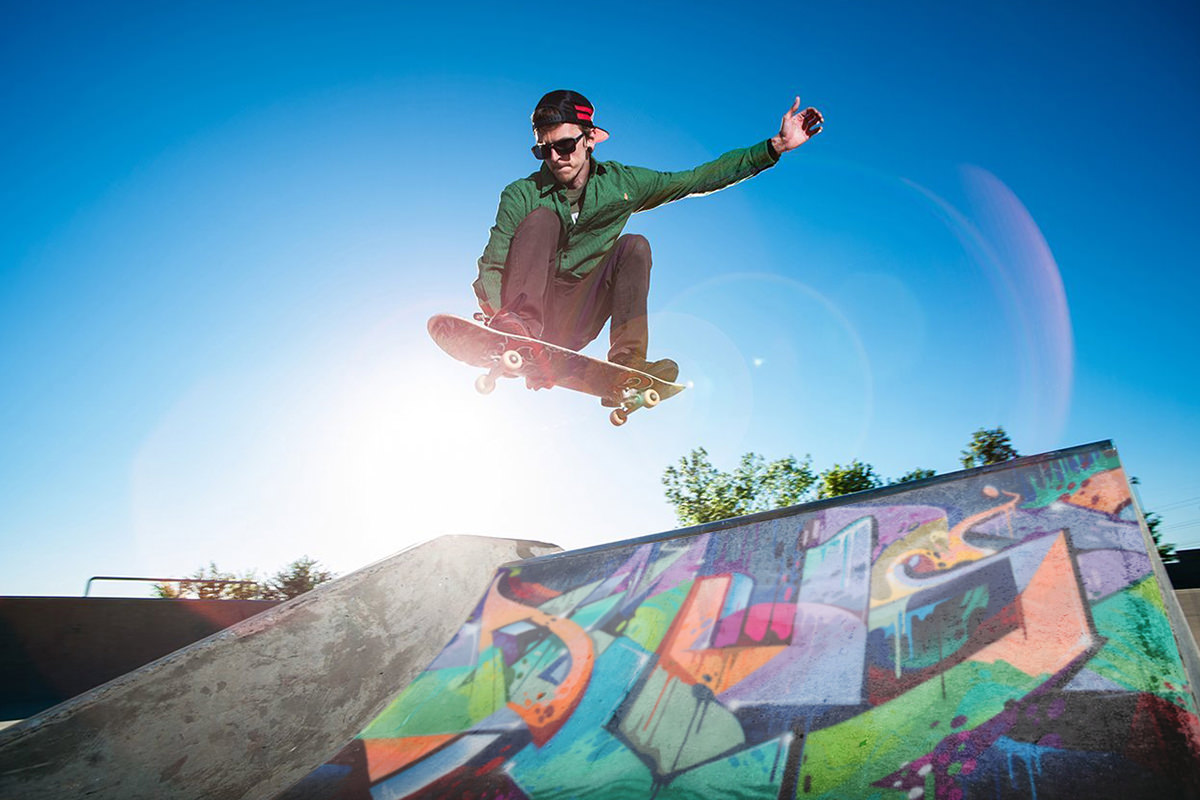
How to Add Graffiti to Your Image With the Transform Tool in Photoshop
Compositing a piece of graffiti from one photo onto a completely different scene — in this case, onto a skate ramp — comes down to two separate skills working together: shaping the graffiti so its perspective and curve match the surface it’s landing on, and then matching its light, contrast, and texture closely enough that it looks like it was always part of the original photo. This tutorial covers both, using Free Transform, the Warp tool, and a handful of Curves and Color Range tricks to sell the final result.
Bringing the Graffiti Image Into Your Scene
Before any shaping or blending can happen, the graffiti photo needs to be moved into the same document as the base image.
-
Move the Graffiti Photo Into the Base Image
With both images open, select the Move tool, hold Shift, and click and drag from the graffiti photo’s tab over onto the base image. Holding Shift centers the pasted layer in the new document.
-
Duplicate the Layer Before Transforming
Press Cmd/Ctrl+J to duplicate the graffiti layer before doing any heavy transforming or warping.
Rough Placement With Free Transform
With a duplicate safely in place, the next step is roughly sizing and positioning the graffiti before any perspective work begins.
-
Lock Width and Height, Then Scale
Press Cmd/Ctrl+T to open Free Transform, lock the width and height together in the options bar, then click and drag on either value to scale the layer without needing to hold Shift separately.
Why Duplicate Before Transforming
Heavy transforming and warping is hard to undo cleanly step by step, and repeatedly hitting undo to back out of a series of transforms is slower than just working from a fresh, untouched duplicate if something goes wrong. Keeping an unaltered copy of the graffiti layer means you can always start the shaping process over without losing the original placement.
Removing the Sky and Isolating the Wall
The graffiti photo includes sky above the wall that isn’t needed and would only get in the way of the perspective work ahead. This is the same basic skill covered in isolating subjects and cleaning up edges in Photoshop — removing everything you don’t need before the real transform work begins.
-
Cut Out the Sky With the Polygonal Lasso
Select the Polygonal Lasso tool, click along the top edge of the wall to trace around the sky, close the selection back at your starting point, and press Delete. Because you’re working on the graffiti layer, this only removes the sky from that layer, leaving the base image’s own sky untouched.
Shaping the Graffiti to the Ramp With Corner-Pin Transform
Getting the graffiti to sit convincingly on a curved ramp surface needs more control than a simple scale or rotate, but Photoshop’s built-in Perspective transform option can feel too restrictive for fine adjustments.
-
Try Perspective, Then Switch to Free Corner-Pin
Press Cmd/Ctrl+T, then right-click and choose Perspective if you want to try it first. For more direct control over each corner independently, instead hold Ctrl (Cmd on Mac) while dragging any corner handle of a regular Free Transform box, which lets you place each corner exactly where you want without the linked constraints of the Perspective mode.
Why Corner-Pin Beats the Built-In Perspective Option
Photoshop’s Perspective transform mode links opposite corners together so that adjusting one affects the other in a fixed relationship, which is useful for simple perspective shifts but limiting when a surface curves or twists in a way that doesn’t fit a single vanishing point. Holding Ctrl/Cmd while dragging individual corners of a normal Free Transform removes that constraint, letting each corner move independently to match a more complex surface.
Warping the Graffiti to Follow the Ramp’s Curve
Once the corners are roughly positioned, the ramp’s actual curve still needs to be built into the graffiti before the transform is finalized.
-
Switch to Warp Mode Without Committing the Transform
While still inside the same Free Transform operation, click the Warp icon in the options bar rather than pressing Enter, so the warp is applied on top of the corner-pin work already in progress rather than starting from a flattened layer.
-
Choose an Arc Direction and Adjust Bend
Open the warp style dropdown and choose Arc Upper or Arc Lower depending on which way the surface curves, and use the flip button next to it if the arc needs to run left-to-right instead of top-to-bottom. Adjust the Bend value, including negative values, until the curve matches your ramp, then add a touch of vertical or horizontal Shear if needed before confirming the transform.
Matching Contrast and Saturation With a Curves Clipping Mask
Once the graffiti is shaped correctly, it will almost certainly look too saturated and too contrasty compared to the flatter, lower-contrast lighting of the base photo.
-
Add a Clipped Curves Adjustment Layer
Add a Curves adjustment layer above the graffiti layer and press Cmd/Ctrl+Option/Alt+G to create a clipping mask so it only affects that one layer. Bring the lightest point of the curve down and the darkest point up to reduce contrast, matching the flatter range of tones already present in the base image’s ramp.
Why a Composited Element Usually Needs Less Contrast, Not More
A photo taken outdoors in direct light, like a graffiti wall, will almost always carry more contrast and saturation than a surface lit more evenly, such as an indoor or shaded ramp. Comparing the lightest and darkest sampled colors in both images side by side, rather than guessing, is a reliable way to see exactly how much contrast needs to come out of the composited element before it will read as part of the same scene.
Restoring Highlights and Shadows From the Underlying Surface
Flattening the graffiti’s own contrast removes some of its texture, so that texture needs to be rebuilt using the highlight and shadow information already present on the ramp underneath it.
-
Select the Ramp’s Highlights With Color Range
On a new layer, go to Select > Color Range and click on a highlight area of the underlying ramp to select similar tones, adjusting Fuzziness until the selection covers the highlight areas without grabbing too much else.
-
Sample and Paint the Graffiti’s Highlight Color
Hide the selection edges with Cmd/Ctrl+H, sample a light color from the graffiti layer with the Brush tool held on Alt/Option, then paint over the ramp within your highlight selection. Clip this layer to the graffiti group and lower its opacity as needed.
-
Repeat for the Shadow Areas
Use Color Range again to select the darker tones on the ramp, sample a dark color from the graffiti, and paint it into the shadow selection on its own layer, setting the blending mode to Soft Light so it deepens the shadows without flattening them.
Why Texture Has to Come From the Surface Underneath, Not the Graffiti Itself
Flattening the graffiti layer’s own contrast to match the scene also flattens whatever texture and dimension it originally had. Sampling the highlight and shadow colors of the base graffiti and painting them back in through a Color Range selection of the underlying ramp restores that dimensional quality using the ramp’s actual surface detail, rather than the graffiti’s now-flattened information, which is what keeps the composite from looking like a flat sticker.
Adding Grunge, Blur, and a Mask for Final Realism
A few finishing touches close the gap between “technically correct” and genuinely convincing.
-
Paint In an Extra Layer of Dark Grunge
On a new layer above your graffiti group, use Color Range to select an even darker tone, paint it into any area that still looks too clean or empty, and set the layer’s blending mode to something like Multiply, Overlay, or Soft Light to fill in that gap naturally.
-
Add a Slight Gaussian Blur to the Graffiti
Go to Filter > Blur > Gaussian Blur on the graffiti layer and apply a very small amount — just enough to soften the graffiti so its sharpness matches the lower resolution and slight softness of the base photo.
-
Mask Off Areas That Shouldn’t Show Graffiti
Add a layer mask to the entire graffiti group, select the metal pipe along the top of the ramp, fill that part of the mask with black and clean up the edge with a small brush, so the graffiti doesn’t wrap onto the pipe.
Why a Slight Blur Helps Sell the Composite
A crisp, high-resolution graffiti photo dropped onto a lower-resolution or slightly softer base image reads as obviously pasted in, no matter how well the perspective and color match. A small Gaussian Blur brings its sharpness down to match the rest of the photo, which does more to sell the composite than almost any other single adjustment in this process.
Final Touches: Saturation, a Painted Highlight, and Matching the Light Flare
The last adjustments are smaller refinements that push the composite from good to finished.
-
Adjust Overall Saturation
Add a Hue/Saturation adjustment layer clipped to the graffiti group and nudge saturation up or down until the color feels right — a slight increase is often what makes the graffiti pop against the rest of the scene.
-
Paint a Soft Highlight
On a new layer, paint a light color where you want an extra highlight, then change the layer’s blending mode to Soft Light to keep the effect subtle.
-
Copy the Original Light Flare Onto the New Texture
Use Select > Color Range to select the color of the lens flare visible in the original graffiti photo, sample that color and paint it onto a new layer, set the blending mode to Screen, then use Free Transform to rotate and reposition the flare so it continues naturally across the new texture. Add a layer mask and paint out any extra you carried along with it.
Why This Approach Works
Compositing an element from one photo into another is really two separate problems solved in sequence: geometry and light. The corner-pin transform and Warp tool solve the geometry problem, letting the graffiti follow a curved ramp surface that a simple scale or basic perspective transform can’t accommodate. Everything after that — the clipped Curves adjustment, the Color Range highlight and shadow sampling, the grunge layer, and the slight blur — solves the light and texture problem, closing the gap between the graffiti’s original outdoor lighting and the flatter light of the scene it’s being dropped into. Sampling highlight and shadow color directly from the underlying surface rather than trying to paint texture from scratch is the detail that keeps the result from looking like a flat sticker, and it’s a technique that carries over directly to compositing tattoos, patterns, or textures onto skin or any other surface.
Final Thoughts
The core lesson here isn’t specific to graffiti at all — it’s a general approach to dropping any flat image onto a dimensional surface convincingly. Shape the geometry first with corner-pin transforms and warp, flatten the composited element’s contrast to match its new surroundings, then rebuild texture by sampling highlights and shadows from what’s actually underneath rather than guessing. Add a touch of blur to match resolution, and finish with small saturation and highlight tweaks. Once that sequence feels familiar, it applies just as well to tattoos on skin, patterns on fabric, or any other texture you want to wrap convincingly around a surface that isn’t flat.
Quick Reference: Keys, Menus and Settings
- Bring it inMove tool, Shift-drag onto the other image; Cmd/Ctrl + J for a copy
- ScaleCmd/Ctrl + T, link W and H, drag on the value
- Corner-pinHold Cmd/Ctrl and drag each corner handle
- Curve itWarp icon before Enter: Arc Upper or Lower, negative Bend, a little Shear
- Match contrastCurves clipped with Cmd/Ctrl + Alt/Option + G: lights down, darks up
- Restore textureSelect > Color Range on the ramp, Cmd/Ctrl + H, paint sampled color; Soft Light
- FinishFilter > Blur > Gaussian Blur (very small), Hue/Saturation, flare layer in Screen
No AI, no generative credits.
Adding Graffiti to a Photo: Common Questions
How do I move a photo from one document into another?
With the Move tool, hold Shift and drag from one image onto the other; Shift centers it. Then press Cmd/Ctrl + J for a copy, so you can start over without relying on Undo.
How do I scale without holding Shift?
Press Cmd/Ctrl + T, click the link icon between W and H in the options bar, then click and drag on either value. Width and height change together.
How do I move each corner of a transform on its own?
In Free Transform, hold Cmd (Mac) or Ctrl (Windows) and drag a corner handle. It gives more freedom than right-click > Perspective, which links the corners together.
How do I bend a flat image to follow a curved ramp?
Before pressing Enter, click the Warp icon in the options bar, choose Arc Upper or Arc Lower and use the orientation button to switch direction. Set Bend, negative values included, add a little Shear, then confirm.
Why does my composited graffiti look pasted on?
It has more contrast and saturation than the ramp. Clip a Curves layer to it with Cmd/Ctrl + Alt/Option + G, bring the lightest point down and the darkest point up to flatten it, and check saturation with Hue/Saturation.
How do I bring back the texture of the surface underneath?
Use Select > Color Range on the ramp’s highlights, hide the edges with Cmd/Ctrl + H and paint a light color sampled from the graffiti on a new layer. Repeat for the shadows with a dark color, set to Soft Light, and clip both to the graffiti.
The graffiti looks too sharp. What helps?
Apply Filter > Blur > Gaussian Blur to the graffiti layer at a very small amount, so its sharpness matches the softer base photo.
How do I keep a lens flare on top of the new graffiti?
On a new layer at the top, select the flare’s color with Select > Color Range and paint it in, then set the layer to Screen. Rotate it with Cmd/Ctrl + T so it continues across the texture and mask off the extra.
Does this work for tattoos or patterns on skin?
Yes. Warp the pattern into place, then copy the highlights and shadows from the surface underneath back over it, the same way the ramp texture is restored here.
From the Magazine View all
Stories, interviews and guides for photographers, new every week.
 EditingLightCraft vs Lightroom: I Edited the Same RAW Files in BothThe free clone on the same RAW files: what matches, what breaks and who should switch.
 InspirationRare Historical Photos: 13 of the Rarest Pictures Ever TakenFrom the earliest surviving picture of a person to the last passenger pigeon: who took each one and why it survives.
 EditingArtCraft: Photoshop Cloned by AI in Two Weeks. Is It Legal?ArtCraft cloned Photoshop and Lightroom with AI and gave them away. Any good? Legal? Safe?
Master Photoshop, Lightroom and Photography
Join PHLEARN PRO for $12.99 a month, or $99.99 a year (save 36%). Cancel anytime, with a 100% money-back guarantee.