Download Assets
This tutorial includes 1 sample image and 1 PDF guide. Downloads are free with a PHLEARN account.
- Download the sample images and PSDs from every free tutorial on PHLEARN
- New free tutorials published every week
- One free account — sign up once, then download anything
Free PDF Guide · 3 Pages
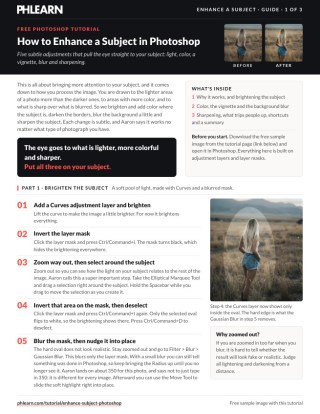
This Tutorial as a Step-by-Step PDF
The guide walks through five adjustments: Curves with an Elliptical Marquee oval and a Gaussian Blur on the mask, Vibrance with the Curves mask copied on, a darker Curves vignette, Image > Apply Image (Merged, Normal) with Iris Blur, then Unsharp Mask with a low Radius. Keep it next to your keyboard.
description
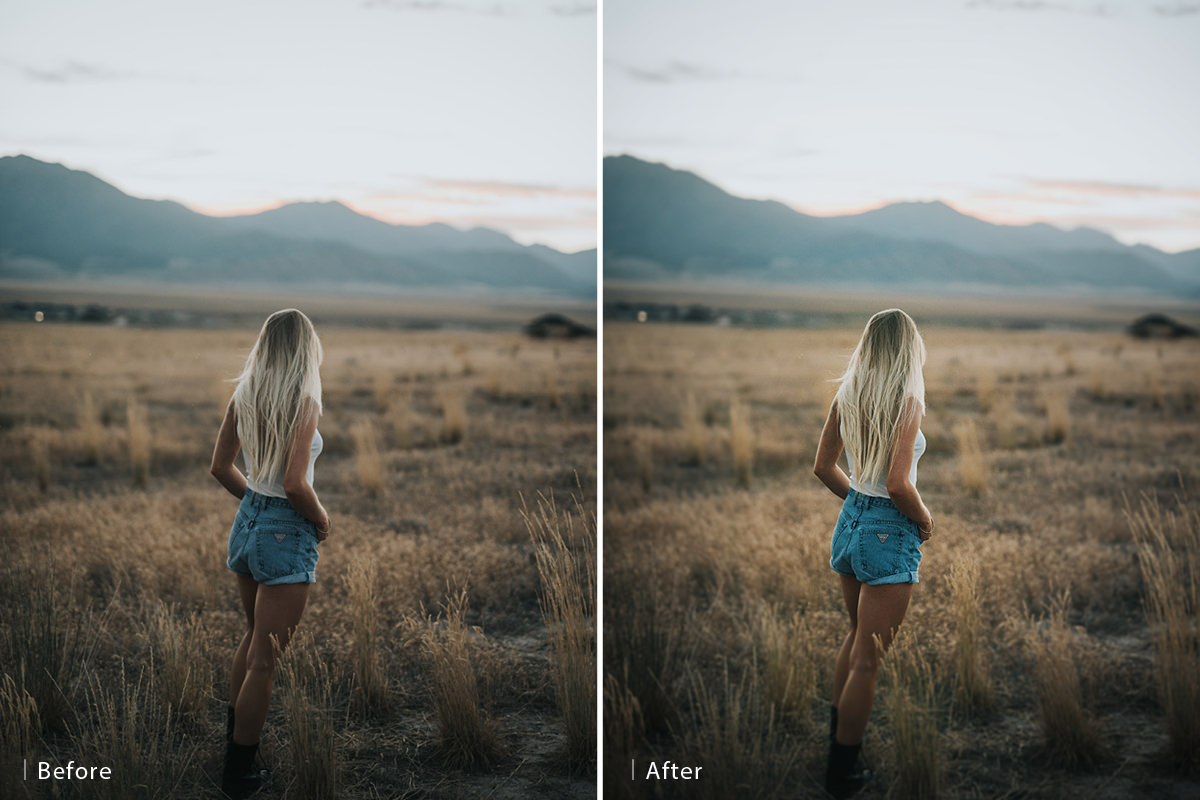
A viewer is naturally pulled toward whatever is lighter, more saturated and sharper than its surroundings — which is the whole basis for this set of subtle adjustments. Brightening the subject with curves, blurring the highlight so it reads as real light rather than a painted patch, adding color, darkening the edges into a vignette, throwing the background out with Iris Blur, and sharpening the subject last.
Enjoying This Free Tutorial?
We publish a new free tutorial every week, each one with sample images and PSDs you can download and follow along with. Sign up and they land straight in your inbox, along with early word on sales, events and subscriber-only offers.
How to Enhance a Subject in Photoshop
This tutorial covers a set of subtle Photoshop adjustments that work together to pull a viewer’s eye directly to the subject of a photo, no matter what that photo actually shows. The technique relies on brightening, adding color, blurring, and sharpening in just the right places, since a viewer is naturally drawn to lighter areas, more saturated color, and sharper focus over their darker, flatter, or blurrier surroundings.
Why Enhancing Your Subject Works
People look at brighter parts of an image before darker ones, at areas with more color before duller ones, and at sharper areas before blurrier ones. Stacking several of these effects together, brightening and adding color to the subject while darkening and blurring everything around it, directs attention without the viewer necessarily noticing exactly why their eye keeps landing in the same spot.
Brightening Your Subject with Curves
Add a Curves adjustment layer and brighten the image slightly by lifting the curve. Click on the layer mask and press Command/Ctrl+I to invert it, which hides the brightening effect across the whole image until it’s revealed over just the subject with a selection.
Isolating the Selection with the Elliptical Marquee
Zoom out far enough to see how the subject’s brightness relates to the rest of the frame, since this comparison is much easier to judge from a distance than up close. Grab the Elliptical Marquee tool and draw a selection around the subject, holding the spacebar to reposition the selection while still drawing it if needed. With that selection active, click the layer mask, press Command/Ctrl+I to invert just that area back to visible, then Command/Ctrl+D to deselect.
Blurring the Highlight for Realism
A hard-edged brightened selection doesn’t look natural, so go to Filter, then Blur, then Gaussian Blur, applied directly to the layer mask. Working zoomed out makes it much easier to judge whether the blur reads as a natural falloff or as an obvious, fake-looking edit, since a blur that looks convincing zoomed out can look overdone up close and vice versa. The exact blur radius will vary from image to image, so it’s worth nudging the value up until the transition disappears rather than typing in a fixed number. The Move tool can also reposition the softened highlight afterward if it needs to sit slightly differently over the subject.
Adding Color to Your Subject
Add a Vibrance adjustment layer and drag the Vibrance slider up, sometimes just a little and sometimes quite a lot depending on the image. Rather than manually redrawing a selection for this new layer, hold Option/Alt and click-drag the layer mask from the Curves adjustment layer up onto the Vibrance layer, watching for the double-arrow cursor that confirms the copy is working. That instantly applies the same softened, subject-only mask to the color boost, so the vibrance increase lands in exactly the same place as the earlier brightening.
Darkening the Edges for a Vignette
Zoomed back out, add another Curves adjustment layer and pull the curve down slightly to darken the overall image. Draw a larger Elliptical Marquee selection this time, one that leaves the subject inside it but darkens more of the surrounding frame, then click the layer mask, invert it with Command/Ctrl+I, and deselect with Command/Ctrl+D. Since the edge of that darkened selection will be visible as a hard line at first, apply Filter, then Blur, then Gaussian Blur to the mask again, adjusting the amount until the vignette’s edge blends in smoothly rather than looking like an obvious ring.
Blurring the Background with Iris Blur
Create a new layer, then go to Image, then Apply Image, choosing Merged for the layer and Normal for the blend mode, which stamps a flattened snapshot of the whole image onto that new layer to work with. Go to Filter, then Blur, then Blur Gallery, and select Iris Blur, which keeps a center area sharp while blurring progressively more toward the edges.
Positioning the Blur’s Center Points
Drag the outer control points out toward, or even slightly past, the edges of the image so the blur reaches all the way to the corners. The inner points act as the sharp center of the effect, so keep those positioned close around the subject, then increase the blur amount until it’s obviously visible, before dialing it back down to the point where the falloff still reads as real camera blur rather than an obvious filter.
Sharpening the Subject
Duplicate the merged layer used for the Iris Blur by dragging it onto the New Layer icon, then go to Filter, then Sharpen, then Unsharp Mask.
Choosing the Right Radius
Keep the Radius low enough to pick up genuine detail in the subject without introducing an obvious halo effect around its edges, which is what happens when the radius is set too high. Adjust the Amount slider until the sharpening looks natural rather than crunchy, then apply it. Since this sharpening should only affect the subject, hold Option/Alt and click-drag the shared layer mask from the Curves or Vibrance layer up onto this sharpened layer, then rename the layers, one for the background blur and one for the subject sharpening, to keep the layer stack easy to follow.
Why These Small Adjustments Add Up
No single step in this tutorial is dramatic on its own; a slight brightness boost, a touch more vibrance, a soft vignette, a background blur, and a bit of sharpening are each subtle changes by themselves. Combined, they work together to shift where a viewer’s eye naturally lands, and the same layered approach applies to essentially any photo regardless of subject matter.
Final Thoughts
Enhancing a subject in Photoshop isn’t about one big dramatic edit, it’s about stacking several small, targeted adjustments, brightness, color, blur, and sharpness, all aimed at the same area using shared and copied layer masks. Once that mask-copying workflow clicks, the same five-step approach can be applied quickly to almost any photo to draw attention exactly where it belongs.
Quick Reference: Keys, Menus and Settings
- Invert the maskClick the mask, Cmd/Ctrl + I
- Select the subjectElliptical Marquee; hold Spacebar to move it while drawing; Cmd/Ctrl + D deselects
- Soften the maskFilter > Blur > Gaussian Blur, Radius up until the oval disappears
- Copy a maskAlt/Option-drag it onto another layer
- Snapshot layerNew layer, Image > Apply Image: Layer Merged, Blending Normal
- Blur the backgroundFilter > Blur Gallery > Iris Blur, outer dots at or past the edges
- Sharpen the subjectFilter > Sharpen > Unsharp Mask, low Radius first, then Amount
No AI, no generative credits.
Free Downloads
Follow Along on the Same Photo
Get the sample photo from the video and the 3-page PDF guide to all five adjustments, from the first Curves layer to the sharpening. Free with a PHLEARN account.
Enhancing a Subject: Common Questions
Why do these edits pull the eye to my subject?
You’re drawn to the lighter areas of a photo, to areas with more color, and to what’s sharp over what’s blurred. Brightening, adding color and sharpening on the subject, while darkening and blurring around it, puts all three to work.
How do I brighten only my subject?
Add a Curves layer and lift the curve a little. Click the mask and press Cmd/Ctrl + I to invert it, draw an Elliptical Marquee selection around the subject, press Cmd/Ctrl + I on the mask again, then Cmd/Ctrl + D to deselect.
How do I hide the hard edge of the oval?
With the mask selected, go to Filter > Blur > Gaussian Blur and raise the Radius until you can’t see the oval. Judge it zoomed out; up close it’s hard to tell fake from realistic.
What Gaussian Blur radius should I use on the mask?
Aaron lands on about 350 for this photo, but it’s different for every image, so don’t just type in 350. Keep raising it until the transition disappears.
Can I move the Elliptical Marquee while I’m drawing it?
Yes. Hold the Spacebar while you drag to move the selection as you create it. You can also use the Move Tool afterward to slide the softened highlight into place.
How do I copy a layer mask to another layer?
Hold Alt/Option and drag the mask from one layer onto the other. A double arrow means it’s working. Here the Curves mask goes onto the Vibrance layer, and later onto the sharpened layer.
How do I darken the edges of the photo?
Add another Curves layer and bring it down a little. Draw a larger oval, press Cmd/Ctrl + I on the mask so only the borders darken, deselect, and run Filter > Blur > Gaussian Blur on the mask so the edge blends in.
Why use Apply Image before blurring the background?
Blur and sharpen need pixels to work on. Create a new layer and go to Image > Apply Image with Layer set to Merged and Blending to Normal; that puts a snapshot of the whole image on the new layer.
How do I set up Iris Blur so it looks real?
Go to Filter > Blur Gallery > Iris Blur. Pull the outer dots to the edge of the image or a little past it, keep the inner dots close to the subject, then bring the Blur down until you can tell there’s a blur but it doesn’t look fake.
Are the sample files free?
Yes, with a free PHLEARN account. You get 1 sample image and 1 PDF guide: the photo from the video and a 3-page guide to all five adjustments.
Master Photoshop, Lightroom and Photography
Join PHLEARN PRO for $12.99 a month or $99.99 a year. Cancel anytime, with a 100% money-back guarantee.