Download Assets
This tutorial includes 1 sample image and 1 PDF guide. Downloads are free with a PHLEARN account.
- Download the sample images and PSDs from every free tutorial on PHLEARN
- New free tutorials published every week
- One free account — sign up once, then download anything
Free PDF Guide · 2 Pages
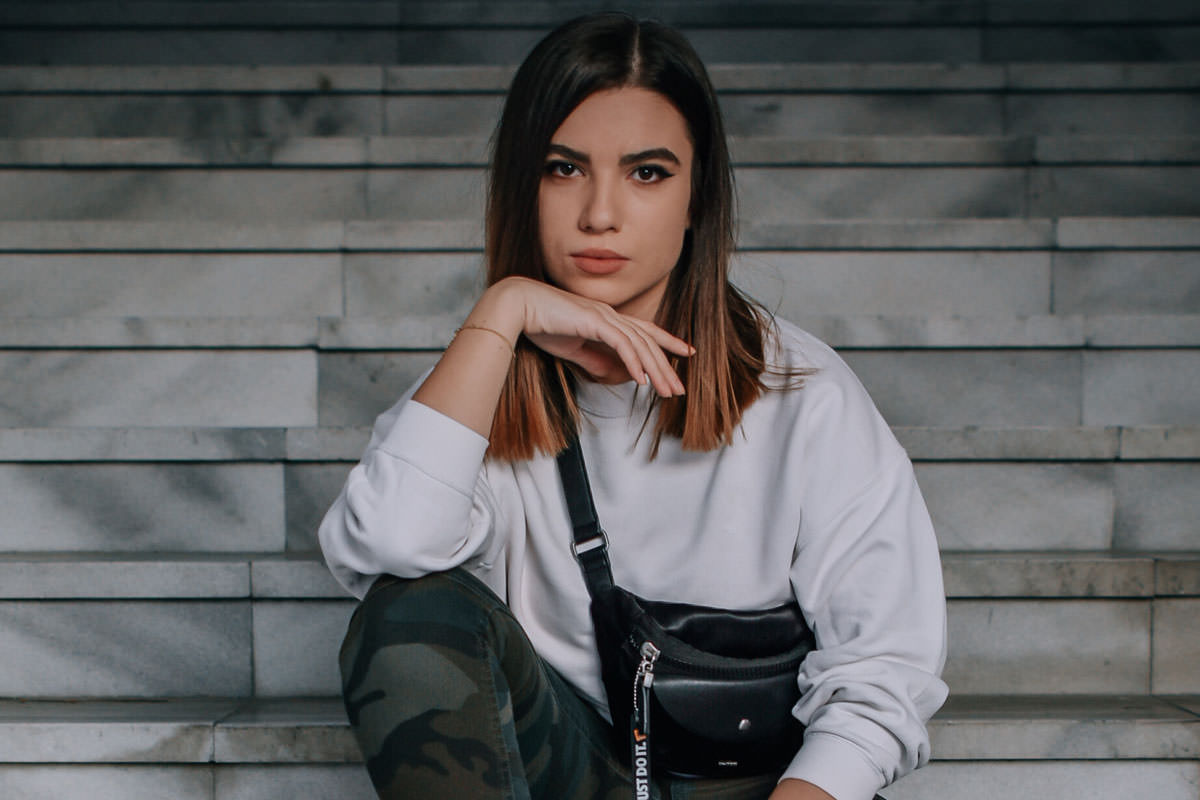
This Tutorial as a Step-by-Step PDF
The guide walks through both halves: a Curves layer pulled up for the dodge and one pulled down for the burn, each mask inverted with Ctrl/Command+I and painted white, then blended with Image > Apply Image (Merged, RGB, Multiply, 100), with Invert checked only for the burn. Keep it next to your keyboard.
description
This dodge and burn approach is close to foolproof, because it lets the photograph’s own lights and darks decide where the effect lands instead of leaning entirely on hand-painted judgment. It is built from two Curves adjustment layers and one blending trick, so it stays non-destructive throughout. Create a Curves layer to dodge, invert the mask and paint white to reveal it, blend it with Apply Image, then repeat with a second Curves layer to burn toward the edges.
Enjoying This Free Tutorial?
We publish a new free tutorial every week, each one with sample images and PSDs you can download and follow along with. Sign up and they land straight in your inbox, along with early word on sales, events and subscriber-only offers.

Simple Dodge and Burn in Photoshop
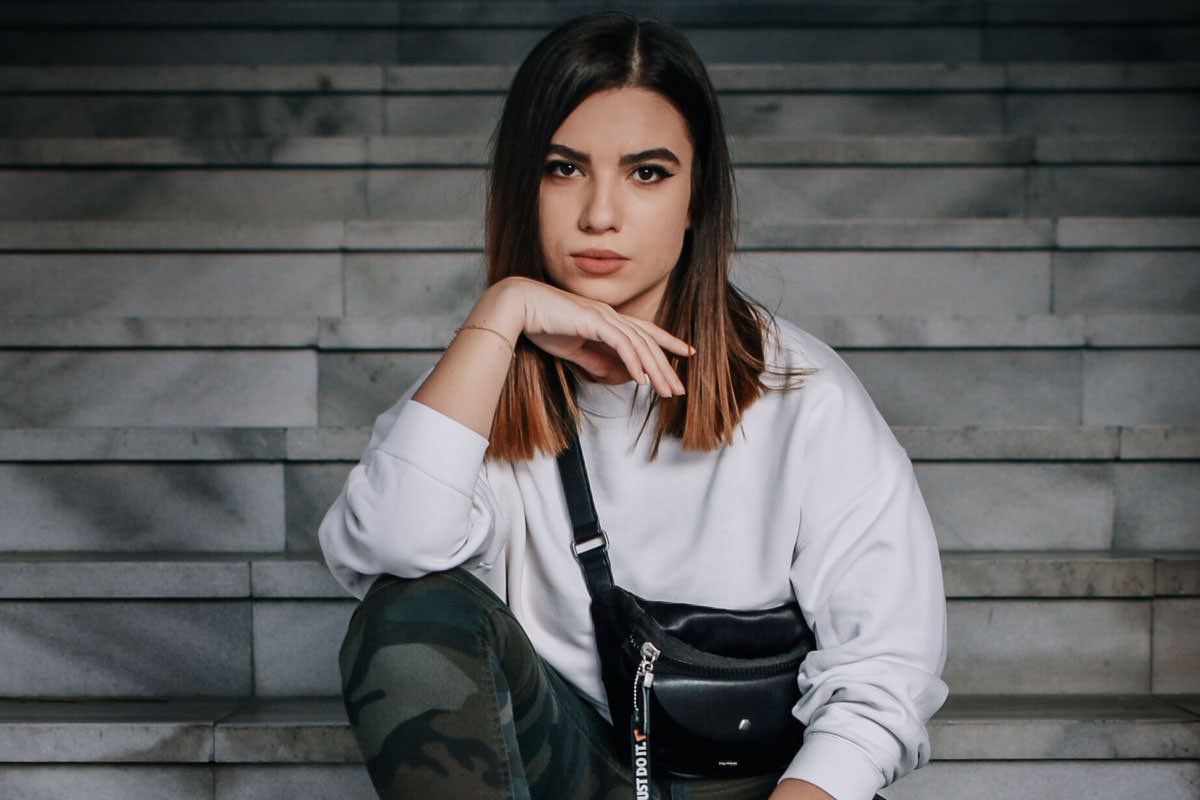
This dodge and burn technique is essentially foolproof because it uses the photograph’s own lights and darks to decide exactly where the effect should show up, rather than relying purely on hand-painted judgment. Built entirely from two Curves adjustment layers and one image-based blending trick, it stays fully non-destructive and adjustable at every stage. The sample photo is by Bogdan Glisik on Unsplash.
Create a Curves Adjustment Layer for Dodging
Layer > New Adjustment Layer > Curves adds the first layer of the technique. Pulling the curve upward brightens the image, which is the basic dodge effect this first layer will apply.
Invert the Mask and Paint White to Reveal the Dodge Effect
Every new adjustment layer starts with a white mask, meaning the brightening effect shows up everywhere by default. Pressing Command/Ctrl+I inverts that mask to black, hiding the effect completely, and then painting white directly onto the mask over just the areas that should actually get brighter reveals the dodge effect exactly where it’s wanted, rather than across the whole image.
Blend the Dodge with Apply Image
At this stage, the brightened area technically works, but it tends to look obviously painted on rather than a natural part of the photograph.
Why the Effect Looks Painted On Before Blending
A simple painted mask applies the same strength of brightening uniformly across the painted area, regardless of what’s actually going on in the image underneath it, which is exactly why it reads as artificial rather than photographic.
Understand What Apply Image’s Settings Are Doing
Going to Image > Apply Image with the layer mask targeted lets the mask itself pull information directly from the image’s own tonal values, blending the dodge effect in a way that responds to what’s actually light and dark in the photo rather than applying evenly.
The Default Apply Image Settings
The default settings work correctly here: Layer set to Merged, Channel set to RGB, Blending set to Multiply, Opacity at 100, and Invert left unchecked. Holding Alt/Option and clicking the layer mask afterward reveals that the mask itself now visibly reflects the image’s own lights and darks, rather than the flat painted shape from before.
Create a Second Curves Layer for Burning
Layer > New Adjustment Layer > Curves adds a second layer, this time with the curve pulled downward to darken the image instead, forming the burn half of the technique.
Paint the Burn Effect Toward the Edges
Command/Ctrl+I inverts this second layer’s mask to black the same way as before, and a large, soft-edged brush painting white toward the outer edges of the image reveals the darkening effect specifically around the outside of the frame, a natural place for a burn effect to draw the eye inward toward the subject.
Invert the Blend for the Burn Layer
Clicking this burn layer’s mask and going to Image > Apply Image again blends it into the photo’s real tonal information the same way as the dodge layer.
Why Burn Uses the Inverted Option
This time, checking the Invert option in the Apply Image dialog is essential, since it flips the blend so the darkening effect becomes visible in the image’s darker areas rather than its lighter ones, the correct behavior for a burn effect that should deepen shadows rather than compete with existing highlights.
Adjust Dodge and Burn Levels Non-Destructively After the Fact
Because both effects live on separate Curves adjustment layers, double-clicking either one’s curve at any point afterward reopens it for further adjustment, brighter or darker for the dodge layer, darker or lighter for the burn layer, based on how the overall blend is actually reading against the photo. Since both layers are already blended against the image’s own tonal information via Apply Image, any later adjustment stays realistic rather than needing to be re-blended from scratch each time.
Why This Technique Is Considered Foolproof
The single detail that makes this dodge and burn method so reliable is Apply Image: instead of trusting a hand-painted mask to look convincing on its own, the mask gets rebuilt directly from the photo’s actual tonal information, brightening the dodge layer where the image is already relatively light and darkening the burn layer where the image is already relatively dark. That built-in feedback loop between the mask and the photo itself is what keeps the final result looking photographic rather than obviously edited, no matter how the two Curves layers get adjusted afterward.
Final Thoughts
Two Curves adjustment layers, one pulled brighter and one pulled darker, each masked with a rough paint pass and then refined through Apply Image, cover the entire dodge and burn technique from start to finish. Keeping both effects on separate, fully adjustable layers means the strength of the dodge and the burn can keep evolving after the fact, without ever needing to redo the painting or the blending from scratch.
Quick Reference: Keys, Menus and Settings
- Dodge layerLayer > New Adjustment Layer > Curves, pull the curve up
- Hide itSelect the mask, Cmd/Ctrl + I, then paint white over the subject
- Blend the dodgeImage > Apply Image: Merged, RGB, Multiply, 100, Invert not checked
- View the maskAlt/Option-click the layer mask
- Burn layerSecond Curves layer pulled down, Cmd/Ctrl + I, paint white toward the edges with a large soft brush
- Blend the burnClick the mask, Image > Apply Image, same settings with Invert checked
- Fine-tuneDouble-click the layer’s Curves icon
No AI, no generative credits.
Free Downloads
Follow Along on the Same Photo
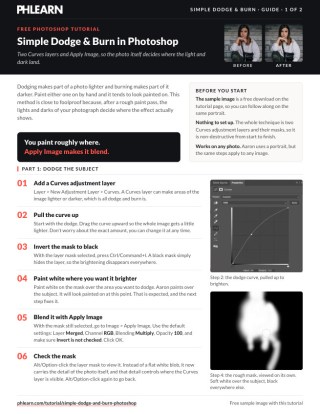
Get the portrait of a woman on marble steps used in the video, plus the 2-page PDF guide with both Curves layers and the Apply Image settings. Free with a PHLEARN account.
Dodge and Burn With Curves: Common Questions
What do dodging and burning mean?
Dodging makes part of a photo lighter and burning makes part of it darker. Here each one is a Curves adjustment layer: the curve pulled up for the dodge, pulled down for the burn.
Why invert the mask to black?
A new adjustment layer shows its effect everywhere. Press Cmd/Ctrl + I with the mask selected to turn it black and hide the effect, then paint white only where you want it.
Why does my dodge look painted on?
A plain painted mask applies the same strength everywhere you painted, whatever is underneath. That look is normal after the paint pass; Image > Apply Image fixes it by putting the photo’s own tones into the mask.
What Apply Image settings should I use?
The defaults: Layer Merged, Channel RGB, Blending Multiply, Opacity 100, with Invert not checked for the dodge. Click OK.
Why check Invert for the burn layer?
It makes the burn visible in the darker areas of the photo. Invert is the only difference: unchecked for the dodge, checked for the burn.
Do I need to select the mask before Apply Image?
Yes. Click the layer mask before you open Image > Apply Image, so the result lands in the mask.
How do I see what Apply Image did to the mask?
Hold Alt/Option and click the layer mask. Instead of a flat white shape, it now carries the detail of the photo itself. Alt/Option-click again to go back.
Where should I paint the burn?
Aaron uses a large, soft-edged brush to paint white toward the outsides of the image, so the darkening shows around the edges of the frame.
Can I change the strength afterward?
Yes. Double-click the Curves icon on the dodge or burn layer and make it brighter or darker. Because the masks are already blended with the photo, it stays realistic.
Is the sample file free?
Yes, with a free PHLEARN account. You get 1 sample image and 1 PDF guide: the portrait from the video and a 2-page guide to every step.
Master Photoshop, Lightroom and Photography
Join PHLEARN PRO for $12.99 a month or $99.99 a year. Cancel anytime, with a 100% money-back guarantee.