

Download Assets
This tutorial includes 1 sample PSD and 1 PDF guide. Downloads are free with a PHLEARN account.
- Download the sample images and PSDs from every free tutorial on PHLEARN
- New free tutorials published every week
- One free account — sign up once, then download anything
Free PDF Guide · 4 Pages
This Tutorial as a Step-by-Step PDF
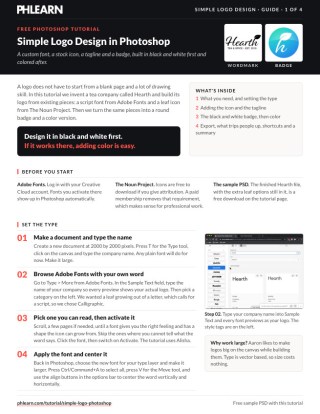
The guide builds the Hearth logo step by step: a 2000 by 2000 document, a script font from Type > More from Adobe Fonts, an SVG leaf from The Noun Project, a tagline centered to a marquee, a black and white badge, then a Radial Gradient set to Lighten. Keep it next to your keyboard.
description
A simple logo doesn’t need to start from a blank page and a lot of drawing skill. Learn how to pair a custom font from Adobe Fonts with a vector icon from a stock library, integrate the two so the icon follows the letterform, and add a tagline that supports the wordmark without competing with it. Then build an icon-only badge version — black and white first, color and gradients after — and export a transparent PNG you can drop onto any background.
For more on this, see How to Create Graphics & Logos in Photoshop.
Enjoying This Free Tutorial?
We publish a new free tutorial every week, each one with sample images and PSDs you can download and follow along with. Sign up and they land straight in your inbox, along with early word on sales, events and subscriber-only offers.
Image Source
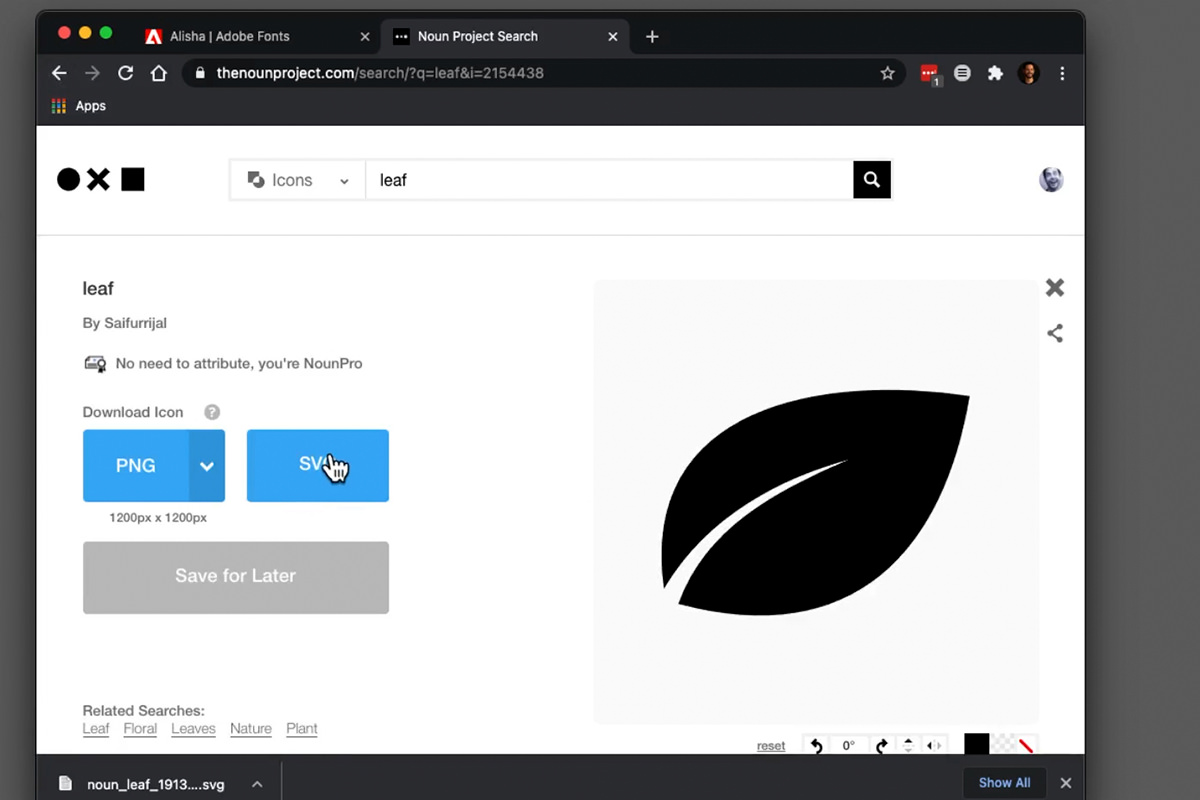
Icon by Saifurrijal via The Noun Project

How to Design a Simple Logo in Photoshop
A logo doesn’t need to start from a blank page and a lot of drawing skill — combining a strong custom font with an existing icon, then building out black-and-white and color versions from the same core elements, gets you a workable set of logo options quickly. This walkthrough builds a fictional tea company’s logo from scratch, but the same steps apply to any wordmark-plus-icon design.
Setting Up Your Document and Type
Every logo needs a name to build around before anything else can happen.
-
Create a New Document
Start a new document sized around 2000 by 2000 pixels — large enough to work on a badge-style logo comfortably.
-
Type Your Company Name
Press T for the Type tool, click on the canvas, and type your company or brand name in a placeholder font to get started.
Finding a Custom Font with Adobe Fonts
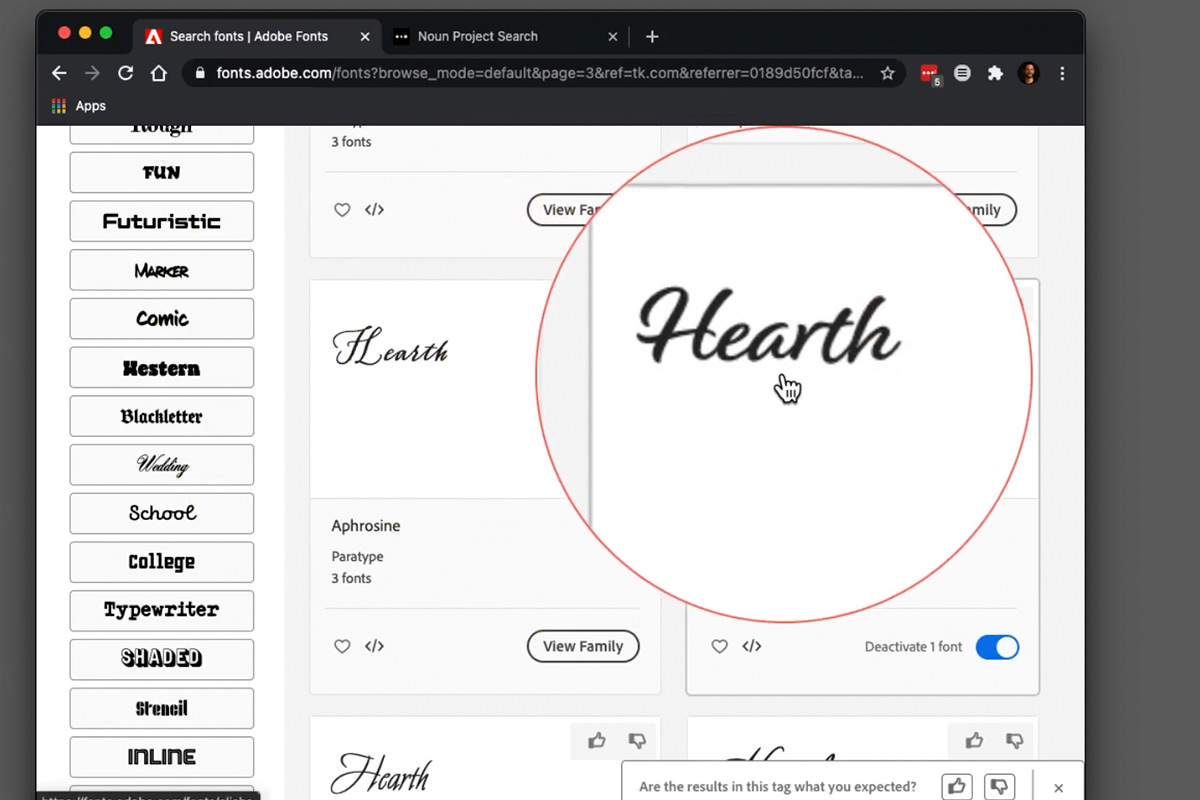
A generic system font rarely has the character a logo needs, so browsing a proper font library for something with the right feel is worth the extra few minutes.
-
Open More From Adobe Fonts
Go to Type > More from Adobe Fonts, signed in with your Creative Cloud account, to browse fonts by category.
-
Type Your Company Name as the Sample Text
In the sample text field, type your own company name so every font preview shows exactly how your logo’s wording will look, and filter by a style category that fits the brand’s personality — calligraphic and script categories, for example, work well for something that should feel handcrafted.
-
Activate and Apply the Font
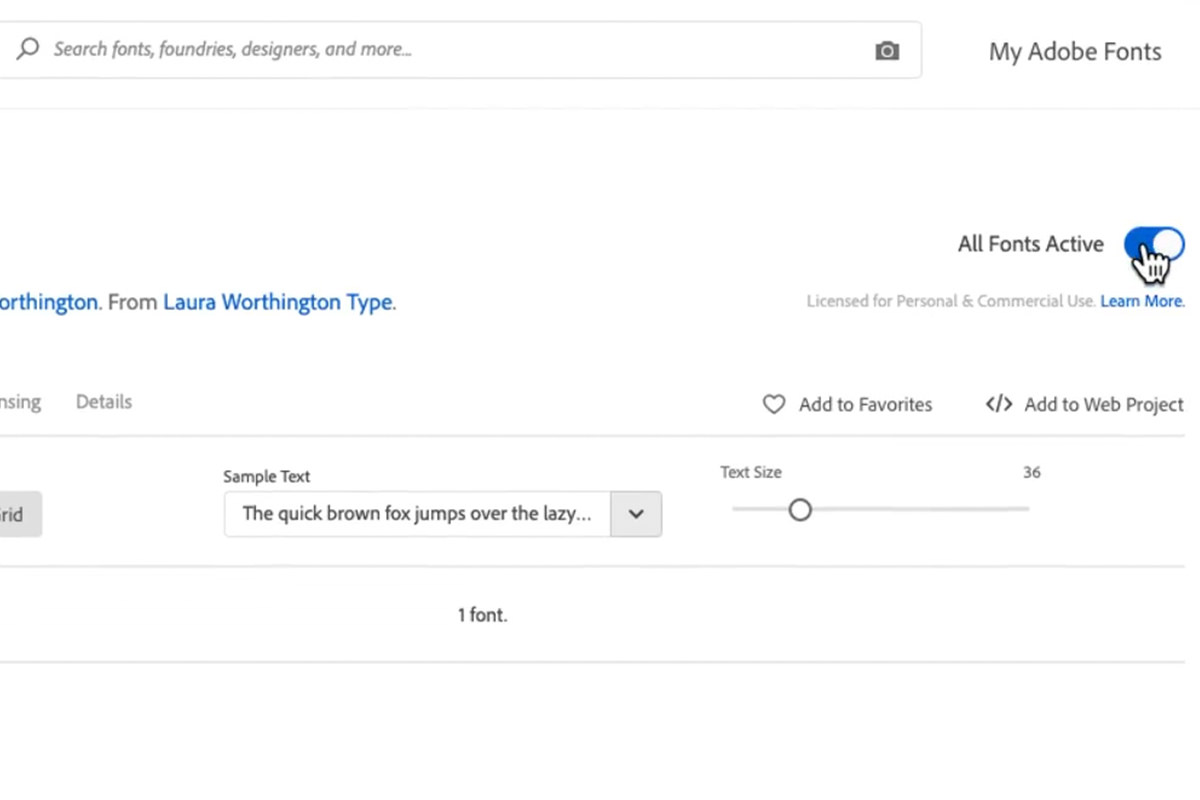
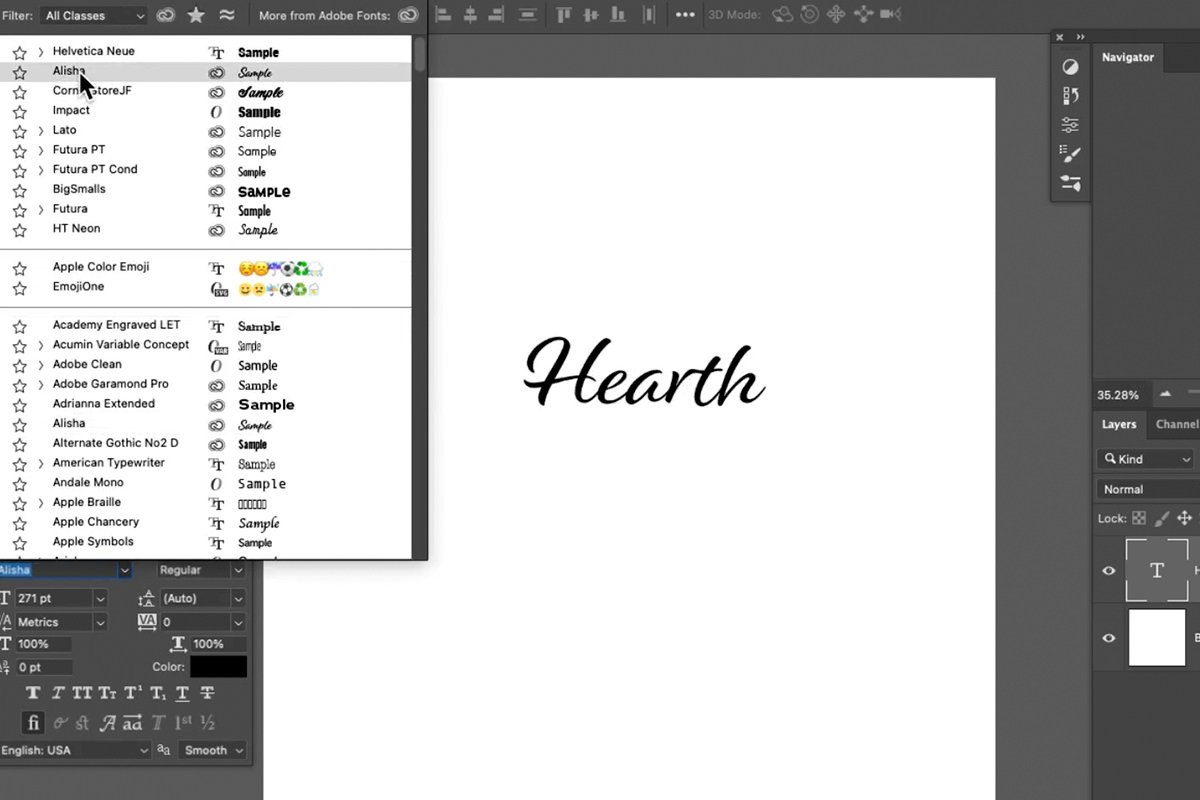
Once you find a font that’s stylish but still easy to read, click Activate to make it available in Photoshop immediately. The tutorial uses Alisha. Apply it to your logo text and make it larger, then press Cmd/Ctrl + A to select all, press V for the Move tool and use the align buttons in the options bar to center the word vertically and horizontally on the canvas.
Adding a Custom Icon from a Stock Library
An icon or small graphic element gives a wordmark logo more personality than text alone, and you don’t need to draw one from scratch to get a good starting point.
-
Search a Stock Icon Library
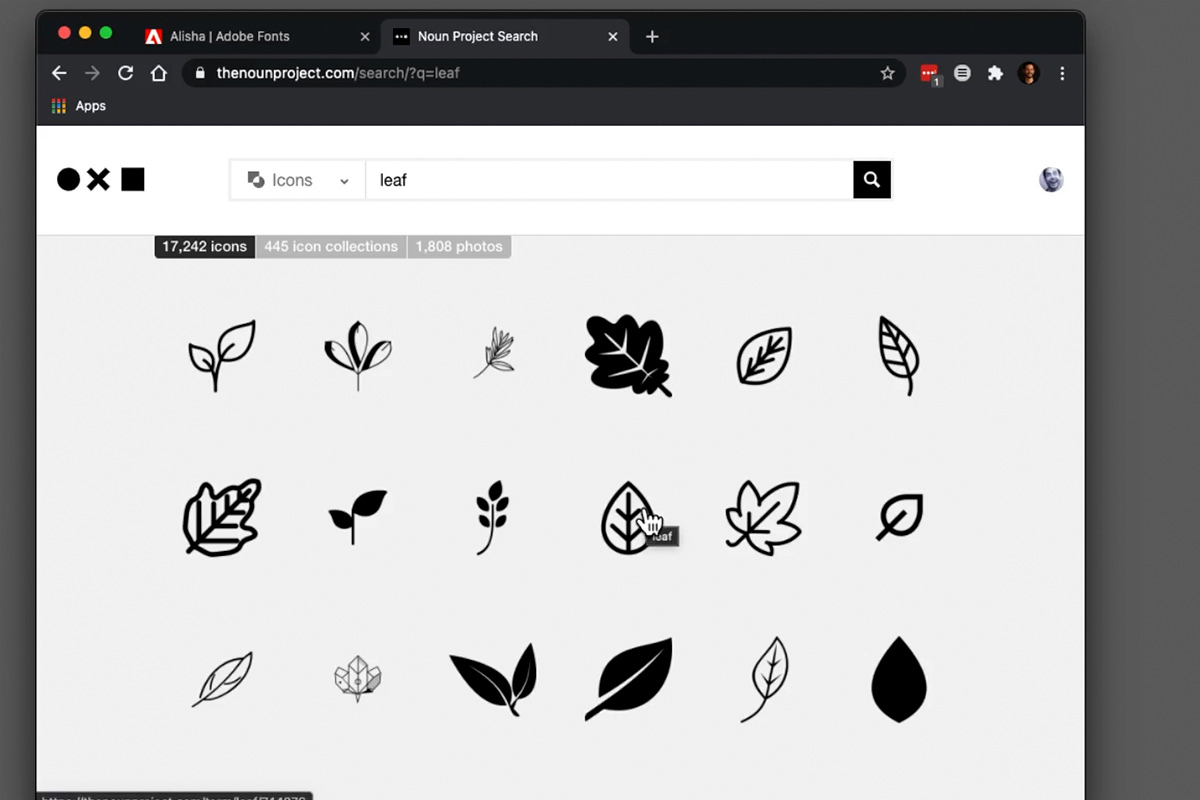
Visit a resource like The Noun Project and search for an icon related to your brand — a leaf, in this example, for a tea company.
-
Download the Icon as an SVG
Download your chosen icon as an SVG file so it comes in as scalable vector artwork rather than a fixed-resolution image, matching the vector nature of your type layer.
-
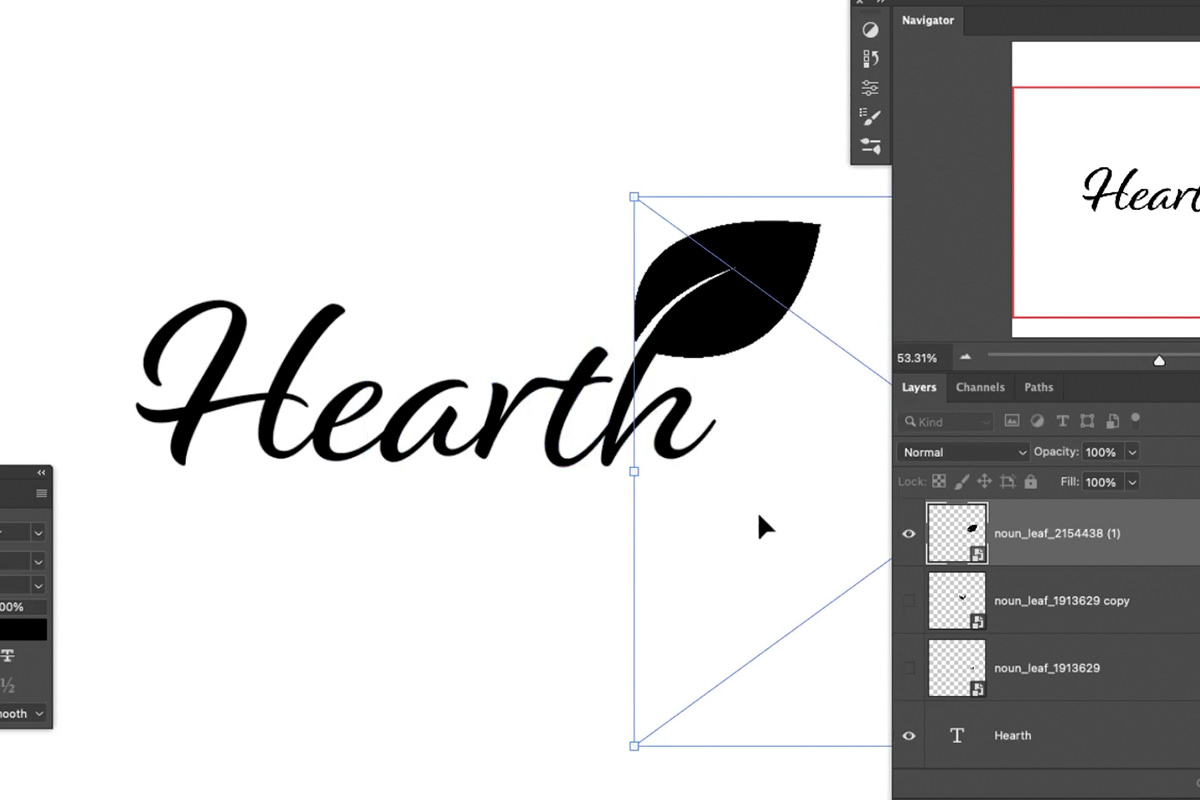
Drag the Icon into Photoshop
Drag the downloaded SVG file directly into your Photoshop document, then press Enter to place it.
Why Start From an Existing Icon Instead of Drawing One
A stock icon library gives you a clean, already-vectorized starting point that would take much longer to draw from scratch, and browsing a variety of options for the same concept helps clarify what you actually want the final icon to look like — even if you end up modifying it heavily or combining pieces from more than one result.
Integrating and Positioning Your Icon
A logo icon reads as intentional, rather than pasted on, when it follows the natural shape of the letters it’s paired with.
-
Scale and Flip as Needed
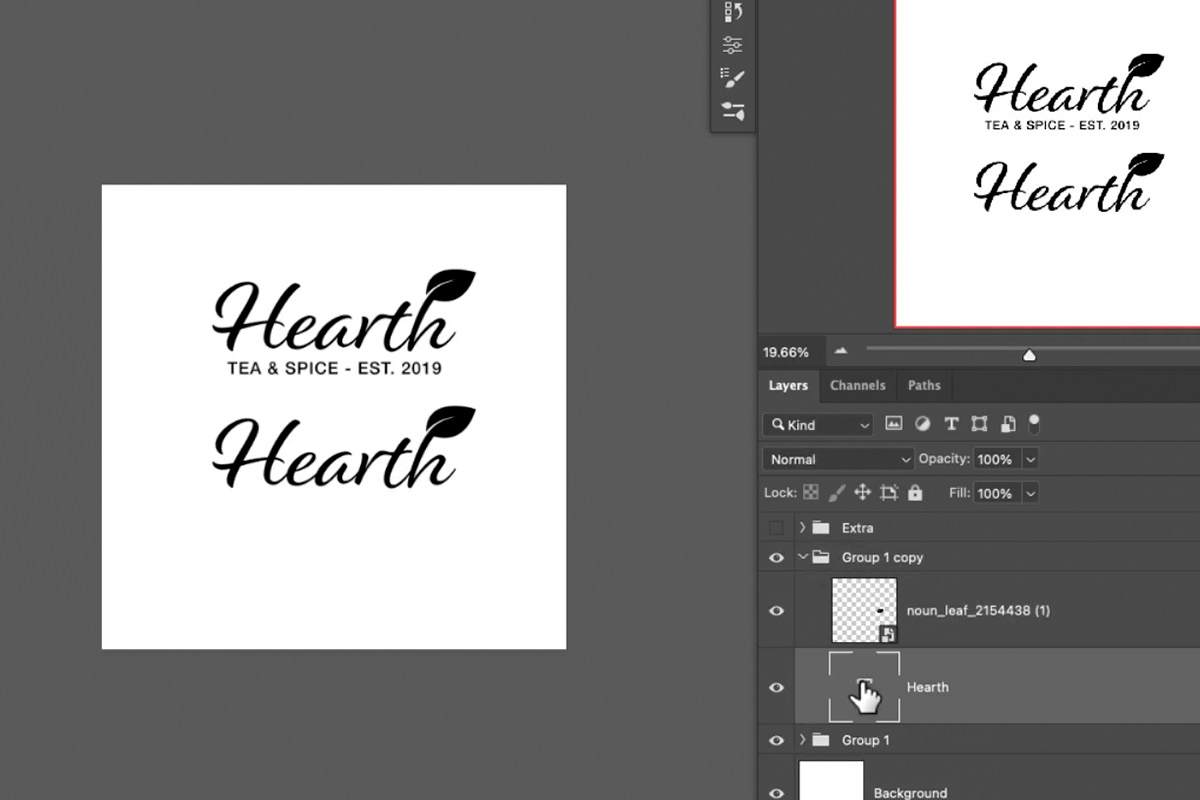
Press Ctrl + T on PC (Cmd + T on Mac) to freely transform the icon, scaling it to a size that complements the text, and right-click the transform box to flip it horizontally if that better matches the direction of your lettering.
-
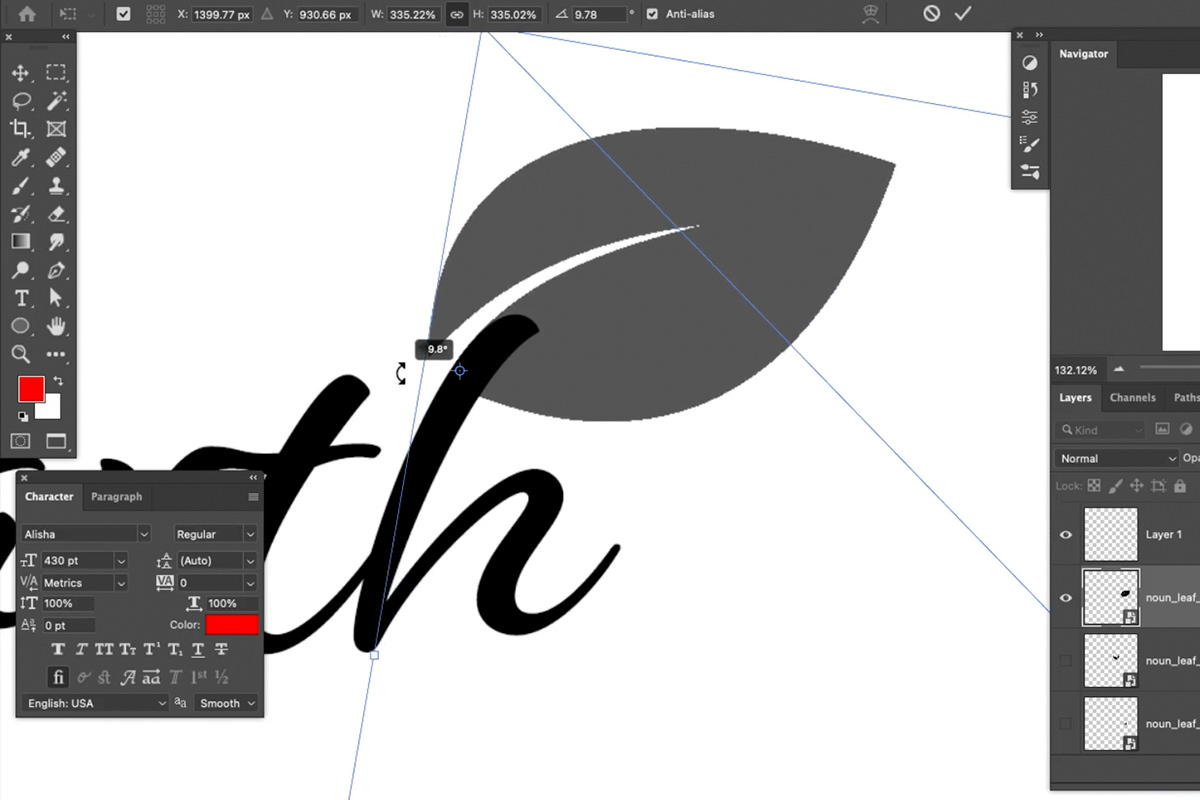
Rotate to Follow the Letterform
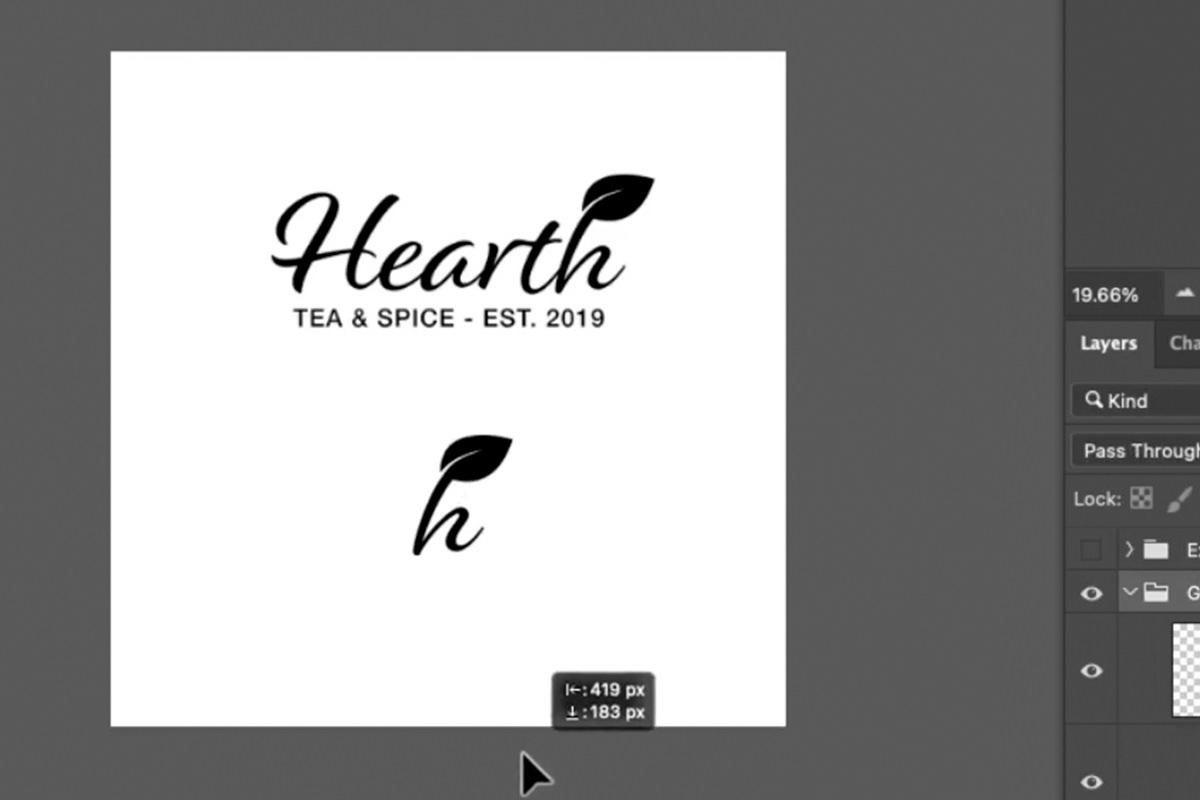
Lower the icon’s opacity so you can see the letter through it, press Cmd/Ctrl + T and rotate the icon so its angle follows the natural curve of the letter it’s emerging from, so the two pieces feel like they belong to the same design rather than sitting at odds with each other.
-
Check Legibility at Full Opacity
Bring the icon’s opacity back up to full and confirm the text is still completely legible with the icon in place — if the icon competes with the wordmark, scale it down or reposition it until the words read clearly first.
Adding a Secondary Tagline
A short line of secondary text underneath the main wordmark can round out a logo without competing with it.
-
Add a New Type Layer
Hold Shift and click with the Type tool to start a fresh type layer rather than editing your existing text, and type your tagline — a short descriptor of what the company does.
-
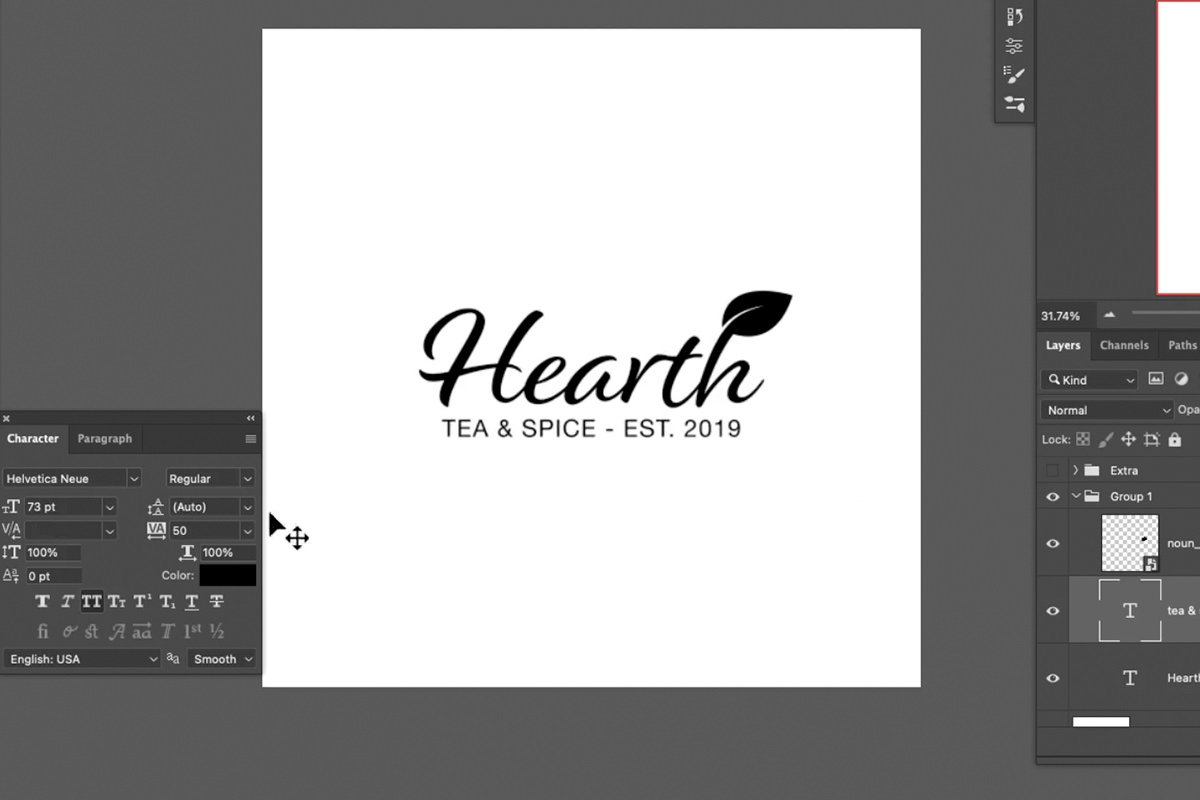
Choose a Simpler, Smaller Font
The tagline in the video is “tea & spice.” Apply a plainer, more formal font to it (Helvetica Neue), set it to All Caps, center align the paragraph, make it noticeably smaller than the main logo text and widen the letter spacing in the Character panel. To fill the width without making it bigger, add words instead; the video adds “EST. 2019.” Zoom out to check it from far away; if it disappears, make it heavier (the video switches to Medium). All of this keeps it small enough that it doesn’t compete with the primary wordmark.
-
Center the Tagline Under the Logo
Draw a marquee selection the width of your main text (not including the icon). With the selection active and the tagline layer selected, press V for the Move tool and click the horizontal center align button to center the tagline on the word, then hold Shift and drag it straight down into place.
Creating an Icon-Only Badge Version
A second, simplified version of the logo — just a single letter or icon inside a circular badge — is useful as a standalone mark for smaller applications like a social media avatar.
-
Isolate a Single Letter
Group the word and the leaf with Cmd/Ctrl + G, then select the logo group, press Cmd/Ctrl + J to duplicate it and move the copy down. Delete the tagline from the copy and edit the name down to just the first letter, with the leaf still attached, to use as the centerpiece of a badge mark.
-
Draw a Circle Behind It
Select the Ellipse tool, hold Shift, and drag out a circle, filling it with black and placing it behind your letter and icon.
-
Recolor the Letter and Icon to White
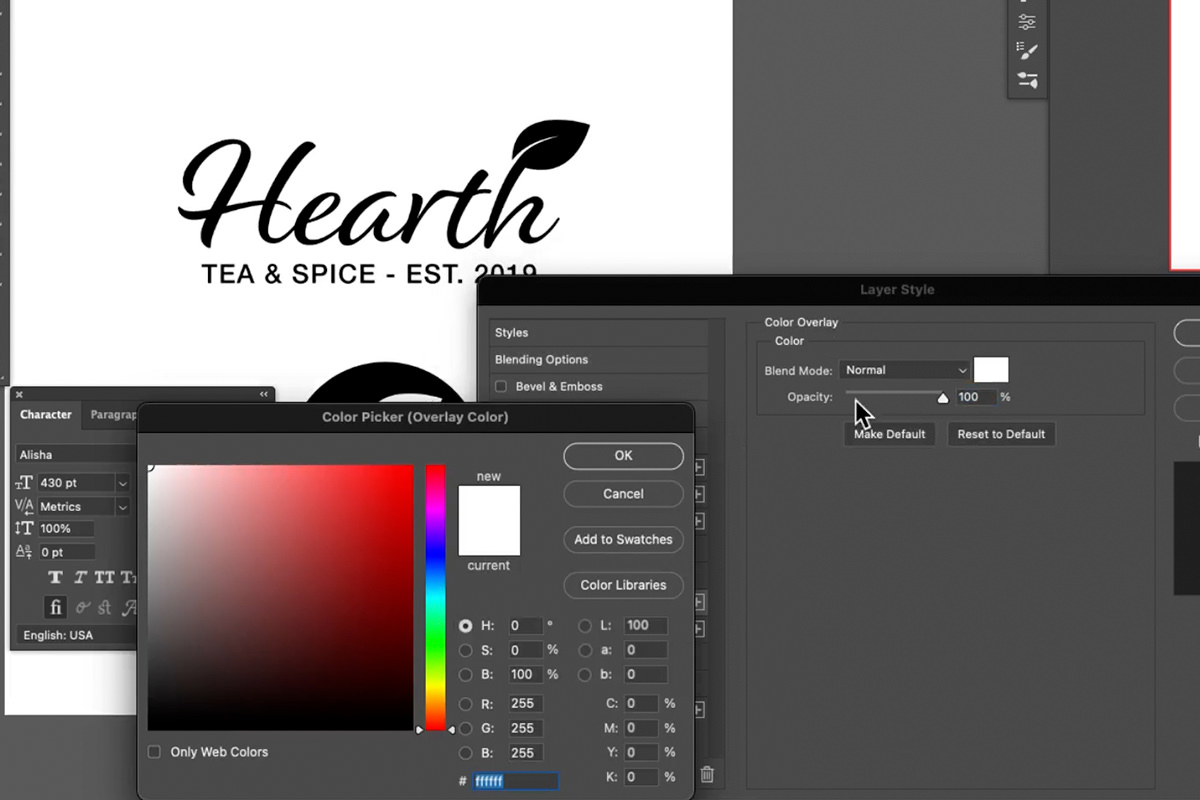
Change your letter’s font color to white in the Character panel, then double-click the icon layer, add a Color Overlay layer style, and set it to white as well, so both elements stand out clearly against the black circle.
Why Design in Black and White First
Starting with a high-contrast black-and-white version forces the logo’s shapes and spacing to work on their own, without color doing any of the visual heavy lifting. A design that reads clearly in black and white will almost always translate well once color is added, while a design that only works because of its colors often falls apart the moment it’s printed or displayed in black and white.
Automatically Centering Your Elements
Rather than eyeballing the position of the letter and icon inside the circle, Photoshop’s alignment tools can center them precisely.
-
Turn the Circle into a Selection
Hold Ctrl on PC (Cmd on Mac) and click the circle layer’s thumbnail to load it as a selection.
-
Group and Align Your Elements
Group your letter and icon layers together, select that group with the Move tool active, and use the horizontal and vertical center-align buttons at the top of the screen to snap the group exactly into the center of the circular selection.
Adding Color and Gradient Variations
Once the black-and-white badge is working, adding subtle color and gradient variations gives you additional options to present.
-
Add a Gradient on a New Clipped Layer
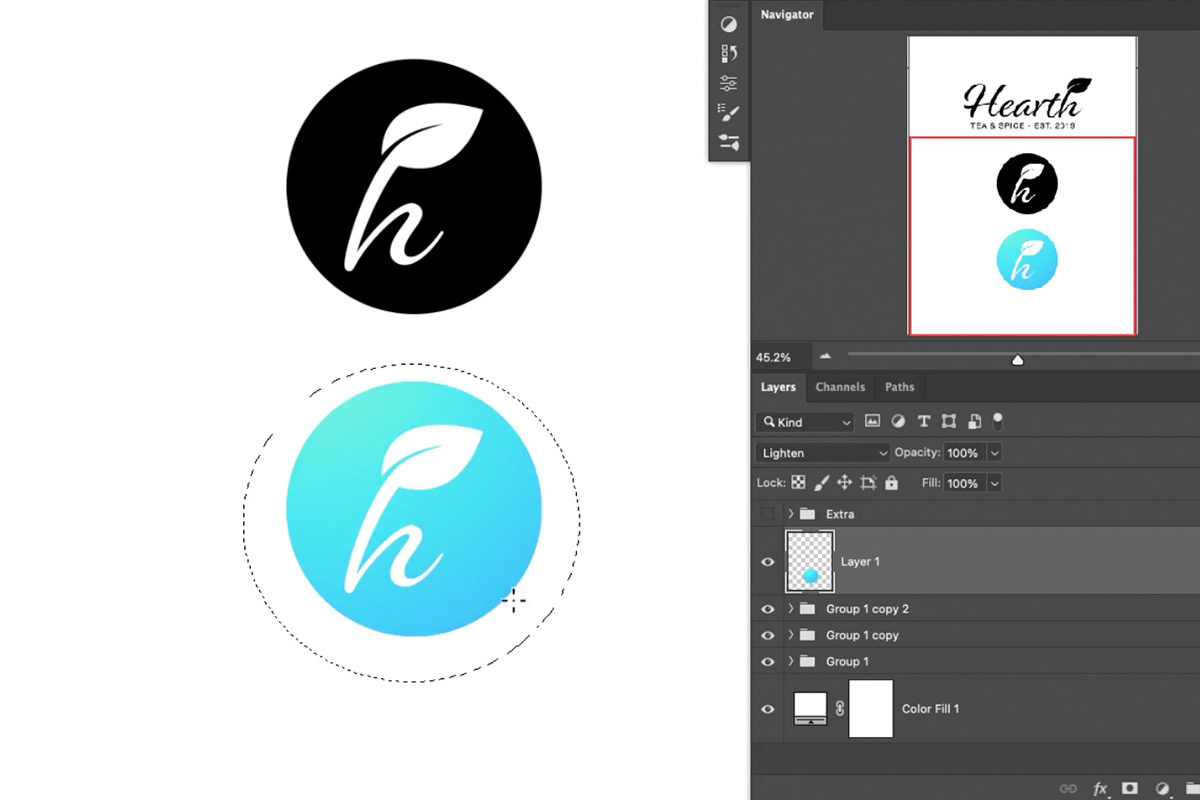
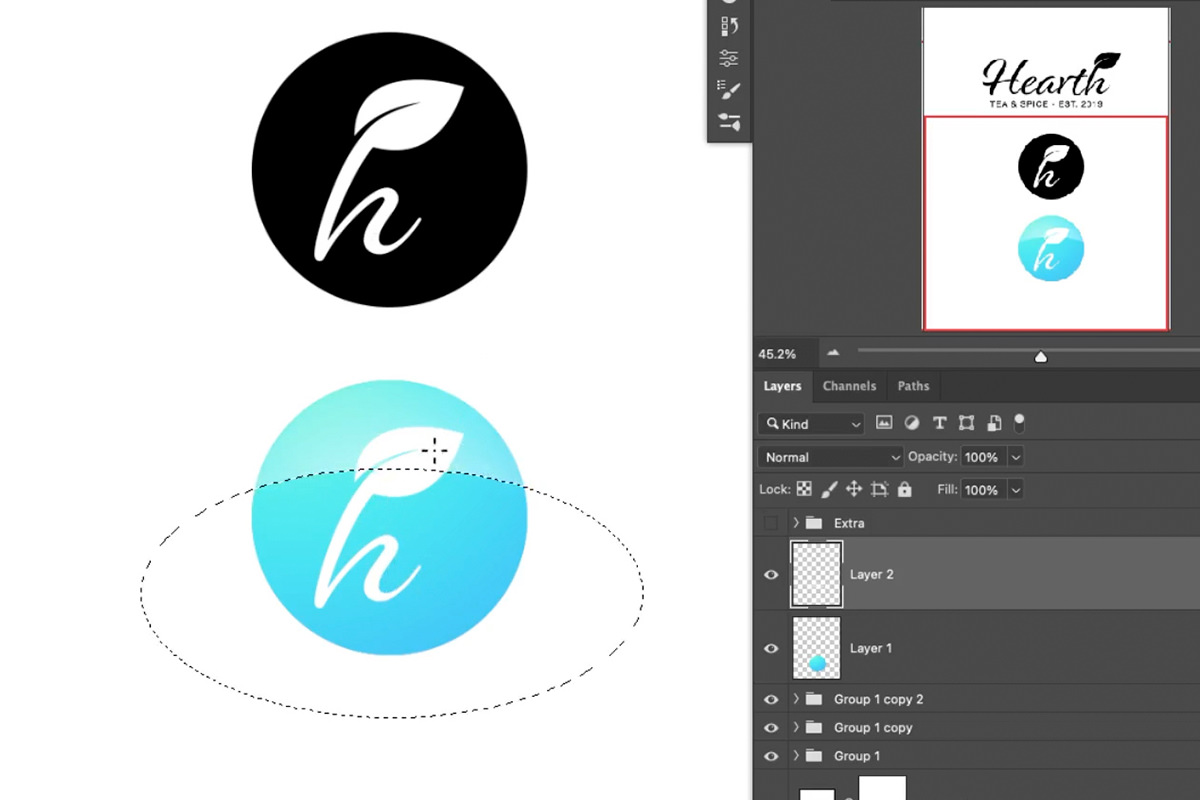
Select the badge group, press Cmd/Ctrl + J to duplicate it and move the copy down. If you run out of room, press C for the Crop tool and drag the crop box out to extend the canvas. Create a new layer above the badge group, draw an elliptical marquee around the badge, and use the Gradient tool with a radial gradient to paint color into that selection, then set the layer’s blending mode to Lighten so it only lightens the black circle rather than covering it.
-
Add a Soft Highlight
On another new layer, make a selection, invert it with Select > Inverse, switch your gradient to Foreground to Transparent with white as the foreground color, and drag out a subtle highlight, then lower that layer’s opacity until it reads as a gentle sheen.
-
Clip and Group the Color Layers
Select your gradient and highlight layers together and press Alt + Ctrl + G on PC (Option + Cmd + G on Mac) to clip them to the badge group beneath them, then group everything together so the finished badge behaves as a single, self-contained element.
Why Clip the Color Layers to the Badge
Clipping the gradient and highlight layers to the badge group beneath them means the color effects can only ever affect the badge, no matter how far you drag a gradient or how large a selection you make. That keeps the color experiments contained and non-destructive, so you can try several different gradients quickly without ever risking color spilling outside the badge shape.
Exporting Your Finished Logo
With a version chosen, the last step is getting the logo out of Photoshop in a usable format.
-
Export as a Transparent PNG
Use Photoshop’s export options to save your logo as a transparent PNG, which works well for placing the logo over photos, websites, or other backgrounds.
When You’ll Need a True Vector Export
Photoshop is well suited to exporting flattened, transparent PNGs, but it isn’t built for true vector file exports the way Illustrator or Affinity Designer are. If a client or print vendor specifically needs a scalable vector file (an AI, EPS, or SVG), that final export step should happen in a dedicated vector application rather than Photoshop.

Why This Approach Works
Designing in stages — type first, then an icon, then a black-and-white badge, then color — keeps every decision testable on its own before it gets locked into the next stage. Starting with a strong custom font and a vector icon means the whole logo stays fully scalable, since neither text nor SVG artwork loses quality no matter how large or small the final logo needs to be. Building the color badge as its own clipped, grouped set of layers on top of an already-working black-and-white version means you can experiment freely with gradients and color without ever risking the core design, which is exactly the kind of low-stakes iteration that produces a handful of genuinely different options to choose from rather than one all-or-nothing attempt.
Final Thoughts
A simple logo built this way — a well-chosen custom font, a modified stock icon, and a black-and-white badge before color — covers most of what a small brand actually needs, and the process scales up naturally into more variations the more time you spend on it. Treat your first finished version as a first round rather than a final answer: it’s much easier to generate a few different options quickly and compare them side by side than to try to perfect a single logo in isolation. Once the core wordmark and icon are solid, everything else — the badge, the tagline, the color treatment — is just building additional presentations of the same core idea.
Quick Reference: Keys, Menus and Settings
- Start the logoNew document, 2000 by 2000 pixels; T for the Type tool
- Find a fontType > More from Adobe Fonts: your name in Sample Text, Calligraphic, then Activate
- Center on the canvasCmd/Ctrl + A, V, then the align buttons in the options bar
- Fit the iconDrag the SVG in and press Enter; Cmd/Ctrl + T, right-click > Flip Horizontal, rotate to follow the letter
- TaglineShift-click with the Type tool; center it to a marquee the width of the word
- Center the badgeCmd/Ctrl-click the circle’s thumbnail, select the group, V, both center align buttons
- Add colorG Radial Gradient on a new layer set to Lighten; Alt/Option + Cmd/Ctrl + G clips it to the badge
No AI, no generative credits. Export a transparent PNG from Photoshop; for vector files, Illustrator or Affinity.
Free Downloads
Follow Along with the Same PSD
Get the finished Hearth logo PSD, with the extra leaf options still inside, and the 4-page PDF guide. Free with a PHLEARN account.
Simple Logo Design: Common Questions
Where do I find a good font for a logo?
Go to Type > More from Adobe Fonts, signed in with your Creative Cloud account. Type your company name in Sample Text, pick a category (the video uses Calligraphic), choose one you can actually read and click Activate. The tutorial uses Alisha.
Where does the leaf icon come from?
The Noun Project. Search for your subject, here “leaf,” and download the icon as an SVG. It is vector based like your type, so the logo scales larger or smaller without losing resolution. Free downloads need attribution; a paid membership removes that.
Why does clicking with the Type tool edit my existing text?
A plain click near existing type starts editing it. Hold Shift and click with the Type tool to start a new type layer for the tagline.
How do I center the tagline under the word and not the leaf?
Draw a marquee as wide as the word only, leaving the leaf out. With the tagline layer selected, press V and click the horizontal center align button, then Shift-drag the tagline straight down.
How big should the tagline be?
Small, so it doesn’t compete with the name. Use a plain font in All Caps with wider letter spacing, and add words instead of enlarging it. Zoom out to check it; the video switches it to Medium when it disappears at a distance.
Why design the logo in black and white first?
If a logo works in black and white, there’s a good chance it works in color. Black and white gives you a lot of contrast, and adding color afterward is easy.
How do I turn the leaf icon white?
The leaf isn’t type, so the Character panel can’t recolor it. Double-click its layer, turn on Color Overlay in Layer Style and choose white.
How do I center the letter exactly in the circle?
Group the letter and the leaf with Cmd/Ctrl + G, then Cmd/Ctrl-click the circle’s thumbnail to load it as a selection. Click the group, press V and click both center align buttons in the options bar.
How do I add color without it spilling outside the badge?
Paint a Radial Gradient on a new layer, set its blend mode to Lighten, then press Alt/Option + Cmd/Ctrl + G to clip it to the badge group below.
Are the sample files free?
Yes, with a free PHLEARN account. You get 1 sample PSD and 1 PDF guide: the finished Hearth logo file, with the extra leaf options still in it, and a 4-page step-by-step guide.
Master Photoshop, Lightroom and Photography
Join PHLEARN PRO for $12.99 a month or $99.99 a year. Cancel anytime, with a 100% money-back guarantee.