
Download Assets
This tutorial includes 1 PDF guide. Downloads are free with a PHLEARN account.
- Download the sample files from every free tutorial on PHLEARN
- New free tutorials published every week
- One free account: sign up once, then download anything
Free PDF Guide · 3 Pages
This Tutorial as a Step-by-Step PDF
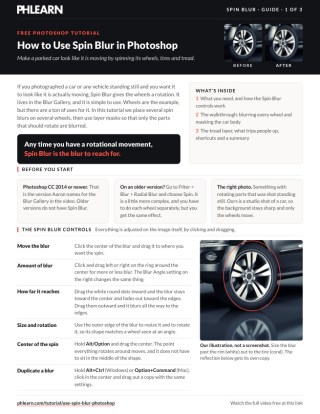
This 3-page guide walks through Filter > Blur Gallery > Spin Blur on a parked car: duplicate the Background layer, size each blur to the wheel and tire, set Blur Angle 10, copy blurs onto every wheel and reflection, mask out the car body, then blur the tread on its own layer. Keep it next to your keyboard.
description
A car sitting still in a studio can be made to read as moving by spinning only its wheels. Aaron places Spin Blur points from the Blur Gallery on each wheel, sizes them so the tire rotates with the rim, duplicates and recenters them across the other wheels, then masks the blur off the car’s body and gives the tire tread its own separate, smaller blur on a second layer.
Enjoying This Free Tutorial?
We publish a new free tutorial every week, each one with sample images and PSDs you can download and follow along with. Sign up and they land straight in your inbox, along with early word on sales, events and subscriber-only offers.

A car photographed standing still in a studio can be made to look like it’s actually moving by applying a rotational blur to its wheels, tires, and tread, using the Spin Blur found inside the Blur Gallery. This tutorial applies multiple spin blurs to a car’s wheels, duplicates them to match rotation across multiple wheels, then masks each blur so it only affects the spinning parts of the car rather than its static body.
Choosing an Image and Duplicating the Background
A vehicle or object photographed standing still, especially one with wheels or other rotating parts, is exactly the kind of image Spin Blur is designed to add convincing movement to.
-
Choose an Image With Rotational Elements
Pick an image like a stationary car, where wheels and tires are the natural place to add a sense of rotation.
-
Duplicate the Background Layer
Click the background layer and drag it to the New Layer icon to create a copy to apply the blur to.
Opening Spin Blur From the Blur Gallery
Spin Blur lives inside the Blur Gallery and arrived in Photoshop CC 2014, with an alternate Radial Blur method for older versions of Photoshop.
-
Open the Blur Gallery
Go to Filter > Blur Gallery > Spin Blur to open the Spin Blur dialog on the duplicated layer.
-
Use Radial Blur on Older Versions if Needed
On older Photoshop versions without the Blur Gallery, go to Filter > Blur > Radial Blur and choose Spin to apply a similar effect to each wheel individually.
Why Blur Gallery Isn’t Available in Every Photoshop Version
Spin Blur was added to the Blur Gallery in Photoshop CC 2014, so anyone using an older version of Photoshop won’t have access to it directly. The Radial Blur filter’s Spin option achieves a similar rotational effect on older versions, though it requires applying the blur to each wheel separately rather than adjusting multiple blur points within one dialog.
Controlling the Blur Center, Amount, and Angle
Spin Blur’s on-canvas controls adjust the blur’s center point, its amount, and how far it fades toward the edges, all directly by clicking and dragging within the dialog.
-
Move the Blur
Click the center of the blur and drag to move the whole blur where you want the spin. Hold Alt/Option and drag to move only the blur center, the point it rotates around.
-
Adjust Blur Amount
Click and drag left or right on the blur ring, or use the Blur Angle field in the sidebar, to increase or decrease how strong the spin effect is.
-
Adjust How Far the Blur Fades
Drag an inner control point inward or outward to change how much the blur fades toward the center versus extending all the way to the edges.
Sizing and Rotating the Blur to Match the First Wheel
Scaling and rotating the blur shape to closely match the actual wheel and tire, including the reflection beneath it, makes the effect look like it belongs to that specific part of the car.
-
Resize the Blur to Match the Wheel
Drag the outer edge of the blur shape to resize it so it closely matches the size of the actual wheel.
-
Extend the Blur to Cover the Tire
Drag the blur shape slightly larger so the tire spins along with the wheel, since one wouldn’t rotate without the other.
-
Recenter the Blur Precisely
Hold Alt/Option and click to reposition the blur’s exact center back onto the middle of the wheel.
-
Lower the Blur Amount
Lower the spin amount to taste. A Blur Angle of 10 works here.
Why Extending the Blur to the Tire Matters
Blurring only the wheel’s rim while leaving the surrounding tire perfectly sharp would look physically wrong, since a spinning wheel and its attached tire always rotate together. Sizing the blur so it covers both the wheel and the tire is what keeps the effect consistent with how a real rotating wheel actually behaves.
Duplicating and Adjusting the Blur for Additional Wheels
Holding a modifier key while dragging duplicates an existing spin blur point, which is faster than rebuilding the same settings from scratch on each additional wheel.
-
Duplicate the Blur Point
Hold Option/Alt+Cmd/Ctrl and click and drag from an existing blur center to duplicate it onto the wheel’s reflection or another wheel. The shiny floor reflects each wheel, so every reflection needs its own copy of the blur too.
-
Match Blur Angle Across Wheels
Set the same blur angle value, such as 10, on each wheel to keep the spin effect consistent throughout the image.
-
Rotate Each Duplicate as Needed
Rotate a duplicated blur point if that wheel’s angle or perspective differs slightly from the one it was copied from.
-
Recenter Each Duplicate
Hold Alt/Option and click to fine-tune each duplicated blur’s center so it lines up precisely with its own wheel.
Masking the Spin Blur to Just the Wheels and Tires
A layer mask painted with black over the car’s static body keeps the spin blur visible only where it belongs, on the wheels and tires themselves.
-
Apply the Spin Blur
Click OK in the Blur Gallery to apply all of the placed spin blur points at once.
-
Add a Layer Mask
Click the layer mask icon to add a mask to the blurred layer.
-
Paint Black Over Static Areas
Use the Brush tool to paint black over parts of the car that shouldn’t be blurred, such as the fender and body.
Why the Tread Needs Its Own Separate Blur Layer
The tread overlaps the wheel blur and needs a different blur of its own, so a single spin blur sized for the wheel can’t handle both. Applying a second, independently sized spin blur specifically to the tread, on its own layer and mask, lets each part of the rotating wheel get the exact amount of blur it needs.
Blurring the Tire Tread on a Separate Layer
A second duplicated background layer, with its own spin blur applied and masked, handles the tire tread separately since it needs different sizing than the wheel and tire blur underneath it.
-
Duplicate the Background Again
Duplicate the background layer once more and move it to the top of the layer stack.
-
Apply a Matching Spin Blur to the Tread
Open Filter > Blur Gallery > Spin Blur again, using the same blur angle, but scale the blur points down to fit just the tread area.
-
Duplicate the Tread Blur to Each Wheel
Hold Option/Alt+Cmd/Ctrl and drag to duplicate the tread blur point onto each remaining wheel that needs it.
-
Add an Inverted Black Mask and Paint White on the Tread
Hold Alt/Option and click the layer mask icon for a black mask, then paint white only over the tread areas to reveal the tread-specific blur there.
Grouping the Layers and Comparing Before and After
Grouping the wheel, tire, and tread blur layers together keeps the file organized, and toggling that group’s visibility shows exactly how much movement the effect adds.
-
Group the Blur Layers Together
Shift-click the wheel and tread blur layers and press Cmd/Ctrl+G to group them.
-
Toggle the Group to Compare
Turn the group’s visibility off and back on to compare the static original against the finished spinning effect.
Why This Approach Works
Applying separate spin blurs to the wheel, tire, and tread on different layers is what allows each part to be sized and masked independently, since a single blur applied to the whole area couldn’t account for their different shapes and rotation needs. Duplicating blur points with a modifier key, rather than rebuilding settings from scratch on every wheel, is what keeps the effect quick to apply consistently across multiple wheels. Masking each blurred layer back to just the rotating parts is what keeps the rest of the car looking sharp and stationary, which is exactly the contrast that sells the illusion of movement.
Final Thoughts
Spin Blur turns a completely static studio photo of a vehicle into something that reads as caught mid-motion, using nothing more than a few carefully placed and masked blur points. The same rotational blur technique applies to anything with a spinning or rotating element, not just car wheels, so it’s worth trying on any image where that kind of movement would add realism.
Quick Reference: Keys, Menus and Settings
- Copy the photoDrag the Background layer to the New Layer icon
- Spin BlurFilter > Blur Gallery > Spin Blur (older versions: Filter > Blur > Radial Blur, Spin)
- StrengthDrag around the blur ring or set Blur Angle (10 here)
- Move the spin centerAlt/Option-drag the center point
- Duplicate a blurOption + Cmd (Mac) or Alt + Ctrl (PC) and drag from the center
- Mask itLayer mask icon, paint black over the body; Alt/Option-click the icon for a black mask on the tread layer
- CompareShift-click both layers, Cmd/Ctrl + G, toggle the group
Free Downloads
Take the Guide With You
Get the PDF guide to Spin Blur: the Blur Gallery controls, fitting the blur to each wheel, duplicating blur pins and masking the wheels and tread. Free with a PHLEARN account.
Spin Blur in Photoshop: Common Questions
Where is Spin Blur in Photoshop?
Filter > Blur Gallery > Spin Blur. Duplicate the background first, by dragging it to the New Layer icon, so you can mask the blur afterward.
What if my Photoshop doesn’t have Spin Blur?
Use Filter > Blur > Radial Blur with Spin selected. It gives a similar effect, but you apply it to each wheel separately.
How do I change how strong the spin is?
Click and drag around the ring of the blur on the canvas, or change Blur Angle in the panel on the right. The video uses a Blur Angle of 10 on every wheel.
What do the white dots inside the blur do?
Drag them in to fade the blur out toward the edges, or out to carry it all the way to the edge. Drag the outer edge to change the size and rotation of the blur.
How do I move the center of the spin?
Hold Alt/Option and drag the center point. That shifts where the spin is centered, so it doesn’t have to sit in the middle of the shape. Dragging without Alt/Option moves the whole blur.
Should the tire spin too, or just the wheel?
Both. Make the blur a little larger than the rim so the tire is included; if the wheel spins, the tire has to spin with it.
How do I copy a spin blur to another wheel?
Hold Option + Cmd on a Mac or Alt + Ctrl on a PC, click the center of the blur and drag. Then resize and rotate the copy to fit the new wheel or its reflection.
Part of the car body is blurred. How do I fix it?
Add a layer mask to the blurred layer and paint black with the Brush tool over the static parts, like the fender. Make sure the mask is selected, not the layer.
Why does the tread get its own blur layer?
The tread overlaps the wheel blur and needs a smaller blur of its own. Duplicate the background again, apply Spin Blur sized to the tread, then Alt/Option-click the mask icon for a black mask and paint white over the tread.
Is there a free download?
Yes, with a free PHLEARN account. You get 1 PDF guide with the steps from the video: the Spin Blur controls, a blur for every wheel, and the masks for the wheels and the tread.
From the Magazine View all
Stories, interviews and guides for photographers, new every week.
 BusinessHow to Compete With AI: Give Your Clients MoreEveryone has the same tools now, and your clients know it. The way to compete is to give them more.
 EditingLightCraft vs Lightroom: Is the Free Clone Any Good?The free clone on the same RAW files: what matches, what breaks and who should switch.
 EditingHow to Tell If a Photo Is AI, and Prove Yours Is RealThe tells that still work in 2026, why detectors disagree, and how to prove your own photos.
Master Photoshop, Lightroom and Photography
Join PHLEARN PRO for $12.99 a month, or $99.99 a year (save 36%). Cancel anytime, with a 100% money-back guarantee.