
Download Assets
This tutorial includes 1 PDF guide. Downloads are free with a PHLEARN account.
- Download the sample files from every free tutorial on PHLEARN
- New free tutorials published every week
- One free account: sign up once, then download anything
Free PDF Guide · 4 Pages
This Tutorial as a Step-by-Step PDF
This guide walks through previewing prints on a wall: File > Scripts > Load Files into Stack, scaling with Ctrl/Command+T, Ctrl/Command-clicking prints with the Move tool to arrange them, then grouping each wall and bending it into the room’s perspective. Use it on your own wall photo before you order prints.
description
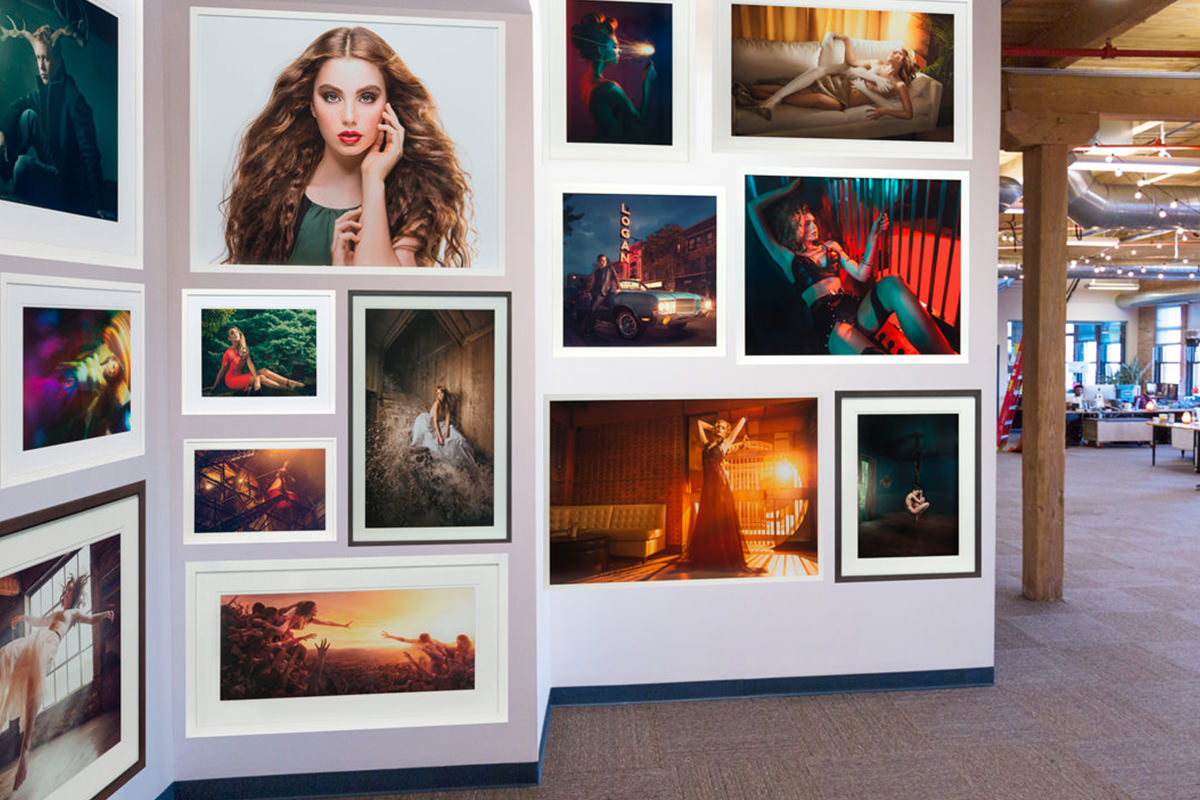
Ordering prints is a lot less risky when the whole wall can be previewed first. This tutorial loads a set of print JPEGs into one document with Load Files Into Stack, drops them onto a photo of the blank wall, arranges and scales them by Cmd-clicking with Auto Select off, then groups each wall and bends it into the room’s real perspective.
Enjoying This Free Tutorial?
We publish a new free tutorial every week, each one with sample images and PSDs you can download and follow along with. Sign up and they land straight in your inbox, along with early word on sales, events and subscriber-only offers.
Deciding what size prints to order and where to hang them is a lot easier when it can be tested visually first, using nothing more than a photo of a blank wall and JPEGs of the artwork. This tutorial loads several print images into one document, arranges and scales them freely on a wall photo, and transforms grouped images into perspective so they look believably mounted on an angled wall.
Loading Multiple Print Images Into One Document
Load Files Into Stack brings a whole folder of print images into a single Photoshop document at once, rather than opening each one individually.
-
Photograph the Blank Wall
Take a photo of the wall where prints will eventually hang.
-
Load Print JPEGs Into a Stack
Go to File > Scripts > Load Files Into Stack, browse to select several print image files at once, and click OK to load them all into one document.
Dragging the Prints Onto the Wall Photo
Holding Shift while clicking and dragging moves several print layers from the stacked document directly onto the wall photo at once.
-
Select the Print Layers
Hold Shift and click to select the print layers in the stacked document.
-
Drag Them Onto the Wall Photo
Click and drag the selected layers from the stacked document over onto the wall photo document.
Scaling Every Print Down to a Usable Size
Selecting all the print layers together and scaling them proportionally brings oversized images down to a reasonable starting size for arranging on the wall.
-
Select All the Print Layers
Shift-click to select every print layer now placed in the wall photo document.
-
Scale Them Down Proportionally
Press Cmd/Ctrl+T, hold Shift, and drag a corner inward to scale all the selected prints down together while keeping their proportions intact.
Why the Exact Size at This Stage Doesn’t Matter
Getting the print sizes perfectly correct at this early stage isn’t necessary, since every print can still be resized freely at any point before a final order is placed. Treating this as a rough starting layout, rather than a final decision, keeps the arranging process fast and low-pressure.
Arranging Individual Images Without Grouping Them
Cmd/Ctrl-clicking directly on an image with Auto Select turned off selects that specific layer instantly, without needing to hunt through the Layers panel first.
-
Turn Off Auto Select on the Move Tool
Select the Move tool and make sure Auto Select is unchecked in the options bar.
-
Cmd/Ctrl-Click an Image to Select Its Layer
Hold Cmd/Ctrl and click directly on an image in the document to select its corresponding layer.
-
Move and Resize Images Freely
Reposition and resize individual images with Free Transform, trying different placements and sizes as if physically arranging prints on a wall.
Grouping the Finished Arrangement for One Wall
Once an arrangement for one wall looks right, selecting and grouping all its layers together prepares them to be transformed as a single unit.
-
Select the Images for One Wall
Hold Shift and Cmd/Ctrl to select every image layer intended for a single wall.
-
Bring the Selected Layers to the Top
Hold Cmd/Ctrl and press the close bracket key to move the selected layers above everything else.
-
Group the Layers Together
Press Cmd/Ctrl+G to group the selected layers into a single group.
Transforming the Grouped Arrangement Into Perspective
Because a photographed wall is rarely shot perfectly straight on, holding Cmd/Ctrl while dragging the corners of a grouped selection bends the whole arrangement to match the wall’s actual perspective.
-
Open Free Transform on the Group
Select the group and press Cmd/Ctrl+T to bring up the Free Transform bounding box.
-
Hold Cmd/Ctrl and Drag a Corner to Match the Wall’s Slope
Hold Cmd/Ctrl and drag a corner point down or up until that edge lines up with the sloped horizontal line of the actual wall in the photo.
-
Adjust the Opposite Corner to Match
Hold Cmd/Ctrl again and adjust the opposite corner the same way until every edge of the group matches the wall’s perspective.
-
Confirm the Transformation
Press Enter to confirm the perspective transform once every corner lines up correctly.
Why the Perspective Step Comes After Grouping
Applying a perspective transform to each print individually would require repeating the same corner adjustments over and over for every single image on the wall. Grouping the entire arrangement first means one perspective transform bends the whole layout into place at once, keeping every print’s relative position intact throughout the adjustment.
Why Each Wall Gets Its Own Independent Transform
Applying one single perspective transform across images intended for multiple different walls would force every section to bend by the same amount, even though each wall may be photographed from a different angle. Grouping and transforming each wall’s images independently instead allows every section to receive exactly the amount of perspective correction it actually needs.
Repeating the Process for Multiple Walls or Sections
The same select, group, and perspective-transform sequence can be applied separately to different sections of a room, even when each section needs a very different amount of perspective correction.
-
Select and Group Each Additional Section
Repeat the Cmd/Ctrl-click selection and grouping process for each remaining wall or section of images.
-
Transform Each Group Independently
Apply Free Transform with Cmd/Ctrl-held corner adjustments to each group separately, since different walls may need drastically different amounts of perspective correction.
Why This Approach Works
Loading every print into one document and arranging them without grouping first is what makes it fast to experiment freely with placement and size before committing to anything. Grouping a finished arrangement before applying the perspective transform is what allows an entire wall’s worth of prints to bend into place together as a single, consistent unit. Testing sizes and placement digitally this way, rather than guessing based on a blank wall alone, removes the uncertainty of ordering prints and frames that might not actually fit the space as intended.
Final Thoughts
Mocking up a wall of prints in Photoshop before ordering anything takes the guesswork out of sizing and placement, turning what could be an expensive trial-and-error process into something that can be previewed and adjusted freely on screen first. The same grouping and perspective-transform approach works for any room or wall, no matter how many separate sections or angles are involved.
Quick Reference: Keys, Menus and Settings
- Load the printsFile > Scripts > Load Files into Stack, Browse, OK
- Move them to the wallShift-click the layers, drag onto the wall photo
- Scale all at onceCmd/Ctrl + T, Shift-drag a corner
- Pick an imageMove tool, Auto Select off, Cmd/Ctrl-click it on the canvas
- One wall at a timeCmd/Ctrl + Shift-click, Cmd/Ctrl + ] to the top, Cmd/Ctrl + G, hide the group
- PerspectiveCmd/Ctrl + T on the group, hold Cmd/Ctrl and drag the corners to the wall lines, Enter
No AI, no generative credits: just layers, groups and Free Transform.

Free Downloads
Take the Guide With You
Get the PDF guide to mocking up prints on a wall: Load Files into Stack, quick Cmd/Ctrl-click arranging, a group per wall and the perspective transform. Free with a PHLEARN account.
Placing Art on a Wall: Common Questions
Why mock up prints in Photoshop before ordering?
You see which sizes and spots work on the real wall before you buy anything. When the prints arrive, you already know how they will look.
What do I need to start?
A photo of the empty wall and JPEGs of the images you want to hang. Load the wall photo into Photoshop, then bring in the JPEGs.
How do I open lots of images at once?
Go to File > Scripts > Load Files into Stack, click Browse, pick the files and click OK. They all land as layers in one document, ready to drag onto the wall photo.
How big should I make each print?
It doesn’t matter at first. Select them all, press Cmd/Ctrl + T and Shift-drag a corner to scale them down, then resize each one as you arrange.
How do I pick one image without hunting through the Layers panel?
With the Move tool and Auto Select unchecked, hold Cmd/Ctrl and click the image on the canvas. This only works while the layers are not in a group.
How do I work on one wall at a time?
Cmd/Ctrl + Shift-click the images for another wall, press Cmd/Ctrl + ] to move them to the top, group them with Cmd/Ctrl + G and hide the group.
How do I make the prints match an angled wall?
Group the prints for that wall and press Cmd/Ctrl + T. Hold Cmd/Ctrl and drag a corner until the top and bottom edges follow the lines of the wall, then press Enter.
Why give each wall its own group?
Each wall faces the camera at a different angle. A wall that runs away from the camera needs far more perspective than one seen nearly head-on, so each group gets its own transform.
Is there a free download?
Yes, with a free PHLEARN account. You get 1 PDF guide to loading, arranging, grouping and putting prints into perspective on a wall photo.
Master Photoshop, Lightroom and Photography
Join PHLEARN PRO for $12.99 a month or $99.99 a year. Cancel anytime, with a 100% money-back guarantee.