
Download Assets
This tutorial includes 4 sample images and 1 PDF guide. Downloads are free with a PHLEARN account.
- Download the sample images and PSDs from every free tutorial on PHLEARN
- New free tutorials published every week
- One free account — sign up once, then download anything
Free PDF Guide · 5 Pages
This Tutorial as a Step-by-Step PDF
Every step from the video in order: Settings > Image Processing > Cloud, the Object Selection tool’s Select Subject dropdown, the four device-versus-cloud comparisons, Select and Mask with the Refine Edge brush, the Hue-mode layer that removes a color fringe, and the duplicate-and-flip hair fix. Keep it next to your keyboard.
description
Cloud processing sends the selection to Adobe’s servers instead of your machine, and on hair and fur the difference is obvious. We’ll show you how this significant update effortlessly isolates complex subjects in challenging images, offering stunningly accurate selections compared to the traditional on-device processing.
Enjoying This Free Tutorial?
We publish a new free tutorial every week, each one with sample images and PSDs you can download and follow along with. Sign up and they land straight in your inbox, along with early word on sales, events and subscriber-only offers.
Image Source

How to Use Cloud Processing with Select Subject in Photoshop
Select Subject has been in Photoshop for years, and it has always struggled with the same things: fine hair, low contrast between subject and background, and complex shapes like foliage or branches.
Photoshop 2025 adds a second option. Selections can be processed on your device as before, or in the cloud — sent to Adobe’s servers for far heavier analysis and returned. It takes a few seconds longer and needs an internet connection, and on difficult images the difference is not subtle.
This is not a generative feature. Nothing is invented; it is a better analysis of the pixels you already have.
Turn Cloud Processing On
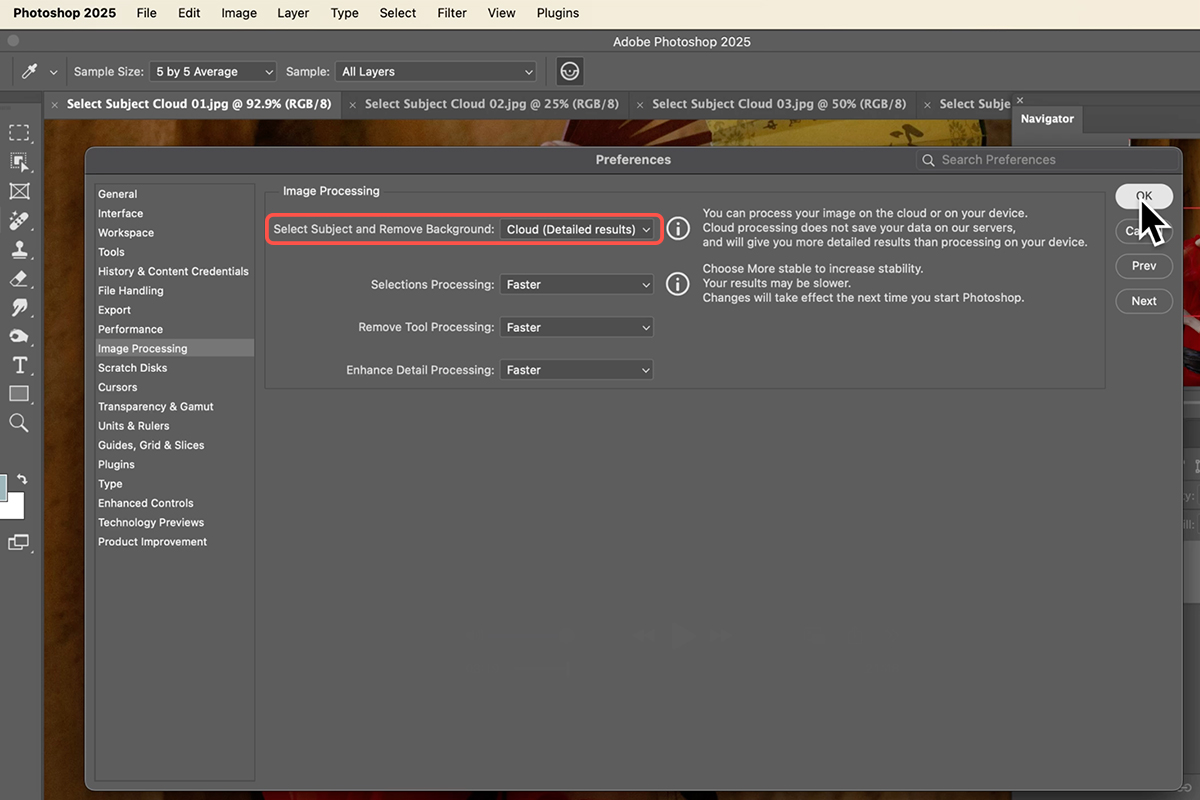
Set it as the default under Photoshop ? Settings ? Image Processing, where Select Subject and Remove Background can each be set to Device or Cloud. Choose Cloud and every selection from then on uses it.
Or Choose Per Image
The Object Selection Tool is the better route. Its options bar has Select Subject with a dropdown for Device or Cloud, so you can decide per image.
Select Subject in the Contextual Task Bar does not offer that choice — it uses whatever your preferences specify. If you want to pick per image, use the Object Selection Tool.
Where It Makes the Biggest Difference
Four hard cases, and how the two compare.
Detailed Background Behind the Subject
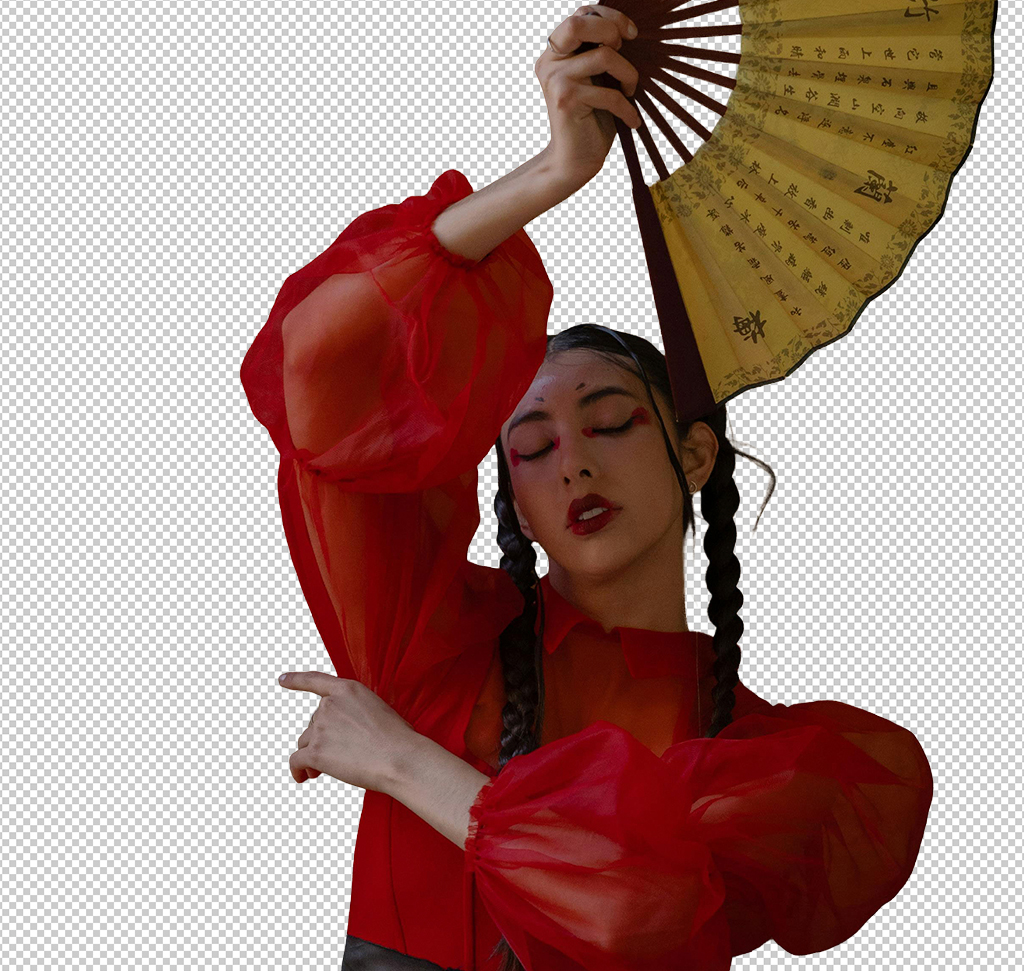
A subject in front of fan blades or similar structure. Device processing includes chunks of background that clearly are not the subject. Cloud processing separates them cleanly, including between the blades — close to flawless.
Curly Hair on a Dark Background
Device processing grabs foliage behind the subject and leaves a visible border. Cloud is substantially better, though not perfect — expect to refine the edge.
Light Hair on a Light Background
The case where contrast barely exists. Device processing includes large areas of background. Cloud handles it far better. Adding a solid color fill layer behind the cut-out is a quick way to see exactly what the mask caught.
Complex Objects Like Branches
The most dramatic case. A subject holding a branch with flowers: device processing misses the hair, leaves rough edges, and does not even include the arm. Cloud processing picks out the individual branches — a selection that would take a long time by hand.
Refine the Edge Afterwards
Cloud processing is better, not perfect. On hair, plan to clean up.
-
Double-click the layer mask
Photoshop asks whether you want mask properties or Select and Mask — choose Select and Mask.
-
Take the Refine Edge Brush Tool
In the left-hand toolbar of the workspace.
-
Paint along the edge of the hair
Photoshop recalculates that region for fine detail when you release. Do not try to be precise — paint over the messy boundary and let it work.
This is the right tool for wispy edges, and it is worth reaching for on any hair selection regardless of which processing produced it.
Removing a Background Color Fringe
Cutting out against a strong background color usually leaves a rim of it in the hair — green fringing from foliage, for instance.
-
Add a new layer and clip it to the subject
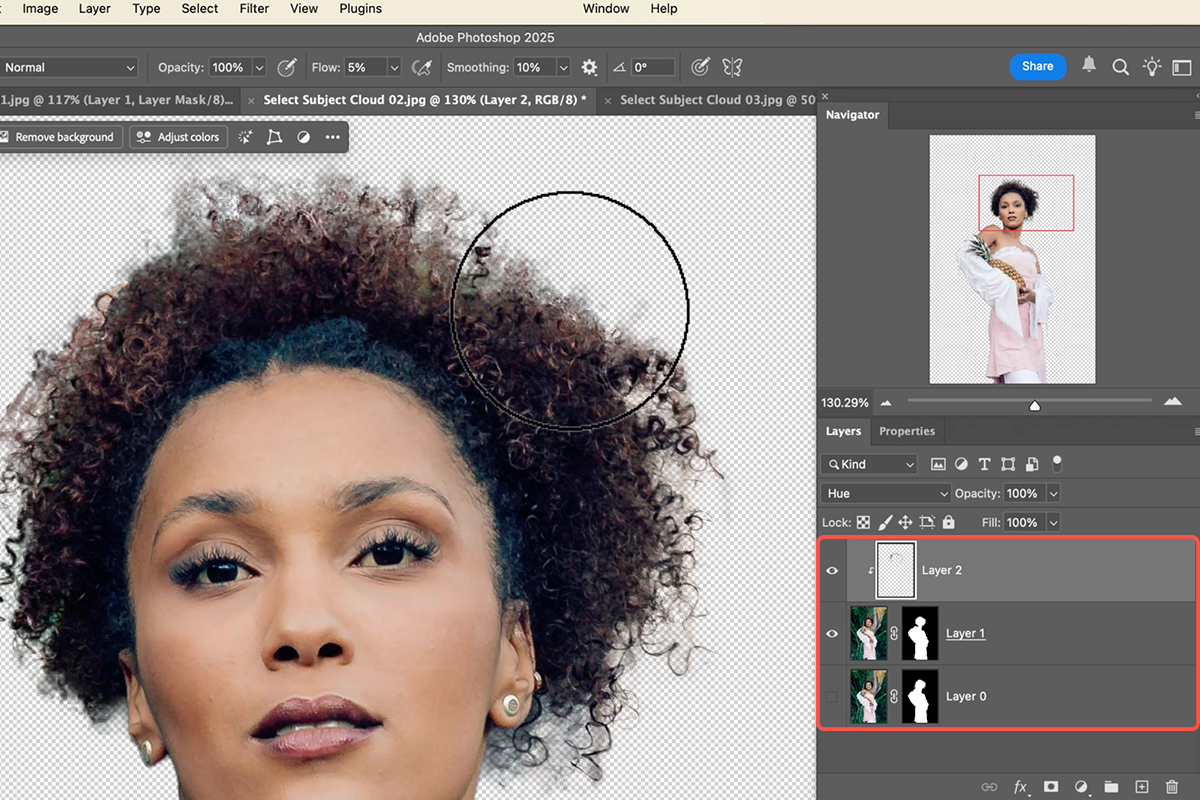
Hold Alt or Option and click between the two layers so the new one only affects the subject.
-
Set its blend mode to Hue
At the bottom of the blend mode list.
-
Sample the correct hair color and paint over the fringe
Press B, hold Alt or Option to sample the real hair color, then paint the affected edge.
Because the layer is in Hue mode, only the color changes — every strand of detail and every variation in brightness is preserved. The fringe becomes hair-colored rather than being erased.
When the Selection Still Will Not Work
Sometimes an area of hair is beyond any selection tool — too low in contrast, too tangled with the background. There is a practical workaround: build the hair from other hair.
Merge your masked layers into a single copy, then use the Selection Brush Tool to select a section of hair that did cut out cleanly. Press Ctrl/Cmd+J to copy it to its own layer.
Press Ctrl/Cmd+T, flip it horizontally, and position it over the problem area. Then right-click and choose Warp to reshape it so it does not read as a mirrored duplicate. Mask the original beneath it.
Repeating this two or three times with different sections, and setting the blend mode to Darken where it helps, builds a convincing hairline.
It is not the original hair, but it is the subject’s own hair, reused — which is a very different thing from generating new hair with AI, and it looks right because it came from the same photograph under the same light.
Worth Knowing
Set Cloud as your default in Image Processing preferences unless you often work offline. Use the Object Selection Tool when you want to choose per image. Expect to refine hair edges with the Refine Edge Brush in Select and Mask. Fix color fringing with a clipped Hue layer rather than erasing it.
The wider point: this is the useful kind of AI in Photoshop. It is not generating content or making creative decisions — it is doing the tedious analytical work of separating a subject from its background, which is exactly the sort of job worth handing over.
Quick Reference: Keys, Menus and Settings
- Turn it on for goodSettings > Image Processing > Select Subject and Remove Background: Cloud
- Choose per imageObject Selection tool > Select Subject dropdown > Device or Cloud
- Cut it outSelect Subject, then Add Layer Mask
- Clean the edgeDouble-click the mask > Select and Mask > Refine Edge Brush over the hair > OK
- Kill a color fringeNew layer clipped to the subject (Alt/Option-click between), blend mode Hue, B, Alt/Option-click the hair color, paint the edge
- Brighten the hair edgeLevels adjustment layer clipped to the subject, Cmd/Ctrl + I on its mask, paint white on the edge
- Hair that still failsSelection Brush around good hair, Cmd/Ctrl + J, Cmd/Ctrl + T > Flip Horizontal, Warp, mask; blend mode Darken helps
Cloud needs an internet connection; no generative credits.

Free Downloads
Follow Along on the Same Photos
Get all four difficult sample images from the video and the PDF guide, and compare device and cloud processing yourself. Free with a PHLEARN account.
Cloud Select Subject: Common Questions
What is cloud processing for Select Subject?
Photoshop sends the image to Adobe’s servers, runs a stronger AI model and sends the selection back. It takes a few seconds longer than device processing and needs an internet connection, and on hard subjects the difference is large.
How do I turn it on?
Settings > Image Processing, set Select Subject and Remove Background to Cloud. Then every Select Subject button uses it. To choose per image, use the Object Selection tool’s Select Subject dropdown.
Do I need the beta?
No. It’s in the full Photoshop 2025 release.
How much better is it?
On the four hard images in the video, a lot: fan blades behind a subject, curly hair on dark leaves, white hair on a white background, and a branch of flowers that device mode mostly skipped. Cloud got the branches, the ponytails and the arm.
The hair edge still isn’t perfect. What now?
Double-click the layer mask, choose Select and Mask and paint over the hair with the Refine Edge Brush. It cleans up what the selection missed.
How do I get rid of a green fringe from the old background?
Clip a new layer to the subject, set it to Hue, sample the real hair color with Alt/Option and paint along the edge. The green takes on the hair’s hue.
What if part of the hair is still unusable?
Borrow hair from a good area: select it with the Selection Brush, duplicate, flip, warp into place and mask. Done a couple of times it reads as the same hair.
Does it use generative credits?
No. It makes a selection; it doesn’t generate pixels.
Are the sample files free?
Yes, with a free PHLEARN account. You get all four sample images and the PDF guide.
Master Photoshop, Lightroom and Photography
Join PHLEARN PRO for $12.99 a month or $99.99 a year. Cancel anytime, with a 100% money-back guarantee.