Full Frame vs APS-C: Crop Factor Explained With the Same Scene
Full frame vs APS-C, shown with one scene and one lens. The crop factor changes how much of the picture you get, and a few things that follow from that. It doesn’t change the lens.
- Full frame36 × 24 mm
- APS-C crop factor1.5x (Nikon, Sony, Fujifilm), 1.6x (Canon)
- A 50mm lens on APS-Cframes like 75–80mm
You borrow a friend’s camera, put your 50mm lens on it, and the picture comes out tighter than it does on your own body. Same lens, same spot, less of the room. Or you read a spec sheet that says “23mm (35mm equivalent)” and wonder which of those two numbers is the real one.
Both come down to sensor size. This guide explains full frame vs APS-C with one photo: a scene shot on a full-frame camera, and the parts of it that an APS-C sensor and a Micro Four Thirds sensor would have recorded from the same spot with the same lens. Once you see that, crop factor stops being a formula and becomes something you can picture, and you can decide which camera makes sense for the way you shoot.
Sensor Sizes, From Full Frame to Your Phone
“Full frame” means a sensor the size of a frame of 35mm film: 36 by 24 millimeters. Every other format is described by how much smaller it is than that. The number that describes it is the crop factor: the full-frame diagonal divided by the smaller sensor’s diagonal.
| Format | Size | Crop factor | Area vs full frame |
|---|---|---|---|
| Full frame | 36 × 24 mm | 1x | 100% |
| APS-C (Nikon, Sony, Fujifilm) | about 23.5 × 15.6 mm | 1.5x | about 42% |
| APS-C (Canon) | about 22.3 × 14.9 mm | 1.6x | about 38% |
| Micro Four Thirds | 17.3 × 13 mm | 2x | about 26% |
| 1-inch type | 13.2 × 8.8 mm | 2.7x | about 13% |
| Phone main camera (1/1.3-inch type) | about 9.8 × 7.4 mm | about 3.5x | about 8% |
The APS-C sizes vary a little from model to model, so the exact factor is somewhere between 1.52 and 1.55 for most Nikon, Sony and Fujifilm bodies and about 1.6 for Canon. Everyone rounds to 1.5 and 1.6, and so will we. Phones vary much more: the main camera on a recent flagship is often around 1/1.3-inch type, and the ultra-wide and telephoto cameras on the same phone use smaller sensors still.
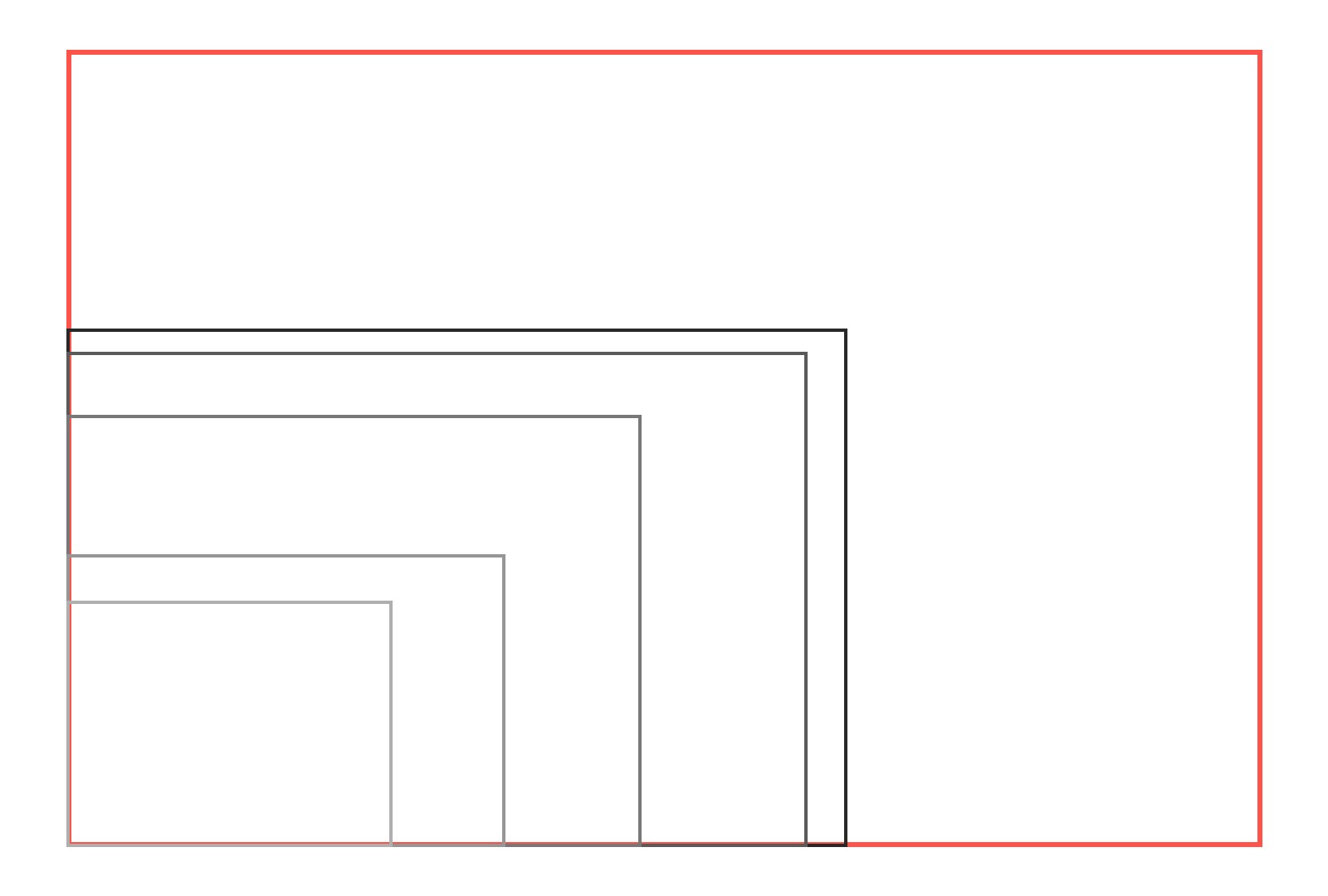
Two things in that table matter more than the rest. The crop factor tells you how the framing changes. The area tells you how much light the sensor collects, which is where the differences in noise come from. We’ll get to both.
What Crop Factor Actually Means
A lens projects a circle of light behind it. A full-frame lens makes a circle big enough to cover a 36 × 24 mm rectangle. Put that same lens in front of an APS-C sensor and the sensor sits in the middle of the circle and records only the middle of the picture. Nothing about the lens has changed. The sensor is smaller, so it sees less of what the lens projects.
That’s the whole idea of crop factor. It’s literally a crop. When people say a 50mm lens “becomes” a 75mm lens on APS-C, what they mean is that it frames like a 75mm lens would on full frame. The lens is still 50mm. It still has the same perspective from where you’re standing, and it still focuses the same way. You’re seeing a smaller part of its picture, enlarged to fill the same screen or print.
So the math is one step: focal length × crop factor = the full-frame focal length that gives the same framing. A 16mm lens on a 1.5x APS-C camera frames like 24mm. A 35mm lens on Canon’s 1.6x frames like 56mm. A 25mm lens on Micro Four Thirds frames like 50mm. If you know your way around full-frame focal lengths, our guide to camera lens focal lengths explains what each one does to a photo, and the crop factor converts any of them to your camera.
Full Frame vs APS-C With the Same Scene
Here’s the photo. It was made on a full-frame Sony with a 16mm lens. The colored frames show what three smaller sensors would have recorded with the same 16mm lens, from exactly the same spot.
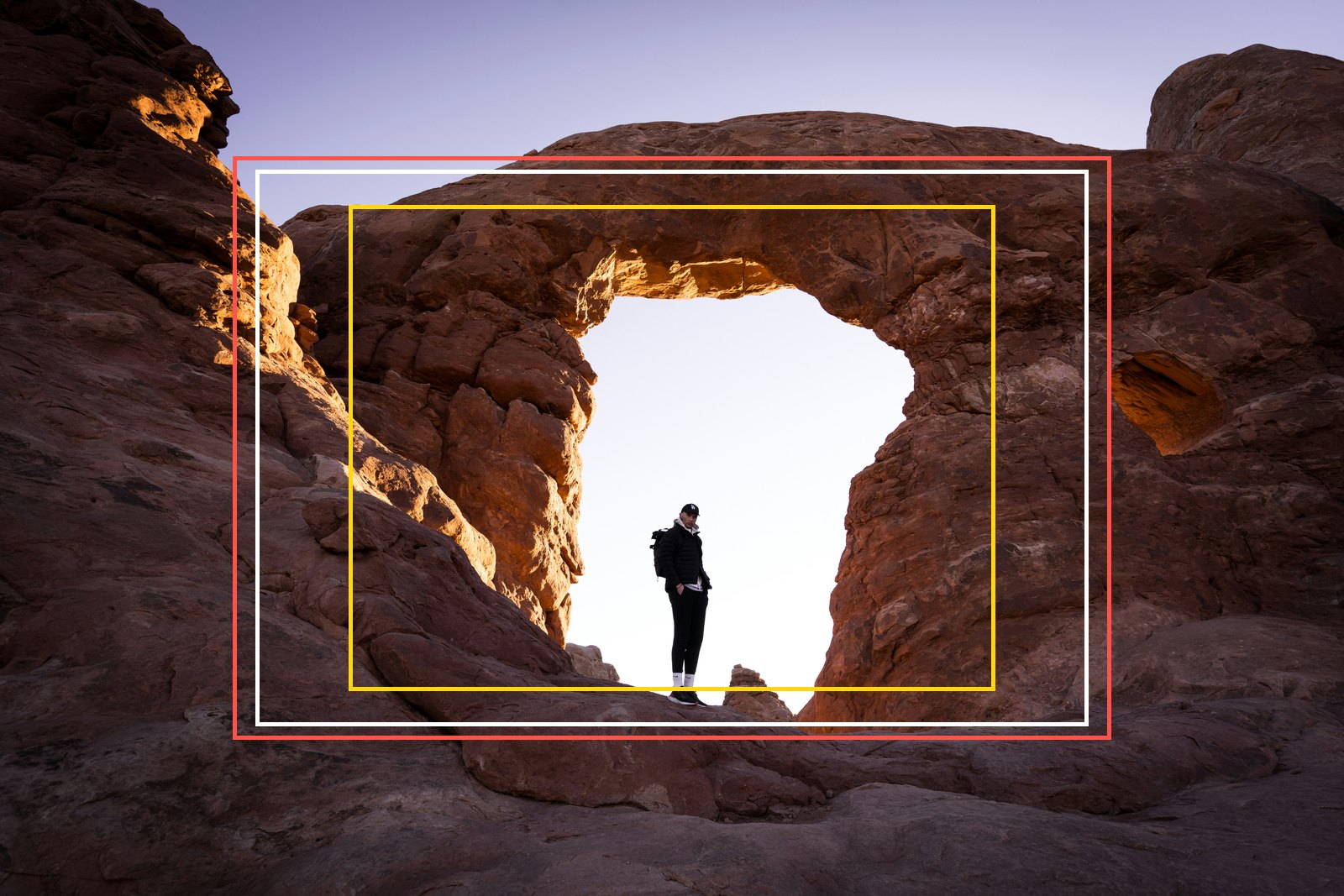
And here are those four pictures at the same size, the way you’d see them on the back of each camera.
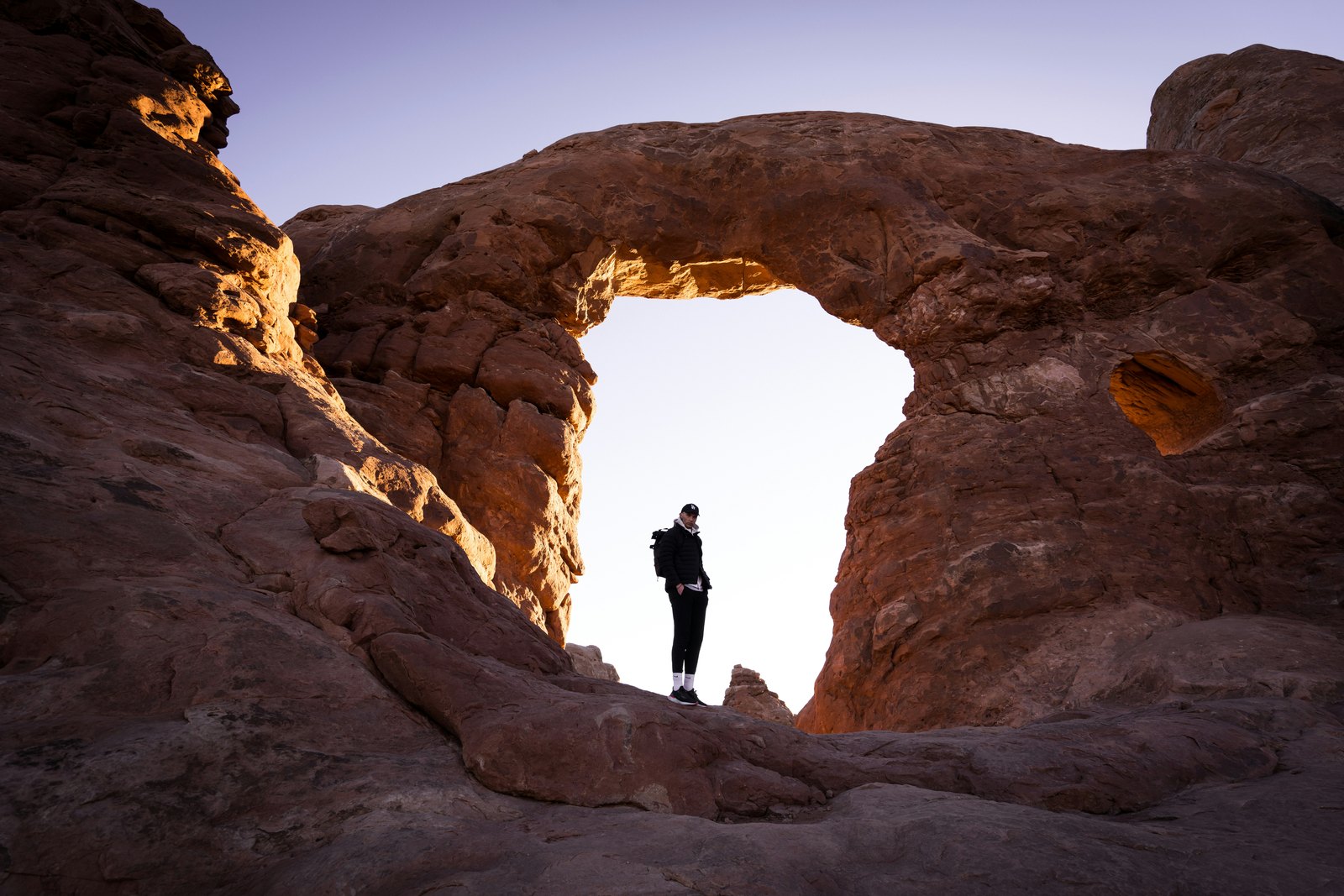


That’s full frame vs APS-C in one picture. Look at what changed and what didn’t. The person, the arch and the rocks are in exactly the same places relative to each other in all four, because the camera never moved. The lines don’t bend differently and the arch doesn’t look closer to the person. Only the edges went away. Micro Four Thirds also changes the shape, because its sensor is 4:3 instead of 3:2.
To get the full-frame picture on the APS-C camera, you’d have two choices: use a wider lens (about 10–11mm), or step back. Stepping back changes the perspective, so the background looks bigger relative to the person. That difference comes from where you stand, not from the sensor.
What Changes When You Pick Full Frame vs APS-C
Field of view. This is the one everybody notices first. The same lens shows less on APS-C. That’s a cost at the wide end and a bonus at the long end. Wide-angle landscape and interior work needs shorter lenses on APS-C: Nikon’s guide to focal length pairs about 10–24mm on its APS-C (DX) cameras with 14–35mm on full frame (FX). Wildlife and sports shooters like that a 300mm lens frames like 450mm.
The bonus is smaller than it sounds. A crop doesn’t add detail; it only throws away the edges. A full-frame photo cropped to the middle is the same picture. Whether you end up with more detail on the bird depends on how many pixels each sensor puts in that middle area. A 24-megapixel full-frame sensor has only about 10 megapixels in its APS-C-sized middle, so a 26-megapixel APS-C camera really does put more pixels on a distant subject. A 45-megapixel full-frame sensor has about 19 there, so the difference mostly disappears.
Depth of field. At the same f-number, the same framing and the same distance, APS-C gives you more depth of field. To match the framing it needs a shorter lens, and a shorter lens at the same f-number blurs the background less. The rule of thumb: multiply the f-number by the crop factor to find the full-frame aperture that gives the same depth of field. A 33mm f/1.4 on a 1.5x APS-C camera looks about like a 50mm at f/2.1 on full frame. That’s a little over one stop more in focus.
That’s why portrait photographers who love a really soft background tend to end up on full frame: an 85mm f/1.4 on full frame would need a 56mm f/0.9 on APS-C to match, and few lenses like that exist. It’s also why the opposite is true for anyone who needs more in focus. Product, street and documentary photographers often like APS-C and Micro Four Thirds for exactly this reason. For more on how background blur works and how to fake it after the fact, see our guide to bokeh photography.
Noise and low light. A full-frame sensor has more than twice the area of APS-C. At the same f-number and shutter speed, the light falling on each square millimeter is the same, so the exposure is the same. But the full-frame sensor collects about 2.3 times more light in total across the whole picture, and the whole picture is what you look at. When both photos are viewed at the same size, the full-frame one has less visible noise: roughly a stop’s worth of difference against APS-C, and two stops against Micro Four Thirds.
For full frame vs APS-C, the sensor’s age matters as much as its size. When Aaron reviewed the Fujifilm X100F, an APS-C compact, he found its high-ISO files cleaner than the ones from his full-frame Canon 5D Mark III, a camera five years older. A new APS-C sensor can beat an old full-frame one. Compare cameras of the same generation and full frame wins, by about that one stop. Our guides to ISO and noise and to managing digital noise cover what to do about the noise you have.
Size, weight and lens cost. APS-C bodies and the lenses made for them are usually smaller, lighter and cheaper. That advantage is biggest at the wide and normal focal lengths, where a lens only has to cover the smaller sensor. Telephoto lenses don’t shrink much, because their size comes from the focal length and the f-number: a 300mm f/4 needs a front opening about 75mm wide on any camera.
The other side: some APS-C systems have far fewer lenses made for them than their full-frame siblings. Fujifilm makes a full line of APS-C lenses because that’s its main format. Canon’s and Nikon’s own mirrorless APS-C lenses number about half a dozen each. Sigma and Viltrox fill some of the gaps, and many owners use full-frame lenses, which work fine but give up the size advantage.
What Doesn’t Change
- The lens. A 50mm lens is 50mm on every camera. Crop factor describes the sensor.
- Exposure. f/2.8, 1/250 and ISO 400 give the same brightness on full frame, APS-C and Micro Four Thirds. You don’t multiply the f-number to work out exposure, only to compare depth of field.
- Perspective from the same spot. As the same-scene photos show, a crop doesn’t change how near and far things relate. Distance does.
- Megapixels. Sensor size and resolution are separate. A 24-megapixel APS-C camera and a 24-megapixel full-frame camera make files of the same size.
- What makes a good photo. Light, timing and composition don’t care about sensor size. The X100F review above is mostly about this: a small fixed-lens camera made Aaron pay more attention to light and shadow, not less.
Crop Factor Conversion Table
Find your lens in the left column. Each other column shows the full-frame focal length that gives the same framing. Numbers are rounded.
| Lens | APS-C 1.5x | Canon APS-C 1.6x | Micro Four Thirds 2x |
|---|---|---|---|
| 10mm | 15mm | 16mm | 20mm |
| 16mm | 24mm | 26mm | 32mm |
| 18mm | 27mm | 29mm | 36mm |
| 23mm | 35mm | 37mm | 46mm |
| 24mm | 36mm | 38mm | 48mm |
| 28mm | 42mm | 45mm | 56mm |
| 35mm | 53mm | 56mm | 70mm |
| 50mm | 75mm | 80mm | 100mm |
| 56mm | 84mm | 90mm | 112mm |
| 85mm | 128mm | 136mm | 170mm |
| 100mm | 150mm | 160mm | 200mm |
| 200mm | 300mm | 320mm | 400mm |
| 300mm | 450mm | 480mm | 600mm |
Going the other way, to get a full-frame look on a smaller sensor, divide by the crop factor:
| Full-frame look | APS-C 1.5x | Canon APS-C 1.6x | Micro Four Thirds 2x |
|---|---|---|---|
| 24mm (wide) | 16mm | 15mm | 12mm |
| 35mm (street, everyday) | 23mm | 22mm | 17.5mm |
| 50mm (normal) | 33mm | 31mm | 25mm |
| 85mm (portrait) | about 56mm | 53mm | 42.5mm |
| 135mm (tight portrait) | 90mm | 84mm | 67.5mm |
That’s why so many APS-C lenses are 23mm, 33mm and 56mm, and so many Micro Four Thirds lenses are 12mm, 17mm, 25mm and 42.5mm. They’re built to frame like the classic full-frame focal lengths. For depth of field, multiply the f-number the same way: f/1.4 on APS-C looks about like f/2 on full frame, and f/1.4 on Micro Four Thirds about like f/2.8.
Using Full-Frame and APS-C Lenses Across Bodies
- Full-frame lenses on an APS-C body work normally on the same brand’s mount. You get the crop.
- APS-C lenses on a full-frame body are the tricky way round. The lens’s circle of light is too small to cover the whole sensor. Nikon, Sony and Canon full-frame mirrorless bodies handle their own APS-C lenses by switching to a crop mode, which records only the APS-C-sized middle of the sensor. You lose more than half the pixels. Check your camera’s manual for how it handles them.
- Phones print an “equivalent” number. A phone camera labelled 24mm frames like a 24mm lens on full frame; its real focal length is only a few millimeters. When you compare a phone to a camera, use the equivalent number.
Which Should You Buy in 2026?
Here’s where we land on full frame vs APS-C. For most people buying a first interchangeable-lens camera, APS-C is the better place to start. The bodies cost less, the kit is lighter, so it comes with you more often, and the image quality from current APS-C sensors is more than good enough for prints, clients and every screen people will see your work on. The money you save is better spent on one good lens.
Full frame makes sense when you can name the reason:
- You shoot paid work in dim light (weddings, events, concerts) and need that extra stop at high ISO.
- You want the softest backgrounds for portraits at normal working distances.
- You shoot wide landscapes or interiors and want the widest choice of ultra-wide lenses.
- You already own full-frame lenses.
Micro Four Thirds is worth a look if you want the smallest telephoto kit, or shoot a lot of video. A phone is enough if your photos live on phones, and a camera of any format starts to pull ahead when you print, crop, shoot moving subjects or work in low light.
One honest caveat: the gap between the formats is smaller than the arguments online suggest. Light, timing and editing make a bigger difference to a photo than one stop of noise. If you already own an APS-C camera, learn its limits before you replace it. We’re also writing a separate guide to choosing your first camera, with current models.
Five Crop Factor Mistakes to Avoid
Most of the confusion about full frame vs APS-C comes down to one of these.
Thinking the lens changes. A 50mm lens doesn’t become a 75mm lens. It frames like one on APS-C. This matters when you buy lenses: a “50mm equivalent” lens for APS-C is a 33mm lens.
Multiplying the f-number for exposure. f/2.8 is f/2.8 for exposure on every camera. Multiply only when you’re comparing depth of field.
Assuming more megapixels means more reach. Only pixels in the middle of the frame count. A full-frame camera with lots of megapixels can crop to APS-C and keep plenty.
Blaming the sensor for perspective. Big noses and flattened backgrounds come from distance. If your 35mm portraits look odd on APS-C, the fix is to stand farther back with a longer lens, which is the same fix on full frame.
Upgrading the body before the lens. In our experience, a sharp prime lens on an APS-C body often beats a kit zoom on full frame for what most people photograph. If you aren’t sure where to start, a 33mm or 35mm f/1.4–f/2 prime on APS-C will teach you more about light and framing than a body upgrade will.
Common Questions About Full Frame vs APS-C
Full frame vs APS-C: which is better? Full frame is better in low light and for very shallow depth of field, by about one stop in each. APS-C is lighter, cheaper and gives more depth of field and a tighter frame for the same lens, which suits a lot of photography. Neither is better for everything.
What does a crop sensor do to a lens? Nothing to the lens. The smaller sensor records only the middle of the picture the lens makes, so the framing is tighter by the crop factor: 1.5x on Nikon, Sony and Fujifilm APS-C, 1.6x on Canon APS-C.
Is crop factor 1.5 or 1.6? 1.5 for Nikon, Sony and Fujifilm APS-C (the exact figure is about 1.52–1.55), 1.6 for Canon. Micro Four Thirds is 2.
Can you use full-frame lenses on an APS-C camera? Yes, on the same brand’s mount. The lens works normally and frames tighter by the crop factor.
Full frame vs APS-C for beginners: which should I buy? APS-C, for most people. It costs less, weighs less and is plenty for learning, clients and prints. Move to full frame when you hit a limit you can name, like noise at the ISO you need.
Do professionals use APS-C? Yes. Plenty of working photographers use Fujifilm’s APS-C cameras for weddings, portraits and street work, and some sports and wildlife shooters carry an APS-C body for the extra framing on long lenses. The format matters less than whether the camera is reliable and the lenses suit the job.
Full Frame vs APS-C: The Short Version
- APS-C is a smaller sensor. It records the middle of what the lens projects.
- Crop factor = how much tighter the frame is: 1.5x (Nikon, Sony, Fujifilm), 1.6x (Canon), 2x (Micro Four Thirds).
- Focal length × crop factor = the full-frame focal length that frames the same.
- f-number × crop factor = the full-frame aperture with the same depth of field. Exposure doesn’t change.
- Full frame: about a stop less noise and a stop shallower depth of field. APS-C: smaller, lighter, cheaper, more reach.
- Most first cameras should be APS-C. Pick full frame for a reason you can name.
Try it on your own photos. Open any full-frame photo in Lightroom Classic, choose the Crop tool, set the aspect to Original and keep it locked, and drag the frame down to two-thirds of the width, centered. That’s what an APS-C camera would have recorded from where you stood. Do it on a wide landscape and on a portrait, and you’ll know which of the two formats you’d miss more.
In this article
- Sensor Sizes, From Full Frame to Your Phone
- What Crop Factor Actually Means
- Full Frame vs APS-C With the Same Scene
- What Changes When You Pick Full Frame vs APS-C
- What Doesn’t Change
- Crop Factor Conversion Table
- Using Full-Frame and APS-C Lenses Across Bodies
- Which Should You Buy in 2026?
- Five Crop Factor Mistakes to Avoid
- Common Questions About Full Frame vs APS-C
- Full Frame vs APS-C: The Short Version
Free with PHLEARN