
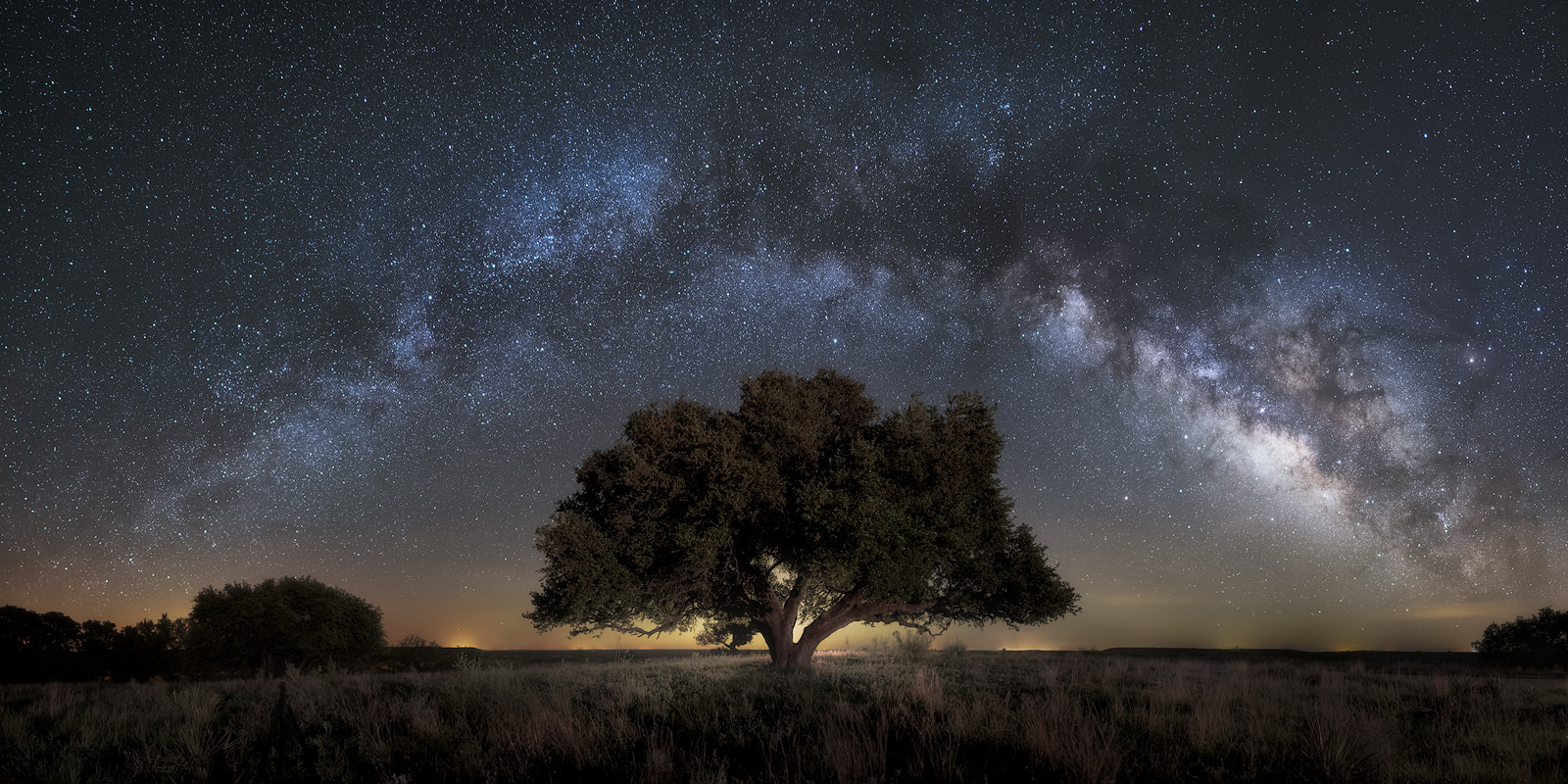
How Chung Hu Captured This Panoramic Milky Way Crescent
After gaining experience as a wedding photographer, software developer Chung Hu began looking for opportunities to combine his passion for technology with his love of photography – and found himself drawn to precision involved in capturing the perfect landscape.
Originally published September 27, 2018, by Jessi Gowan. Updated October 16, 2026, by PHLEARN Staff: How Chung Hu planned and shot a 56-frame Milky Way panorama over a Texas oak tree, now with kit cards and a few common questions answered from his story; the original text is unchanged.
An avid traveler and eager adventurer, Chung said he is always searching for dramatic, vibrant scenery to shoot. And what could be more dramatic than the spectacular curve of the Milky Way?
- CameraCanon 5D Mark IV
- LensRokinon 24mm f/1.4
- Panorama7 slices of 8 frames each
7
slices in the panorama
56
individual shots, with the noise-stacking images
100+
megapixels in the end result
Finding the Oak Tree
“I picked up a panoramic leveling base a few months ago, and I was itching to give it a test run,” said Chung, adding that the timing of the purchase perfectly coincided with the appearance of the Milky Way arch, which is particularly visible from the Northern Hemisphere during the early summer months.
In search of the ideal location, Chung said he made a trip out to rural Texas. Not only was he hoping to find a relatively unlit area that would make the stars stand out against the velvety blackness of the night sky, he was also on the lookout for a specific local landmark.

“I’ve heard that this oak tree is getting very popular among Texas photographers,” he said, “but it was just me shooting that night. In fact, I think I was the only person in the campground.”
In fact, I think I was the only person in the campground.
Chung Hu
After scouting the location and planning his shot with PhotoPills, Chung decided to place an F&V HDV-Z96 LED light behind the tree to create enough backlighting that the twisted trunk would still be visible in the dark – and then climbed on top of his car to do some light painting to brighten up the front of the tree.
Chung Hu’s Equipment and Settings
As an Amazon Associate I earn from qualifying purchases.
The Kit

30.4 MP full-frame CMOS sensor, Up to 7.0 frames per second continuous shooting speed, 4K video recording

Fast f/1.4 Wide-Angle 24mm Lens, Manual Focus & Manual Exposure, Multi-Layer Coating to Reduce Flare


Lever-Release Clamp and Hook, Load Capacity: 25 lb, 30 Degrees Total Leveling

Daylight Balanced: 5600K (3200K w/ Tungsten Filter), Dimmable (0-100%)
Using a Canon 5D Mark IV and a Rokinon 24mm f/1.4 lens, mounted to his Really Right Stuff TVC-34 tripod and Really Right Stuff TA-3 leveling base, Chung got to work shooting the many individual shots that would eventually make up this stunning capture.
Shooting the Panorama

“This is a seven-slice panoramic,” he said. “Each slice is made from eight identical images for noise reduction – with the noise-stacking images, this image is composed of 56 individual shots. The end result was over 100 megapixels.”
Each slice is made from eight identical images for noise reduction – with the noise-stacking images, this image is composed of 56 individual shots.
Chung Hu
And, according to Chung, the leveling base came in incredibly handy. Once the level is set, he said, doing the panoramic capture was a breeze – even in complete darkness.
More of Chung’s photography can be found on his website. His portfolio is impressive, showcasing his ability to use his technical background to achieve the ideal timing and lighting for capturing stunning landscape shots from destinations around the world. His work can also be seen on Facebook, Instagram, Flickr, and 500px.
Common Questions About Chung Hu’s Milky Way Panorama
Who is Chung Hu? A software developer and landscape photographer who worked as a wedding photographer first. He wanted to combine his love of technology with photography and found it in the precision of planning landscapes, especially night skies.
How do you shoot a Milky Way panorama? Chung scouted the location and planned the shot with PhotoPills, then shot seven slices from a tripod with a panoramic leveling base. Once the base is level, he says, the panorama is easy to capture, even in complete darkness. Each slice is eight identical frames stacked for noise reduction, so the final image is 56 shots and over 100 megapixels.
When can you see the Milky Way arch? It is especially visible from the Northern Hemisphere in the early summer months, which is when Chung went out to test his new leveling base.
How was the oak tree lit at night? He placed an F&V HDV-Z96 LED light behind the tree so the twisted trunk would show against the dark, then climbed on top of his car to light-paint the front of the tree.
What gear did Chung Hu use? A Canon 5D Mark IV with a Rokinon 24mm f/1.4 lens, on a Really Right Stuff TVC-34 tripod with a Really Right Stuff TA-3 leveling base.







Join the conversation