
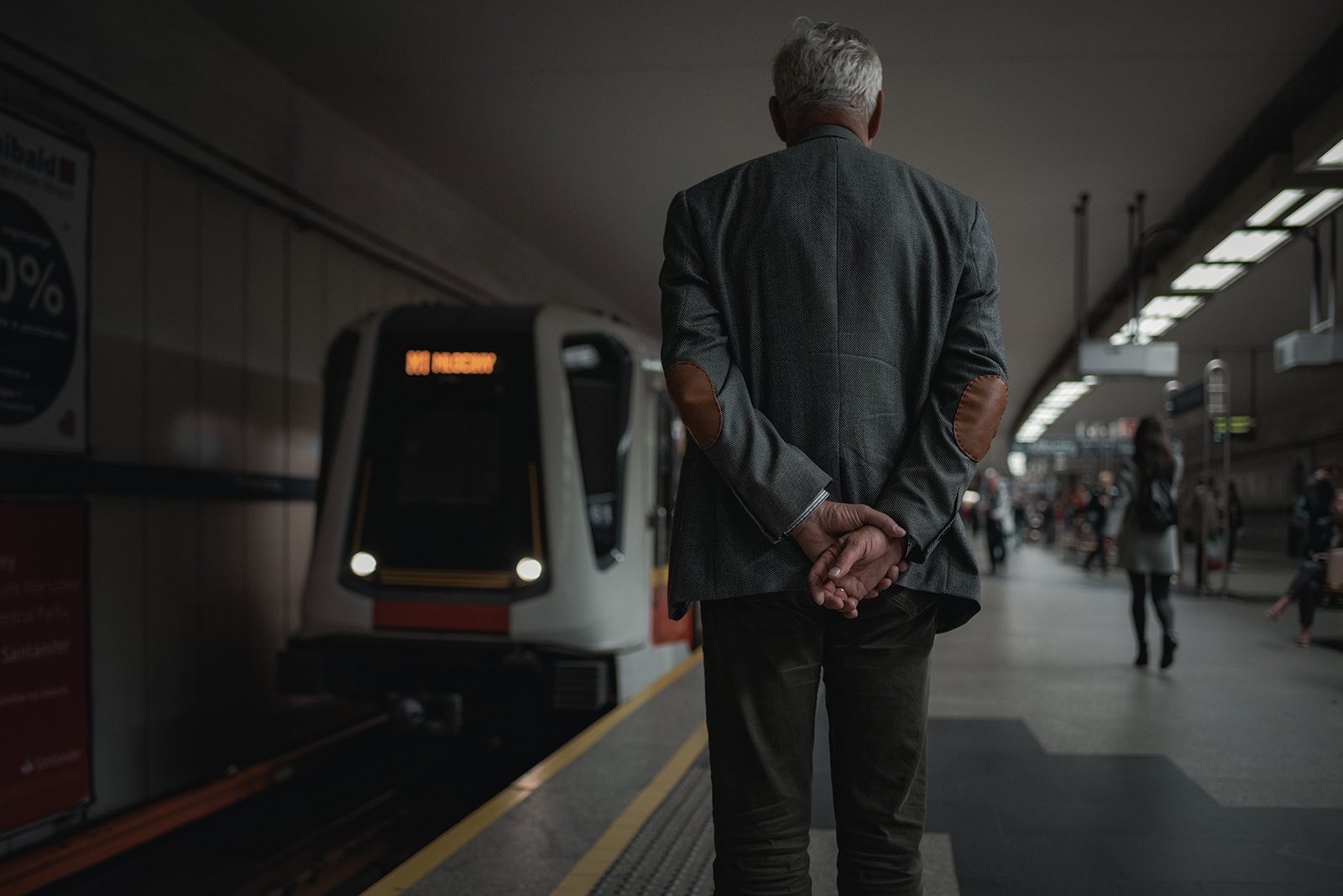
How Lucasz Waszak Captured This Cinematic Metro Scene
Street photography can be intimidating for a lot of new photographers, but it was the challenge of the genre that appealed to Polish photographer Lucasz Waszak shortly after visiting New York City in 2017.
Originally published December 18, 2018, by Jessi Gowan. Updated October 16, 2026, by PHLEARN Staff: Lucasz Waszak shot this cinematic metro scene at the Politechnika station in Warsaw with a Nikon D810 and a 35mm lens, underexposing it to protect the highlights. New in this update: sections, The Shot box, a workflow box and kit cards.
One Stop on the Metro
Typically, Lucasz says, he takes advantage of warm weather by going on photo walks and looking for potential subjects. But with his eight-month-old son strapped to his chest in a baby-carrier while headed to a shoot in Warsaw, he decided to pop in to the Politechnika metro station to catch a ride, instead.
“I figured it would be easier to go one stop on a tube, not to waste my energy and time,” he says, adding that he had a different lens with him than what he generally uses for capturing scenes on the street. “I’d opted for a 35mm that day. My go-to is the 50mm, but I’ve been experimenting with 35mm a bit lately, and enjoyed being a step closer to my subjects.”
Although Lucasz admits he has no artistic background – he studied management and economics in university and is pursuing a career in the culinary industry – his interest in street photography has provided him with plenty of inspiration. And despite having different equipment than he is used to using in an underground setting, Lucasz found himself framing an eye-catching composition.
“I think this shot was somewhat inspired by two photographers, whom I’ve followed very closely since I started shooting,” he says. “Paola Franqui has been known to post a lot of hand shots, while Shane Taylor does a lot of fantastic work on the London tube. I guess, when you’ve seen hundreds and hundreds of images, these inspirations get stuck in your head and you just start noticing things like this.”

Camera & Settings
- CameraNikon D810
- LensNikkor 35mm f/1.8G
- SettingsAperture priority, ISO 800, 1/100s
Store links in this article are affiliate links, so PHLEARN may earn a commission. As an Amazon Associate, PHLEARN earns from qualifying purchases.
Camera and lenses


Aperture Range: f/1.4 to 16, Silent Wave Motor AF System

Shooting in a dark environment like the metro, Lucasz prefers using his 50mm wide open at f/1.4 and an ISO of 800 – but for this shot, he equipped his Nikon D810 with a Nikkor 35mm f/1.8. The result was Lucasz’s very first underground shot with the 35mm, shot in aperture priority at ISO 800.
“I don’t like the quality or the amount of vignetting when shooting the 35mm wide open; I usually stop it down to at least f/2,” he says. “The camera settled for a 1/100s shutter speed. Since I find that a little slow, I will never choose to go below ISO 1600 in a similar situation again. I guess these small errors sometimes result in something good, though, or simply just don’t matter – this still proved to be a fairly popular photo.”
Metering-wise, Lucasz takes advantage of Nikon’s highlight priority mode. By heavily underexposing to protect the highlights, he says he can achieve the cinematic effect he’s been drawn to recently.
“The shadow detail is, of course, far easier to recover than blown highlights,” he adds.
The shadow detail is, of course, far easier to recover than blown highlights.
Lucasz Waszak
How He Edited the Metro Scene
This results in a fairly comprehensive post-processing workflow, which Lucasz has been using for the last few months and has refined to a precise art. First, he says, he applies his own HSL preset in Photoshop, which drastically changes the hue and saturation of blue shades and punches up the reds.
“I desaturate the image as a whole, but make up for it with the vibrance slider,” he says. “I push the dehaze slider a little to the right, but will sometimes balance this with negative clarity.”
Correcting the exposure, Lucasz says, depends on the scene. He uses a medium contrast tone-curve, with blacks “crushed to around five percent,” and occasionally uses split-toning to replicate the look of vintage film and add some emotional depth to his images.
35mm
the lens he tried that day
1600
the lowest ISO he’d use next time
5%
where he crushes the blacks

Too Easy to Replicate?
The final image, according to Lucasz, draws on the popularity of some typical “Instagram bait” like crossed hands and metro stations. The shot is cinematic, evocative, and intriguing – but Lucasz says he feels that, for a street photographer, it wasn’t challenging enough since he wasn’t facing the subject and the image could be recreated fairly easily.
“I think the best photos are the ones that can’t be easily replicated,” he says. “For example, my Movers photo, which is perhaps my first shot that got kind of popular, and might remain my best.”
I think the best photos are the ones that can’t be easily replicated.
Lucasz Waszak

Lucasz’s Instagram page is full of compelling street photography that offers a glimpse into his perspective on the world around him, and highlights his talent for capturing small, but beautiful, moments. His work can also be found on his website.
Common Questions About Shooting a Metro Scene
Where was this metro scene photographed? At the Politechnika metro station in Warsaw. Lucasz was on his way to a shoot with his eight-month-old son in a baby carrier and decided to ride one stop instead of walking. His interest in street photography had grown after a visit to New York City in 2017.
What camera settings did he use? A Nikon D810 with a Nikkor 35mm f/1.8 in aperture priority at ISO 800; the camera chose 1/100 of a second. He found that a little slow and says he won’t go below ISO 1600 in a similar situation again. In dark places he usually shoots his 50mm wide open at f/1.4, and he stops the 35mm down to at least f/2 because he doesn’t like its vignetting wide open.
How did he get the cinematic look in this metro scene? Mostly by underexposing: he uses Nikon’s highlight priority metering mode and underexposes heavily, because shadow detail is easier to recover than blown highlights. In the edit, he applies his own HSL preset to shift the blues and punch up the reds, desaturates the image but adds vibrance, nudges dehaze up, sometimes with negative clarity, and uses a medium contrast tone curve with blacks crushed to about five percent. Split toning sometimes adds a vintage film look.
Who is Lucasz Waszak? A Polish street photographer with no artistic background: he studied management and economics and was pursuing a career in the culinary industry. He says this shot was partly inspired by Paola Franqui’s hand shots and Shane Taylor’s work on the London tube.





Join the conversation