Here’s How Photographer Jax Navarro Plays with Star Wars Characters in Real Life
Jax Navarro, also known as Plasticaction, is an LA-based toy photographer. He creates lifelike recreations of high-action and cinematic moments with toys as his main subjects.
Originally published February 25, 2018, by Dane Johnson. Updated October 16, 2026, by PHLEARN Staff: A new layout for this toy photography interview, with themed sections, pull quotes and photo pairs, and Jax’s story of how he made his Darth Vader pizza night shot from a separate 2018 article; Jax’s answers are unchanged.
In our interview, we talk about his inspiration for getting into this style of photography, as well as his most recent struggles with the Incredible Hulk, and about how comfort can be an enemy to any creative endeavor.

3
hours a day behind the wheel, where his ideas are born
5
hour drive to the Imperial Sand Dunes for the Luke shot
40
year Star Wars anniversary behind the Hasbro job
Getting Started in Toy Photography
What led you into toy photography, and were there toy photographer influencers in your life that turned you on to it?
As an Amazon Associate I earn from qualifying purchases.
It started when I got a BB-8 toy, I loved that thing and so I just thought, “you know what, I’m going to, just for fun, I’m just going to start a BB-8 account [on Instagram], and post photography shots of this little toy.” And from that point, that’s when I started browsing related hashtags and saw some really crazy, amazing work. You know guys were just, and women, were posting very cinematic, real looking photos of toys. I was like, “wow, I need to try this.” This was about two years ago, and it’s been kind of an addiction ever since.
At what point did you feel like your creative career had begun? Or at what point did you begin to think of yourself as an artist and/or photographer?
It’s probably when I started getting paid [laughs] to post on Instagram. Even then I had questioned myself, like why do they want to pay me to do what I was doing before? Is my work really that special? That was, I believe, back in 2014. That’s when it set in that I could actually start making money off of this and potentially do this for a living.
But yeah, it still kind of blows me away. It’s been very surreal and I’m having a blast doing it. In the beginning I never thought of the photography I was doing as art, but now with what I’m doing with the toys, man, it’s definitely an art. Definitely an art.
Influences
When you did the hashtag searches earlier on, who were some of the photographers that popped up that you’ve been emulating or are inspired by?
Oh man, there’s this guy, Galactic_Warfighters, he’s an ex-Marine and he takes Stormtroopers and does storytelling through photos of his experiences in war. It was just mind-blowing, if you look at it, it looks like you’re watching a movie. He was one of them.
There’s another guy, SgtBananas. He just came out with a book. His stuff is pretty incredible. A lot of his work is practical effects. Who else? Man, there’s so many. But those are two of the main guys who got me to want to try it.
Where Ideas Come From
What’s the concepting process like for you? How does it begin?
Well, for work, I’m behind the wheel about three hours a day, so that’s where my creations are born. It’s when I’m behind the wheel and constantly thinking of different things. One of the questions that I ask myself when I’m creating is how can I make this funny and original? Because I love comedy and I love laughing and I love playing pranks on people. That’s the main point I try to hit is making something funny and original.
To be honest with you, whether I’m in the car or I’m at work, ideas will pop into my head and I know I better write it down before I forget. That’s basically how everything’s born, I’m just sitting, driving in my car, and thinking about it.


Do you have a quote or mantra that you find helpful to remain focused in your life and art?
“Be comfortable with being uncomfortable.”
I struggle with that a lot because, you know, human nature involves wanting to always feel comfortable, you don’t want to put yourself in an uncomfortable situation. And the same goes with life, and being a creative and doing photography. I think that when you start becoming comfortable, in whatever craft you’re doing, I think that’s when you stop growing and stop becoming interesting, because that’s when it becomes routine and you don’t have to think about it, you just do it and it becomes boring and that will reflect in your work. I don’t want to keep doing the same thing, I want to keep it fresh and not be afraid to try different things.
Be comfortable with being uncomfortable.
Jax Navarro
When a Shot Won’t Work
What about when something’s not working in a shoot or in your creative process? How do you react or try to respond?
I had one this weekend. I was actually creating all weekend, which was really fun, and somewhat frustrating. To be specific, I was trying to get the Hulk to dunk. And I couldn’t sell it, no matter how I posed it or how I angled the camera, I couldn’t sell it. It didn’t look good at all.
I spent over an hour just trying to make it look decent and I couldn’t so… normally I just keep trying and trying, but I started getting frustrated. I’m pretty stubborn, so I usually keep at it, but I think that walking away, putting it down, and possibly revisiting it, you might be able to make it work out. But with this particular one, I may have to just put it to rest.

So did you push pause on that one, or have you found a solution to having the Hulk dunk?
I couldn’t find the solution, but I think I’m going to revisit it again. I don’t have any options at this point, but in my head, I see it. I see the picture. I see how it’s supposed to look. But with figures there are certain limitations because figures have joints, and if they lack a certain number of joints they won’t be able to pose as normal humans would. This particular one had limited articulation, and so that’s where the challenge was. I don’t know if I’ll be able to overcome that because that’s a pretty huge roadblock. But I hope so because it’s a really good idea and I think people would love it.
Directing the Scene
What if you were to be captured in a photo like you create? What would your character be and what would your character be doing?
I would be in a director’s chair, and I’d be telling all these crazy sci-fi characters what to do. I’d be dictating the scene, “Hulk you need to smash Batman against the wall.” You know, stuff that nobody’s ever seen before. That’s what I love about it; being the director, being the screenwriter, being everything in this little scene that I create, with no limitations.
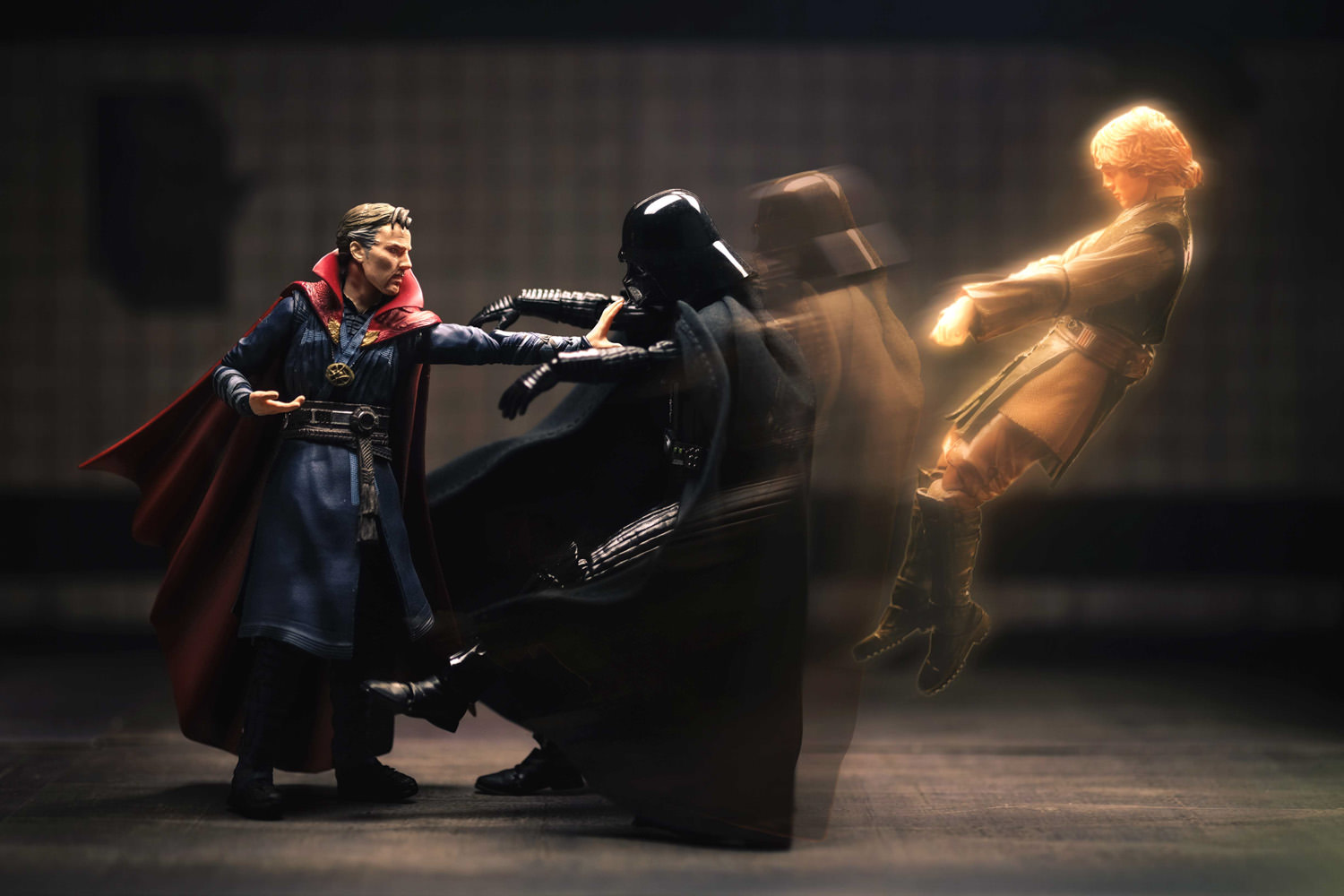
You know I don’t have to get a license to have Luke Skywalker fight Iron Man or something crazy like that, right? You wouldn’t see that in the movie, and that’s the cool thing about what I do is you can do that. There are no limitations to what you create.
There are no limitations to what you create.
Jax Navarro
What impact are you hoping to make through your images?
My focus lately is adding more of the parody aspect, the satire aspect into what I do. I’m going away from recreating scenes from movies. I think bringing comedy into it is a lot of fun. I love getting good reactions from something that I’ve created. That makes my day.


Are there any series or genres or action figures that you’re particularly focused in on right now?
Well my anchor, so to speak, has always been Star Wars because I’ve loved it since I was born, basically. When I was a kid I always wanted a bunch of Star Wars toys. Growing up, I don’t want to say we were poor, but my parents couldn’t afford a lot of toys for us, so I’m making up for it now. I don’t always shoot Star Wars, but I always try and put a Star Wars spin into it.
Stuck in the Dunes
What’s one of your favorite scenes you’ve made so far?
About a year ago, I was fortunate enough to do some work for Hasbro. Basically what they wanted me to do was recreate scenes from the very first Star Wars that came out forty years ago, and they were doing it because of the 40-year anniversary. One of the shots that I wanted to do was young Luke Skywalker in his homeland of Tatooine, which is a desert-sand-dunes-type of landscape.
First I created his home, essentially, this dome-looking diorama — I created that from scratch, which I’ve never done before so that was very interesting and very time-consuming, but nonetheless it looked pretty good. I was happy with it. When I completed that, my wife and I drove up to the Imperial Sand Dunes, about a five-hour drive from where I live. They had filmed some Star Wars scenes there, so it was a great looking landscape.
When we got there I was looking for a specific location that I read about but couldn’t find, so when I asked one of the locals, she was like, “Okay, go down this road, it’s not a street, it’s a gravel road, and it’ll be on your left about five or ten miles down.” I have a sedan, an Altima, and I go down this road, very rough gravel, I’d say about five to ten miles into it, and it started getting soft, not as rough. I tell my wife this doesn’t seem right, I’m going to turn around. The moment I turn around my car gets stuck.
I’m like, okay, I saw this in the movies that if I hit the gas I’m going to end up burying my car because it’s going to keep digging up the sand. We were about four hours away from complete darkness in the middle of nowhere, and nobody was driving by. It was really scary. Luckily, a city worker drove by with a pickup truck, and I flagged him down. He was able to help me get my car out of the sand – two hours later, so that left me about an hour and a half, or two hours to shoot and I hadn’t even arrived at the location yet.
Long story short, once I found a location, I rushed it, I got a really nice image, it’s not my best work, but it’s the process before it and what happened that made that particular photo really special. I am glad I got out of there alive.
I am glad I got out of there alive.
Jax Navarro

Learning and Watching
Has PHLEARN helped in any way in your editing or post-processing of your images?
Yeah, absolutely! I was browsing one day and ran into PHLEARN, Aaron does an amazing job with not only showing you how to use certain tools, but the way he explains it – he’s a great teacher. Specifically, the first tutorial that I saw was on how to create a cinemagraph. I’ve seen so many tutorials where these people will step you through it, and I go through it fine, but then wonder: “Okay, I know how to create a lightsaber, but what else can I do with this tool?” And Aaron just explains it.
For example, the pen tool: I’ve seen so many people use the pen tool on tutorials, and quickly go through it, and I would try and keep up; I would see what they did and how they did it, but I wouldn’t get why they were doing it. That’s why I am a big fan of PHLEARN because the way they show it and how they explain is great. I love it.
What’s one book you think any creative should read? Or what movie or show do you think any creative should watch?
To answer your first question, I’m a little embarrassed by it because I don’t read much. It’s funny as I’ve tried to read before and my mind goes somewhere else even though I’m reading the words. I’ve never been a good reader.
But as far as movies or shows go, Breaking Bad comes to mind when I think of creativity and art, because not only is the story amazing, but the cinematography is… wow. I can’t even put it into words, it’s just breathtaking. Like the pizza scene. When he throws the pizza on the roof and how they captured that, I can’t even put it into words. I know that doesn’t sound interesting, but it’s amazing. It gives you a certain feeling that you can’t explain. It’s visually amazing.
How He Made Chivalry Is Not Dead
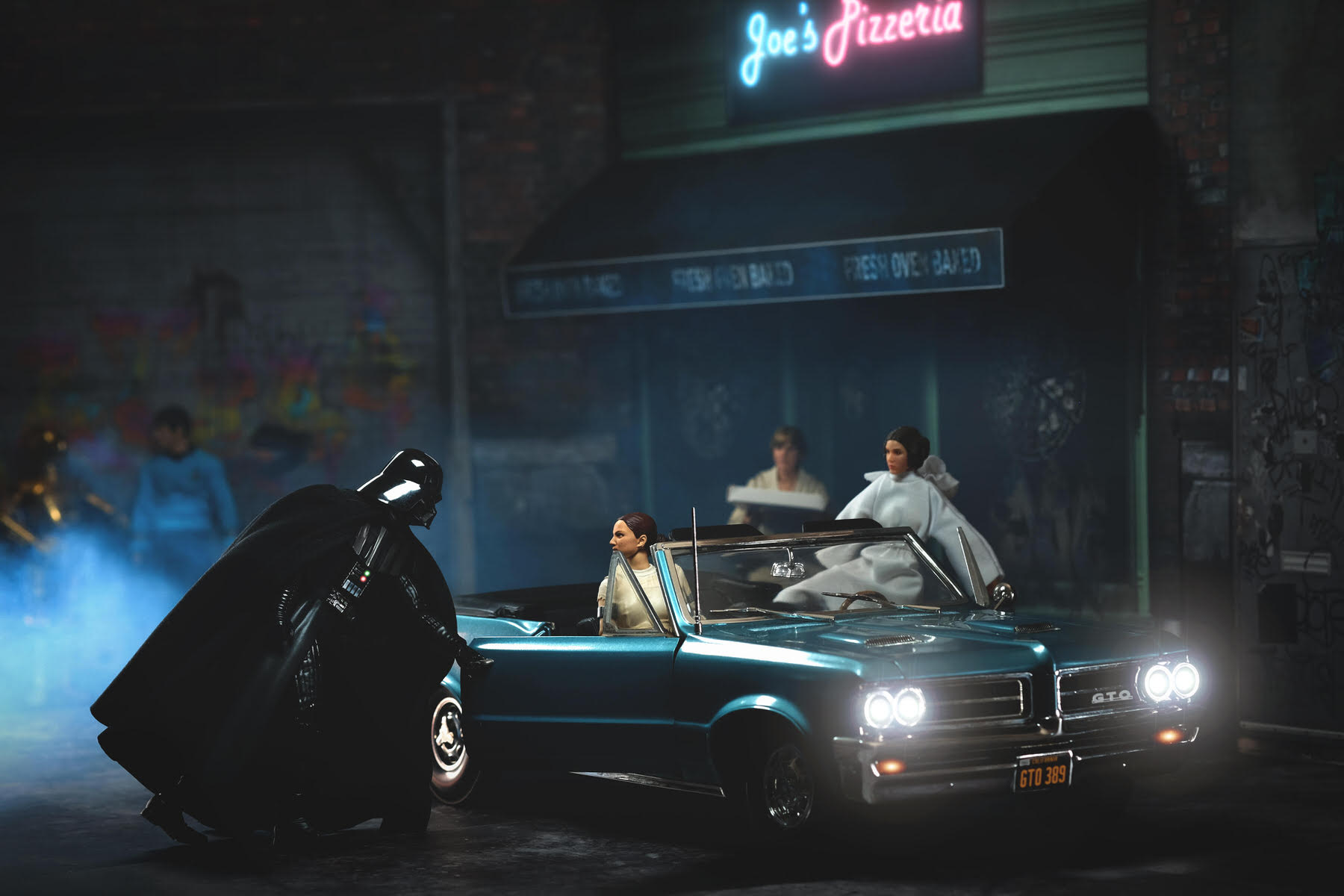
For those who don’t know my work, I incorporate a ton of Star Wars in my shots, and for this particular one, I took the franchise’s favorite family (the Skywalkers) and put them in a not-so Star Wars environment to show a softer side of the Empire’s evil villain. I think anyone who’s a fan of a celebrity, athlete or fictional character always finds intrigue in seeing what these “super humans” do as normal people. And that was the thought process behind this shot. The Skywalkers going out for a couple of slices, just like any pizza-loving family would.
The subjects I used (Luke Skywalker and Padme Amidala by SH Figuarts, Darth Vader by Mafex, Princess Leia by Hasbro) are all 1/12th or 6 inch in scale, including the model car (1964 Pontiac GTO by Ertl) and cardboard diorama by Extreme Sets.
It probably took about an hour to set up and position all of the subjects, lighting, and camera; then another hour or two to take photos, where I tweak with the subject positioning, lighting, angles, and environmental elements (in this case fog, simulating exhaust smoke from the car). This was all set up on my dining room table.


Post-processing was all done in Photoshop CC 2017. Nothing too fancy, just a few adjustment layers (levels, curves, saturation, exposure, and brightness) and I added a neon effect to the Pizzeria sign, headlights to the Pontiac GTO, and lights to Vader’s chest.
You can keep up with Jax’s work over on his Instagram.
Common Questions About Jax Navarro’s Toy Photography
Who is Jax Navarro? Jax Navarro, also known as Plasticaction, is a toy photographer based in Los Angeles. He recreates high-action, cinematic moments with toys, and Star Wars has always been his anchor. He started by posting photos of a BB-8 toy on Instagram, about two years before this 2018 interview, and later did work for Hasbro.
Where do Jax Navarro’s toy photography ideas come from? Mostly from driving. He spends about three hours a day behind the wheel, and that is where his ideas are born; he writes them down before he forgets. The question he asks himself is how to make a shot funny and original, and by 2018 he was moving away from movie recreations toward parody and satire.
How do you make toy photos look real? In Jax’s “Chivalry Is Not Dead” shot, the Skywalker figures and the model car are all 1/12 scale (6 inch), set in a cardboard diorama on his dining room table. Two LED desk lamp panels shine straight down like streetlights, and two portable LED lights backlight fog from a fog machine; he notes the fog only shows with a good backlight. Setup took about an hour, then another hour or two of shooting and adjusting. Some figures can’t be made to work: a Hulk with limited joints would not pose for a dunk.
What camera does Jax Navarro use? For “Chivalry Is Not Dead” (2018), a Fujifilm X-T1 with a 60mm f/2.4 macro lens on a Joby Gorillapod, with a wired remote release, at f/5.6, ISO 250 and 1/60 second. He finished it in Photoshop CC 2017 with a few adjustment layers, plus a neon glow on the pizzeria sign, the car’s headlights and lights on Vader’s chest.
In this article
Free with PHLEARN