
description
Learn how to master motion blur in Photoshop when the motion curves instead of running straight across the frame. It comes down to three steps: cut the subject out with a pen path, clone stamp them out of the background entirely so nothing is left to smear into a halo, and then build the blur itself. Two Radial Blur smart objects, each masked to its own half and weaker in the distance, are blended along the seam with the Smudge tool.
Enjoying This Free Tutorial?
We publish a new free tutorial every week, each one with sample images and PSDs you can download and follow along with. Sign up and they land straight in your inbox, along with early word on sales, events and subscriber-only offers.
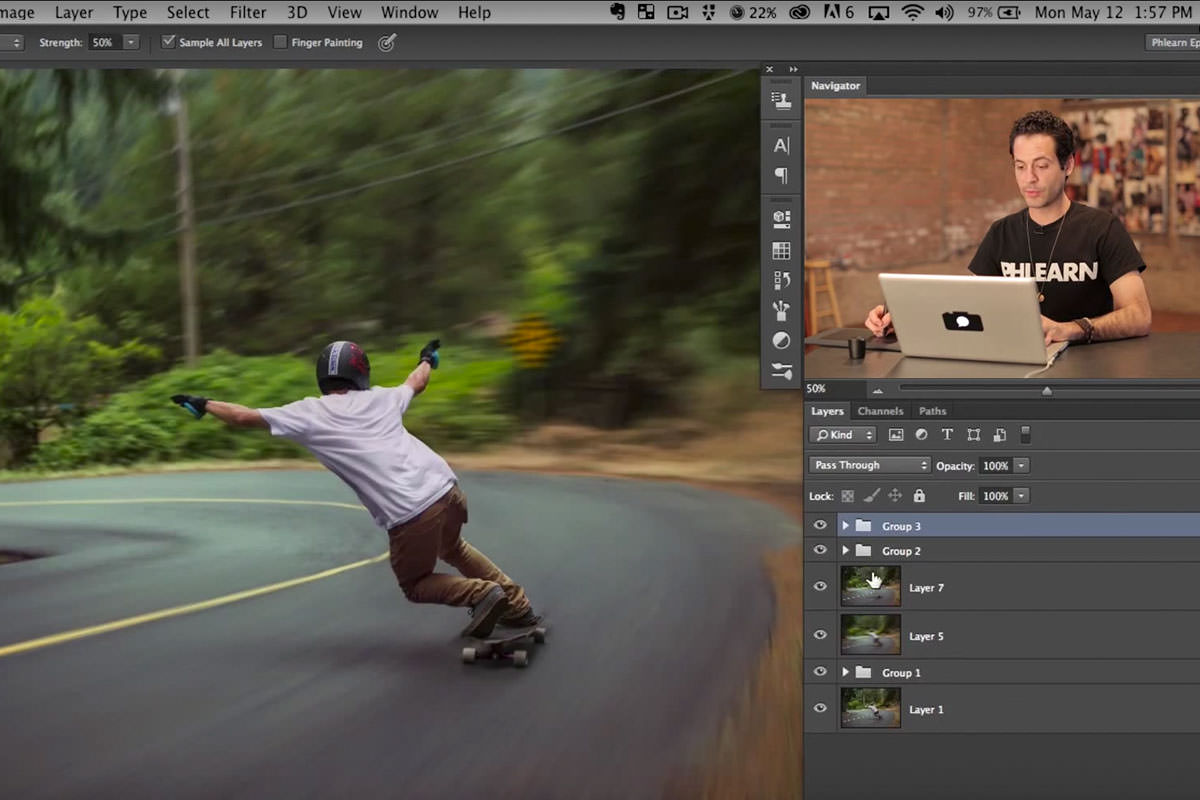
How to Master the Motion Blur in Photoshop
Adding motion blur to a photo after the fact takes more than just running a filter over the whole image, especially when the motion follows a curve rather than a straight line. This tutorial cuts a subject out first, removes them entirely from the background, then builds a curved motion effect out of two separate radial blurs blended together. How to Create a Blurred Background covers the more general background-blur approach.
Cutting the Subject Out From the Background
A clean pen path cutout separates the subject from the background entirely, which is the first of three requirements for a convincing motion blur.
-
Load the Pen Path as a Selection
Click on the saved pen path and Cmd/Ctrl-click it to load it as a selection.
-
Duplicate the Background Layer
Duplicate the background layer.
-
Add a Layer Mask From the Selection
Click the Add Layer Mask button to load the selection directly as a mask, isolating the subject on the duplicated layer.
Seeing Why an Unremoved Subject Causes Problems
Applying a blur to the background before removing the subject from it leaves a visible halo, since the subject’s own shape still exists underneath the cutout.
-
Apply a Simple Motion Blur to Test
Go to Filter > Blur > Motion Blur on the background layer and apply a basic side-to-side blur with the angle set to zero.
-
Notice the Halo Around the Subject
Notice that the subject’s shape still shows up blurred in the background, creating a visible outline or halo around the cutout subject placed on top.
Removing the Subject From the Background With Clone Stamp
Clone stamping the subject out of the background entirely, even roughly, is what prevents that halo from showing up once the blur is applied.
-
Create a New Layer
Create a new layer to clone stamp onto.
-
Sample From Varied Areas
Press S for the Clone Stamp tool, hold Option/Alt, and sample from several different surrounding areas rather than just one spot.
-
Paint Over the Subject
Paint directly over the subject to remove them from the background, without worrying about being perfectly precise since the area will be blurred anyway.
Why Removing the Subject First Prevents the Halo
A motion blur filter simply smears whatever pixel data already exists in that spot, so if the subject’s shape is still there, that shape gets smeared into the background along with everything else. Clone stamping the subject completely out beforehand means there’s nothing left of their shape to smear, which is what eliminates the telltale halo once the blur is applied.
Designing a Curved Blur With Radial Blur and Smart Objects
Converting the background to a smart object before applying Radial Blur keeps the blur’s center point and amount fully adjustable, which matters when a scene’s motion follows a curve rather than one straight line.
-
Stamp a Visible Layer
Press Shift+Option/Alt+Cmd/Ctrl+E to stamp a new layer combining the cleaned-up background.
-
Convert It to a Smart Object
Right-click the layer and choose Convert to Smart Object.
-
Apply a Zoom-Style Radial Blur
Go to Filter > Blur > Radial Blur, choose the Zoom blur method, and position the center to match the direction of motion for one part of the curve.
Why a Smart Object Makes Refining the Blur Easier
Applying Radial Blur directly to a regular layer locks in that exact center point and amount with no way to adjust it without starting over. Converting to a smart object first keeps the filter’s settings editable, so the center position and blur amount can be double-clicked and refined as many times as needed to get the curve looking right.
Masking Off Half the Blur
A layer mask restricts this first radial blur to only the part of the curve it was actually designed for, reverting the rest back to the original image.
-
Add a Layer Mask
Add a layer mask to the radial blur smart object layer.
-
Paint Black Over the Unrelated Half
Paint black over the part of the image this particular blur doesn’t apply to, reverting that area back to how it looked before the blur.
Duplicating and Reversing the Radial Blur for the Other Direction
A duplicated copy of the radial blur layer, with its center moved and its amount reduced, handles the opposite direction the curve bends toward.
-
Duplicate the Blur Layer
Press Cmd/Ctrl+J to duplicate the radial blur layer.
-
Fill the Mask With White
Fill the duplicated layer’s mask with white to make the whole layer visible again.
-
Move the Blur’s Center and Reduce Its Amount
Double-click the Radial Blur filter, move the center point to match the other direction of motion, and reduce the blur amount, since objects farther from the camera should show less motion blur.
-
Mask Off the Opposite Half
Paint black on this layer’s mask over the area that belongs to the first blur, leaving each radial blur visible only on its own side.
Why Blur Amount Should Decrease With Distance
An object moving at a given speed appears to move a shorter distance across the frame the farther it is from the camera. Reducing the radial blur’s amount for the more distant part of the scene keeps that relationship believable, rather than applying the same intensity of blur regardless of how close or far something is.
Blending the Two Blurs Together With the Smudge Tool
The Smudge tool smooths over the seam where the two differently angled radial blurs meet, since Photoshop has no single blur filter that can curve on its own.
-
Create a New Layer for Blending
Create a new layer above both radial blur layers.
-
Enable Sample All Layers
Select the Smudge tool and make sure Sample All Layers is checked.
-
Smudge Along the Seam
Smudge along the curve where the two blurs meet, blending the transition between them so it doesn’t read as two distinct, separate effects.
Placing the Subject Back and Adding Subtle Motion
With the background finished, bringing the cutout subject back on top and adding a touch of the same smudging keeps the whole image feeling consistent.
-
Place the Subject Back on Top
Bring the cutout subject layer back to the top of the layer stack, over the finished blurred background.
-
Mask Any Overlapping Details
Mask out any small details, such as wheels, where the subject should overlap naturally with elements in the background.
-
Smudge Small Areas of the Subject
Use the Smudge tool lightly on small areas of the subject, such as a foot or hand, to add a subtle hint of motion consistent with the background blur.
Why This Approach Works
Cutting the subject out and then completely removing them from the background, rather than just masking them on top, is what prevents the telltale halo that gives away a fake motion blur. Using smart objects for the radial blur is what makes it practical to refine a complex, curved effect built from two separate blurs rather than committing to settings that can’t be adjusted afterward. Reducing blur amount for more distant parts of the scene, then smudging the seam between the two blurs, is what sells the illusion of one continuous, curving motion.
Final Thoughts
A straight, simple motion blur works fine for something moving directly sideways, but a curving path takes this extra layering and blending work to look convincing. The same three-step framework, cut the subject out, remove them from the background, then design a blur that matches the actual motion, applies to any image that needs motion added after the shot was already taken.
Quick Reference: Keys, Menus and Settings
- Load the cutoutPaths panel, Cmd/Ctrl-click the pen path; duplicate the background, then the layer mask button
- Test a simple blurFilter > Blur > Motion Blur, Angle 0
- Remove the subjectNew layer, S for Clone Stamp, Alt/Option-click to sample from many spots
- Stamp visibleShift + Alt/Option + Cmd/Ctrl + E
- Curved blurRight-click > Convert to Smart Object; Filter > Blur > Radial Blur, Blur Method: Zoom; mask off the half it doesn’t fit
- Other directionCmd/Ctrl + J, fill the mask with white, double-click Radial Blur to move the center and lower the Amount
- Blend the seamNew layer, Smudge tool with Sample All Layers checked
No AI, no generative credits.
Motion Blur in Photoshop: Common Questions
What does it take to fake motion blur convincingly?
Three things: cut your subject out from the background, remove the subject from the background with the Clone Stamp tool, then design a blur that matches how the motion in the image actually moves.
Why is there a halo around my subject after I blur the background?
The subject is still in the background layer, so the blur smears their shape into it. Clone stamp the subject out of the background before you blur, and the outline disappears.
How carefully do I need to clone the subject out?
Not very. The background is about to be blurred, so a rough job that gets rid of the subject’s colors is enough. Hold Alt/Option to sample from lots of different places so nothing repeats.
How is the subject cut out?
With a pen path made before the episode. Cmd/Ctrl-click the path in the Paths panel to load it as a selection, duplicate the background layer, then click the layer mask button.
When is a plain Motion Blur enough?
When the subject moves straight sideways, like a pan. Filter > Blur > Motion Blur with an Angle of 0 works fine for that. A path that curves needs the radial blur approach.
How do you make a blur that follows a curve?
Photoshop has no blur that bends, so the video fakes it with two Radial Blurs set to Zoom, each with its center placed for one direction of the curve, and a mask on each so it only shows on its own side.
Why convert the layer to a smart object first?
Radial Blur then becomes a smart filter. Double-click it in the Layers panel to move the center or change the amount as often as you like, instead of undoing and starting over.
Why does the second blur use a lower amount?
The farther something is from the camera, the less motion blur it shows. The part of the scene farther away gets the weaker blur.
How do I hide the line where the two blurs meet?
Make a new layer, pick the Smudge tool with Sample All Layers checked, and smudge along the curve where the blurs join. The same tool adds a hint of motion to a foot or hand on the subject.
Master Photoshop, Lightroom and Photography
Join PHLEARN PRO for $12.99 a month or $99.99 a year. Cancel anytime, with a 100% money-back guarantee.