

Download Sample Images
description
Whether you’re creating hundreds of retouched photos for your client, or want to see all your vacation photos in the same style, batch editing is the one workflow that makes it all possible.
Learn how to apply an edited look to as many photos as you want with just a few clicks. Then, follow along as Aaron teaches how to use virtual copies to quickly create different looks for your client, such as black and white. This will allow you to edit your images in no time at all and create multiple versions with minimal effort, even if you have hundreds of photos.
If you’re ready to take a deep-dive into everything Lightroom Classic has to offer, try our PRO tutorial The Beginner’s Guide to Lightroom Classic!
Enjoying This Free Tutorial?
We publish a new free tutorial every week, each one with sample images and PSDs you can download and follow along with. Sign up and they land straight in your inbox, along with early word on sales, events and subscriber-only offers.
Free Lightroom Preset Sample 10 Pack
Lightroom Presets are a great way to quickly add style and charm to your photos. Try our custom-made PHLEARN Lightroom Presets with our free sample 10 pack of some our favorite bright and beautiful looks!
Watch Next
This episode is part of our FREE Intro to Lightroom Classic series.

QUICKLY EDIT HUNDREDS OF PHOTOS
Edit One Photo, Apply It to the Whole Shoot
It happens on every job. You get a card full of images onto your computer and the whole run is a third of a stop under, or the white balance drifted warm for the entire indoor set. Correcting that one frame at a time is not work — it’s typing.
Lightroom Classic’s answer is Sync Settings: edit one photo properly, then push those exact changes across every other image in a click. Add virtual copies on top and you can deliver the same shoot in colour and black and white without duplicating a single file on disk.
This is part five of our free Intro to Lightroom Classic series, picking up from the third episode where we covered the Develop module sliders.
Start from a Culled, Filtered Selection
Batch editing works best on a set you’ve already narrowed down. Using the three-round culling process from earlier in the series, filter to your red and yellow labels — the frames that are actually going to a client — so you’re syncing across the images that matter rather than the whole card.
Edit Your Reference Image First
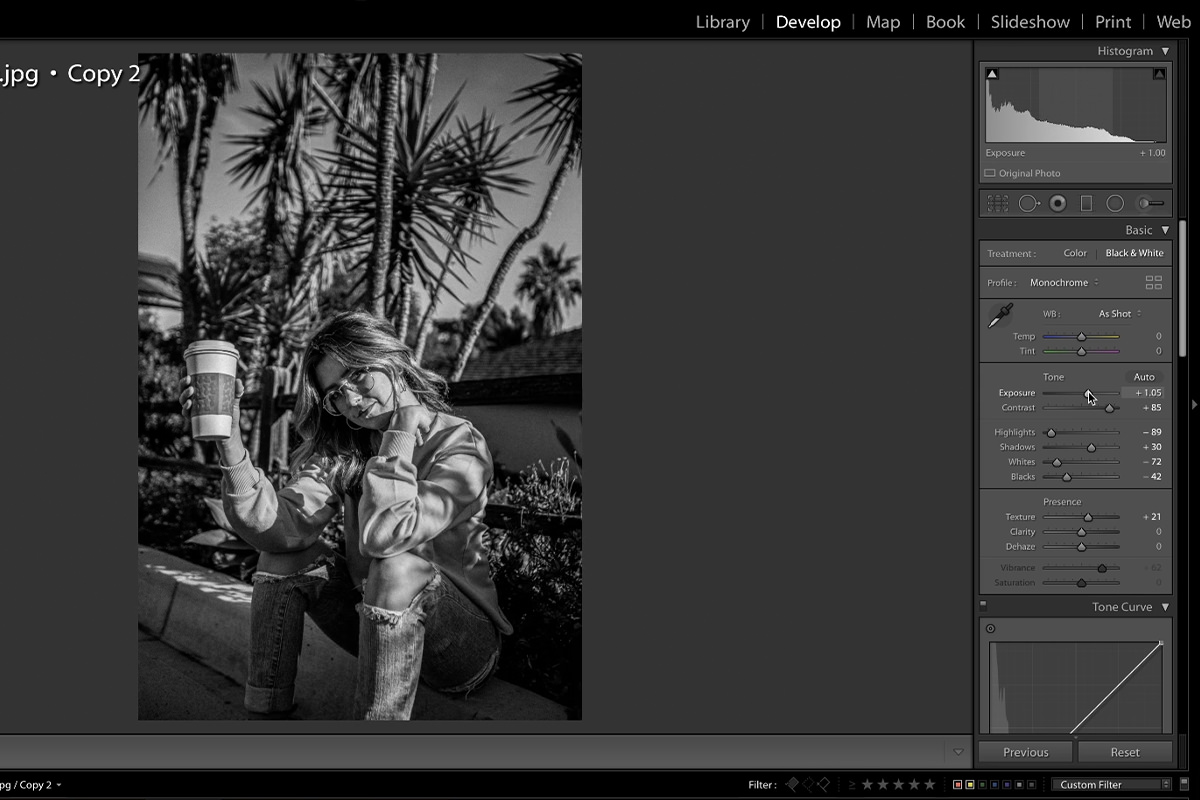
Everything downstream copies from one photo, so get that photo right before you sync anything.
-
Open your best frame in the Develop module
Double-click it in the grid, then press D or click Develop.
-
Build the look
In the example that’s a black and white conversion, raised Contrast, Highlights and Whites pulled down, Shadows and Blacks lowered, and a touch of Texture.
-
Add finishing effects
Down in the Effects panel, a little Grain gives a convincing film feel on a monochrome conversion. Toggle the before and after to check you haven’t overdone it.
Take the time here. Every image in the batch is about to inherit these decisions.
Syncing Settings Across the Batch
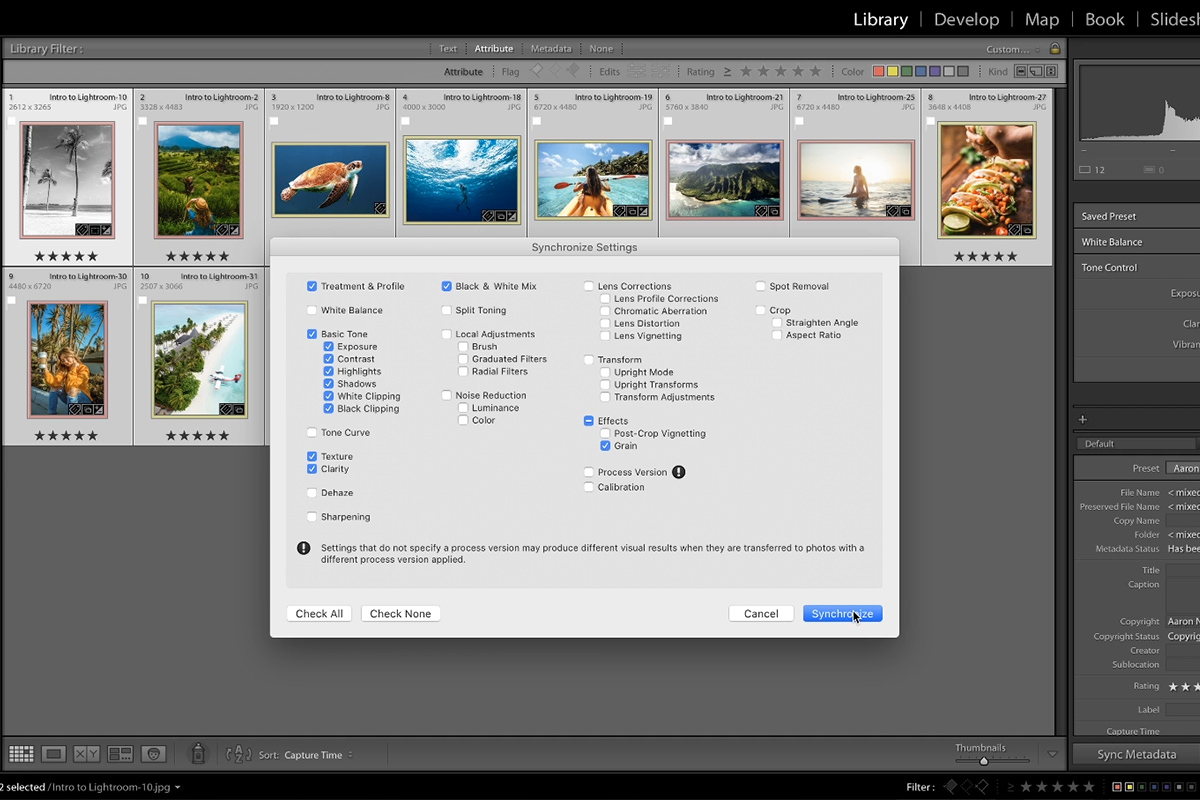
Back in the Library module, the selection order is what decides which photo is the source — and it’s easy to get wrong.
-
Click your edited photo first
This becomes the active image. It gets a lighter border than the rest of the selection, and that lighter border is the tell — it marks the photo whose settings will be copied.
-
Shift-click the last photo in the run
Everything between is selected, with your edited frame still active.
-
Click Sync Settings
Bottom right of the Library module.
-
Hit Check None first
This is the important step. The dialog arrives with almost everything ticked, and syncing settings you never touched is how a batch goes wrong.
-
Tick only what you actually changed
Treatment & Profile, Basic Tone, Texture & Clarity, Black & White Mix, Grain. Leave Sharpening, Noise Reduction, Lens Corrections, Transform and anything else you didn’t touch unticked.
-
Click Synchronize
The edit ripples across the entire selection instantly.
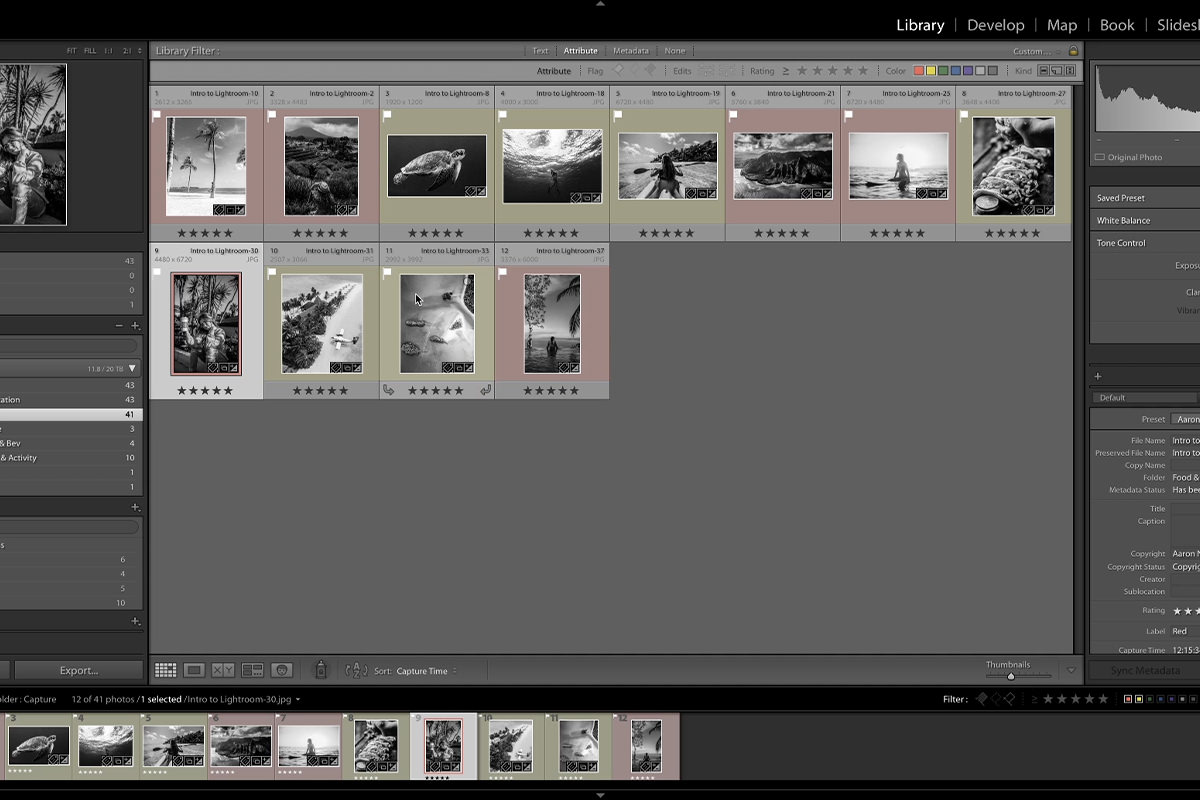
Spot Removal is the one to be most careful with. Sync it and Lightroom applies your repairs at those exact coordinates on every photo — which is only correct if the same dust spot sits in the same place across the set. From a dirty sensor, that’s genuinely useful. From retouching a blemish, it’s a mess.
Synced images stay fully editable. If one frame lands darker than the rest, adjust its Exposure individually afterwards; nothing is locked.
Virtual Copies: Two Versions, No Extra Files
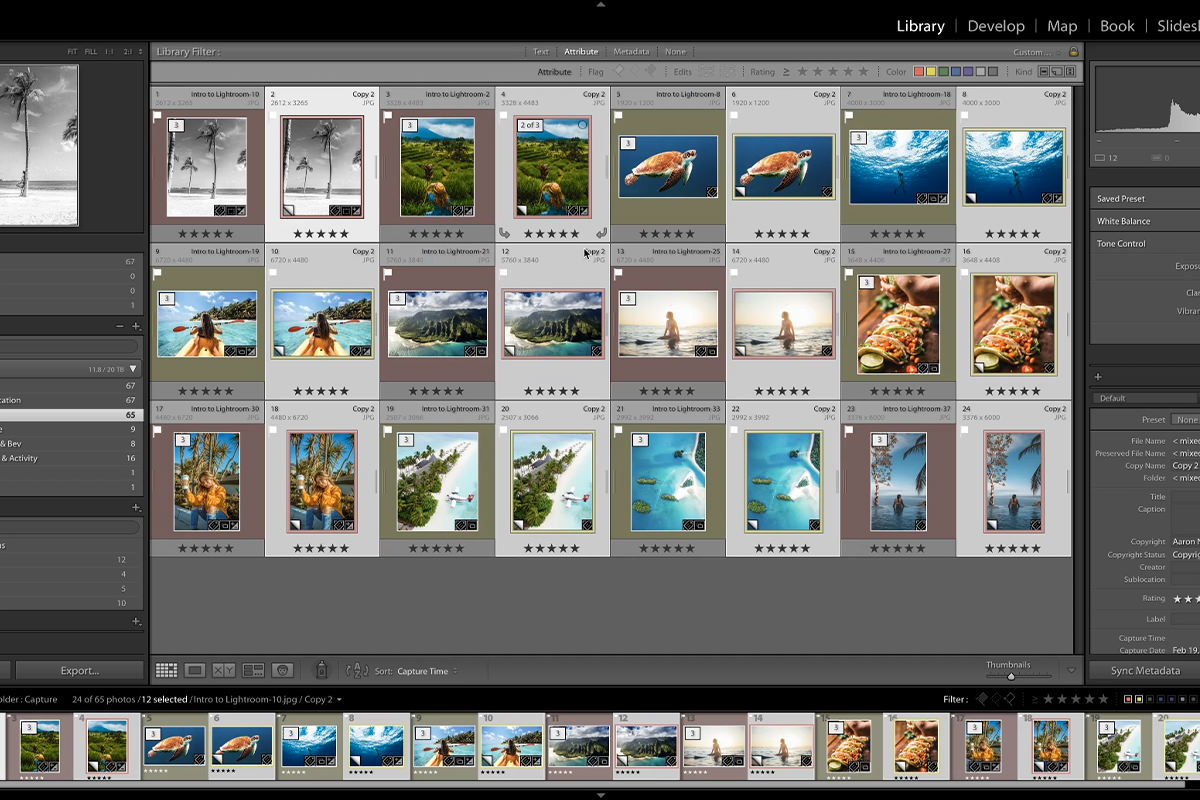
Syncing a black and white look across the set solves one problem and creates another: the colour versions are gone. Virtual copies solve it.
A virtual copy is a second set of edit instructions pointing at the same original file. It takes up essentially no additional hard drive space — nothing is duplicated on disk — but Lightroom treats it as a separate photo you can edit and export independently.
-
Undo the batch sync if you already applied it
Cmd/Ctrl + Z steps back through everything, including a whole synchronize. Lightroom’s undo is unusually deep — it will even walk back your selection.
-
Select everything and create the copies
Cmd/Ctrl + A, right-click, Create Virtual Copies. Every photo now has a twin.
-
Sync the black and white look onto the copies only
Select the first copy, Shift-click the last, Sync Settings, Synchronize. Your originals keep their colour edit and the copies carry the monochrome one.
Filtering originals from copies
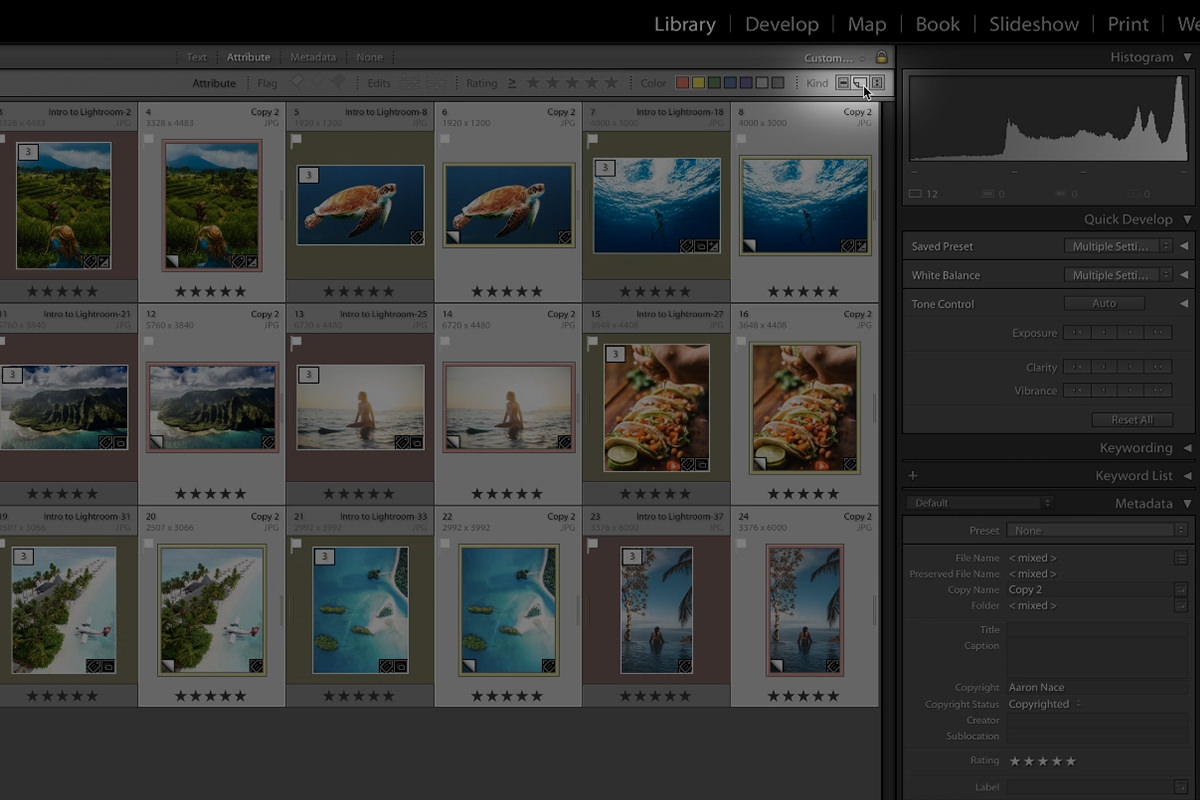
A grid alternating between originals and copies gets confusing fast. In the Library Filter bar (press \ if it’s hidden), the Metadata section can filter on copy status — switch to Virtual Copies to isolate them, Master Photos for the originals, or clear it to see everything.
Exporting Both Versions
With the two sets separated, exporting is straightforward — and this is where the folder structure from part one earns its keep.
-
Filter to Master Photos and select all
These are your colour versions.
-
File › Export
JPEG, sRGB is right for anything heading to the web. Tick Add to This Catalog so the exports appear in Lightroom automatically.
-
Export into a named subfolder
Inside the shoot’s Output folder, create one called Color.
-
Repeat for the virtual copies
Switch the filter to Virtual Copies, select all, export into a Black and White folder alongside it.
The result on disk is a single shoot folder with clearly separated colour and monochrome deliverables. For a client, that’s the same set of images delivered two ways — considerably more value for the same shoot, and no extra storage.
Stacking to Tidy the Grid
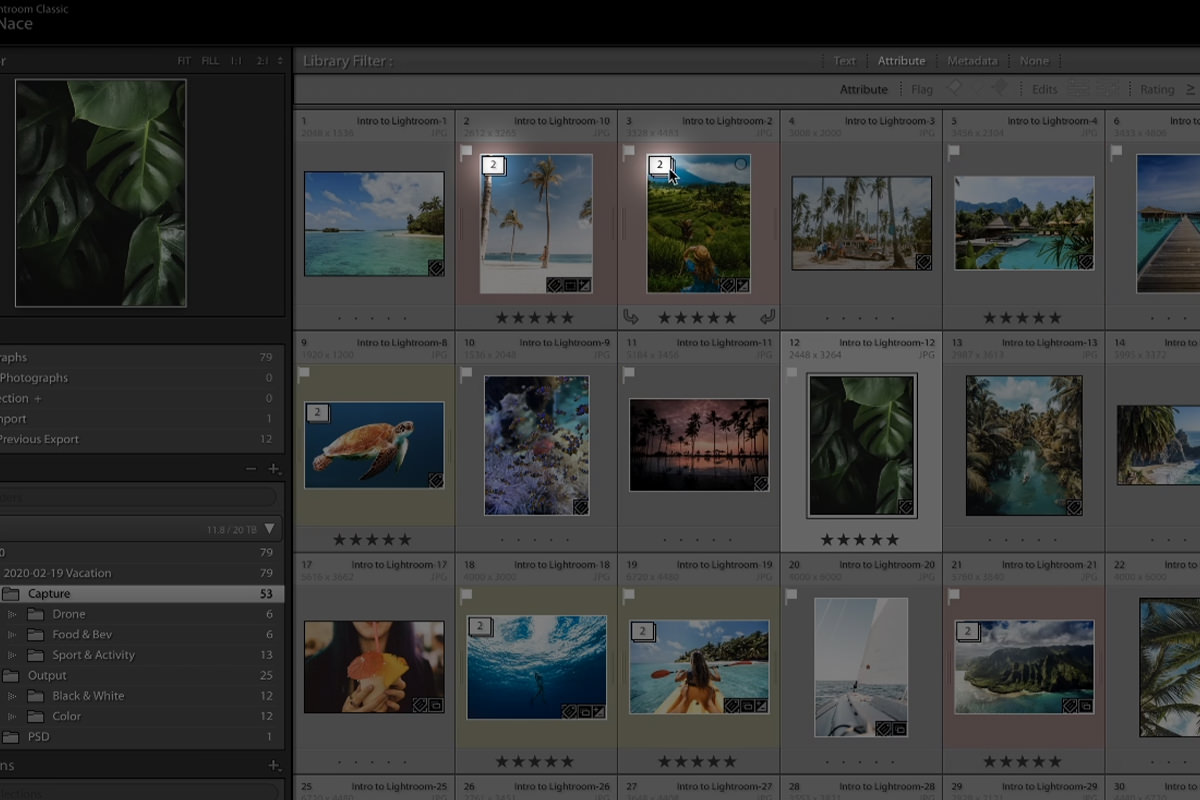
Once every photo has a twin, the grid is twice as long. Stacking collapses each original and its copies into one thumbnail with a count badge.
Go to Photo › Stacking › Collapse All Stacks. Click the number badge on any thumbnail to expand that one stack; Expand All Stacks reverses it. Virtual copies stack with their master automatically, and you can stack any images together manually as well.
It’s purely cosmetic, but on a shoot with three or four versions of every frame it’s the difference between a grid you can read and one you can’t.
Be Your Client’s Hero
The practical value here isn’t really the time saved on corrections, useful as that is. It’s that delivering variations costs almost nothing once the workflow exists.
Colour, black and white, a sepia tone, a muted film look — each is one virtual copy set, one sync, one export. The client receives three or four complete versions of their shoot instead of one, from the same afternoon’s work and the same disk space. That’s a straightforwardly better deliverable, and it takes minutes.
Where Batch Edits Go Wrong
Not clicking Check None first
The single most common mistake. The Sync dialog opens with nearly everything ticked, so unless you clear it you’ll push settings you never touched across the whole set. Check None, then tick back only what you changed.
Syncing Spot Removal by accident
Repairs are applied at fixed coordinates. Correct for sensor dust, destructive for anything else. Leave it unticked unless you specifically mean it.
Selecting in the wrong order
The source photo has to be the active one — the lighter border. Click it first, then Shift-click to extend. Start from the wrong end and you’ll sync an unedited frame’s settings over your work.
Expecting one edit to fit every frame
A sync gets the whole set close, not finished. Lighting shifts across a shoot; expect to nudge exposure on a few frames afterwards. That’s normal, and it’s still a fraction of the work.
Duplicating files instead of using virtual copies
Exporting a whole set just to re-import and edit it differently wastes disk space and detaches the versions from each other. Virtual copies keep everything linked to one original.
Continue the Intro to Lightroom Classic Series
Each part builds on the last:
- How to Import & Organize Photos in Lightroom Classic — importing, copyright metadata and a folder structure that lasts.
- How to Filter & Favorite Images in Lightroom Classic — the three-round culling workflow.
- How to Edit Photos in Lightroom Classic — the Develop module sliders, in the right order.
- Advanced Photo Editing in Lightroom Classic — local adjustments and range masking.
- How to Create Presets in Lightroom Classic — the next episode, saving a look so it’s one click every time.
- How to Export Photos in Lightroom Classic — export presets, sizing for the web, and watermarked client proofs.
Want the whole thing in one place? The Beginner’s Guide to Lightroom Classic covers the program end to end, and our Lightroom Presets library is worth a look once you know what a preset is actually doing.
Make It the Default Way You Work
Batch editing is one of those techniques that quietly changes how you approach a shoot. Once you know a look can be pushed across two hundred frames in a click, you stop editing defensively — you spend the effort on getting one image genuinely right, because that’s the one that sets the tone for everything else.
Try it on your next set. Edit your single best frame properly, sync it, and see how much of the shoot is simply finished.





Enjoying This Free Tutorial? Go Further with PRO.
Unlock Full Sample Files, PSDs, and Hundreds of Masterclasses!

Download full project assets, original PSDs, and RAW images for every lesson
Unlimited access to our complete library of PRO Photoshop & Lightroom courses
Instant 4K Ultra HD streaming on all devices, anytime, anywhere
Full access to our entire library of Photoshop Actions, Presets, and LUTs
Flexible monthly and annual membership plans
Cancel anytime with zero hassle or commitments