
How Ole Henrik Skjelstad Stitched Together This Spectacular Norwegian Landscape
Patience is key for capturing the spectacular moment where the sun dips below the horizon – and Ole Henrik Skjelstad, a photographer who lives just north of Oslo, Norway, snapped a photo in July that was well worth the wait.
Originally published September 11, 2018, by Jessi Gowan. Updated October 16, 2026, by PHLEARN Staff: Ole’s behind-the-shot story, now in sections with The Shot box, kit cards, a pair of his raw frames, an About the Artist box and a few common questions answered from the article.
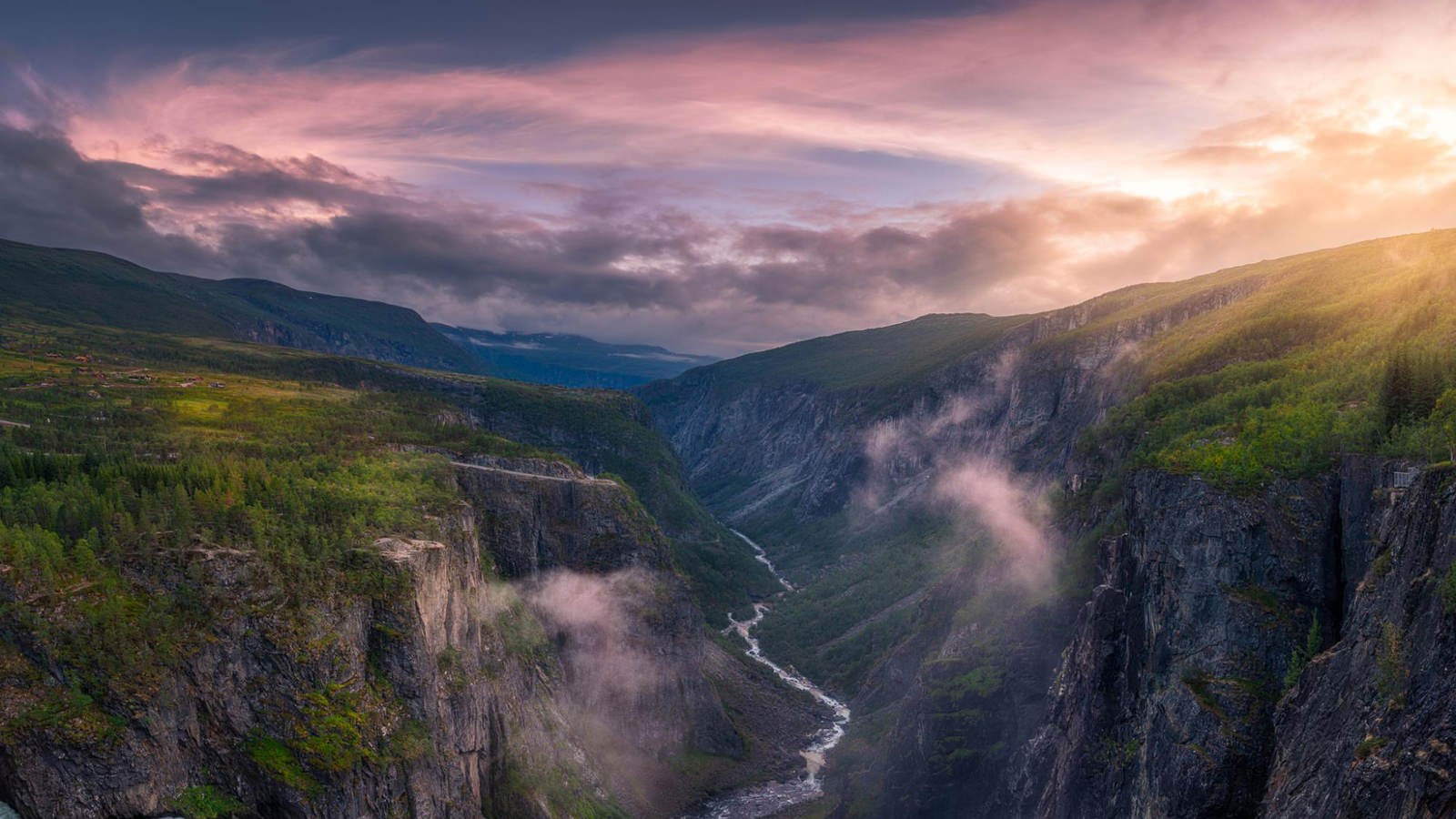
Ole Henrik Skjelstad shot this sunset over the Vøringsfossen waterfall in two frames, one for the valley and one for the sky, then stitched them in Lightroom and finished the image in Photoshop. Here are his settings and his steps.
Waiting Out the Gray at Vøringsfossen
After visiting Romsdalen with photographer Greg Benz, the pair went to Hardanger with the goal of shooting Voeringsfossen (Vøringsfossen), a waterfall located on the western slopes of Hardangervidda.
“I have been at Vøringsfossen a few times and am reasonably familiar with the location,” Ole said, but added that with recent construction work in the area to provide more safe vantage points for visitors to view the expansive valley, he wasn’t sure if the landscape would look the same.
“We headed up there a few hours before the sun would set so that we could test out various possible compositions,” he said. “It was pretty gray when we arrived, but luckily, the cloud cover opened up a few minutes during sunset and thus offered us some nice colors and light.”
It was pretty gray when we arrived, but luckily, the cloud cover opened up a few minutes during sunset and thus offered us some nice colors and light.
Ole Henrik Skjelstad
How Ole Henrik Skjelstad Shot the Two Frames
- CameraPentax K-1
- LensPentax 15-30mm f/2.8 at 15mm
- Settingsf/8, ISO 100, 0.3 s (bottom frame), NiSi 6-stop ND
As an Amazon Associate I earn from qualifying purchases.
Camera & Settings

36.4MP Full-Frame CMOS Sensor, 3.2″ Cross-Tilt LCD Monitor, Full HD 1080p30 Video Recording

Aperture Range: f/2.8 to f/22, Supersonic Direct-Drive AF Motor, Dust- and Weather-Resistant Design
Using a Pentax K-1 and the Pentax 15-30mm f2.8 lens, Ole shot at a focal length of 15mm to capture as much of the view as possible – but admitted that even that “didn’t encapsulate the whole scene.”
“After having shot the bottom half of the scene, which included just a small fraction of the sky, I tilted my camera upwards to get more of the beautiful sky,” he explained. “It would, of course, have been possible to shoot verticals, but for some reason, I decided against it.”


For the bottom half of the image, Ole said he shot at f/8 with an ISO of 100 for an exposure time of 0.3 seconds. In order to keep from blowing out the highlights in the sky, he said he shot the upper half “a couple of stops darker.” He also used a NiSi 6 Stop neutral density filter to smooth the flowing water.
Stitching in Lightroom, Finishing in Photoshop
After importing the RAW files into Lightroom, Ole combined the two images and did some stitching and boundary warp to create a seamless, true-to-life panoramic shot.

Then, he turned to Photoshop. A bit more warping was needed, he said, to bring back the proper scale of the waterfall. He also adjusted the color, did some dodging and burning, and tweaked the midtones to brighten the entire scene before applying a few dramatic filters in Color Efex Pro.
Finally, he achieved the finished product that he’d waited hours for – an image which he said reveals “the sense of awe that comes over you when you are standing close to the edge, beholding the valley and the spectacular scenery ahead of you, accompanied by the roar from the waterfall.”

The sense of awe that comes over you when you are standing close to the edge, beholding the valley and the spectacular scenery ahead of you, accompanied by the roar from the waterfall.
Ole Henrik Skjelstad
To see more of Ole Henrik Skjelstad’s work, find him on 500px or Instagram.
Common Questions About Ole Henrik Skjelstad’s Vøringsfossen Photo
Who is Ole Henrik Skjelstad? A Norwegian landscape photographer who lives just north of Oslo. He made this image one July evening on a trip with photographer Greg Benz, after the two had been to Romsdalen together.
Where is Vøringsfossen? In Hardanger, Norway, on the western slopes of Hardangervidda. Ole had been there a few times before, but construction work to give visitors safer viewpoints over the valley meant he wasn’t sure the place would look the same.
What camera settings did he use? A Pentax K-1 with the Pentax 15-30mm f/2.8 lens at 15mm. The bottom frame was f/8, ISO 100 and 0.3 seconds, with a NiSi 6-stop neutral density filter to smooth the flowing water. He shot the upper frame a couple of stops darker so the sky’s highlights wouldn’t blow out.
How did he stitch the two frames? He imported the RAW files into Lightroom, combined the two images and used stitching and boundary warp for a seamless panorama. In Photoshop he warped it a little more to bring back the true scale of the waterfall, adjusted the color, dodged and burned, brightened the midtones, and added a few filters in Color Efex Pro.






Join the conversation